



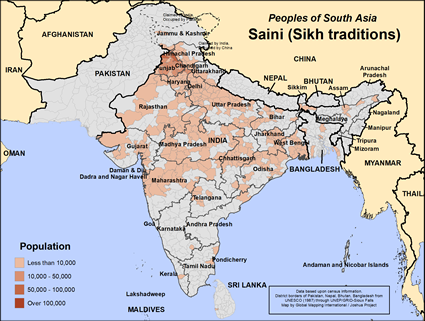
The Saini are a prominent agricultural community found primarily in the northern Indian states of Punjab, Haryana, Himachal Pradesh, Delhi, and parts of neighboring regions. While members of the broader Saini community may follow either Hinduism or Sikhism, this group identifies with Sikh traditions and has been closely associated with Punjabi Sikh culture for generations. Community traditions trace their ancestry to the ancient Surasena or Shoorsaini lineage, and some accounts connect them to warrior and agricultural populations of North India. Historically, the Saini developed a reputation as skilled farmers, landowners, and at times military recruits, particularly during the colonial period when many served in the armed forces.
The Sikh Saini are concentrated largely in Punjab, Haryana, and Delhi. Their primary language is Punjabi, and Sikh teachings, history, and community institutions have played a significant role in shaping their identity. Education has long been valued within the community, and many families have expanded beyond agriculture into business, government service, professional careers, and entrepreneurship. Despite their respected social position, there has been relatively little gospel witness among many Sikh Saini communities.
Agriculture has traditionally been the foundation of Saini life. Many families have owned or cultivated farmland and raised livestock, contributing significantly to the agricultural economy of northern India. Over time, improved access to education and urban opportunities has enabled many Sikh Saini to enter fields such as engineering, medicine, education, business, government service, and the military. Even those living in cities often maintain strong connections to their ancestral villages and agricultural heritage.
Family relationships are highly valued, and extended family networks provide social and economic support. Respect for elders, community involvement, and family honor remain important cultural values. Marriage is viewed as a significant family responsibility, and community gatherings help maintain social bonds. Daily life often revolves around work, family responsibilities, participation in gurdwara activities, and observance of Sikh festivals and commemorations.
Food habits generally reflect Punjabi culture and commonly include wheat-based breads, lentils, vegetables, dairy products, and regional specialties. Hospitality is highly regarded, and community events frequently include shared meals and acts of service. Sikh values of hard work, generosity, and community service continue to influence many aspects of daily life.
The Sikh Saini follow Sikhism and regard the teachings of the Sikh Gurus and the Guru Granth Sahib as central to their faith. Religious life often includes worship at the gurdwara, participation in kirtan (devotional singing), prayer, community service, and observance of important Sikh festivals such as Vaisakhi and Gurpurabs. The principles of devotion to God, honest labor, and service to others are widely respected within the community.
Many Sikh Saini identify strongly with Sikh history and the sacrifices made by Sikh leaders and martyrs. Their spiritual worldview is shaped by Sikh teachings concerning God, morality, service, and community life. While Sikhism rejects many aspects of traditional Hindu ritualism, it remains distinct from biblical Christianity in its understanding of salvation, sin, and the person of Jesus Christ. Most Sikh Saini have had little opportunity to hear a clear explanation of the gospel and the biblical message that salvation comes through faith in Jesus Christ and His finished work on the cross.
The Sikh Saini need greater access to the gospel through trusted relationships, Scripture in languages they readily understand, and believers who can communicate biblical truth with wisdom and respect. Because many are well educated and strongly connected to Sikh traditions, meaningful gospel engagement often requires patient relationship-building and a genuine understanding of their culture and beliefs.
Practical needs vary between rural and urban settings. Some families continue to face challenges related to agricultural sustainability, economic pressures, and employment opportunities, while others seek advancement through education and professional careers. Community development initiatives, educational opportunities, and compassionate service can help strengthen families and open doors for meaningful relationships.
Pray that the Sikh Saini would have opportunities to hear a clear presentation of the gospel and come to understand the person and work of Jesus Christ.
Pray that God would raise up faithful workers who will build genuine relationships among the Sikh Saini and share biblical truth with wisdom, humility, and love.
Pray that the Sikh Saini would be adopted through the People Group Adoption program so that churches and believers will commit to ongoing prayer, outreach, and future gospel engagement among them.
Pray that any existing Punjabi-speaking believers with connections to the Sikh Saini would be strengthened in their faith and equipped to share the gospel with their own community and neighboring peoples.
Scripture Prayers for the Saini (Sikh traditions) in India.
https://en.wikipedia.org/wiki/Saini
https://en.wikipedia.org/wiki/Saini_(surname)
https://www.sikhiwiki.org/index.php/Saini
https://www.peoplegroups.org/explore/GroupDetails.aspx?peid=12253
| Profile Source: Joshua Project |




