



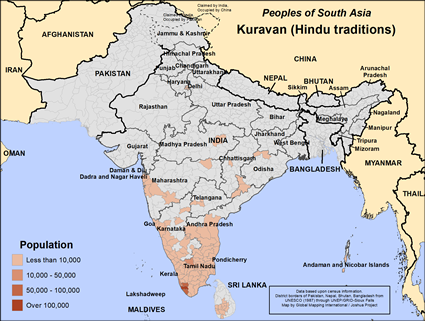
The Kuravan are an indigenous community of southern India found mainly in Tamil Nadu, Kerala, Andhra Pradesh, Karnataka, and nearby regions. They are known by several related names including Kuravar, Kuruvan, Kuruva, and Sidhanar. The name "Kuravan" has historically been connected with hill people, wandering communities, and in some areas with palm reading and fortune telling traditions. Most Kuravan today speak Tamil or Malayalam, though older dialects and tribal speech forms have declined over time. The community is recognized among India's Scheduled Castes or Scheduled Tribes depending on the region, reflecting a long history of social marginalization.
Historically, many Kuravan lived in hills and forest regions where they practiced hunting, gathering, bamboo work, herbal medicine, animal keeping, and shifting agriculture. Over centuries, social pressures, land restrictions, colonial policies, and modernization forced many families into agricultural labor, basket making, fortune telling, tattooing, and other forms of manual work. During British colonial rule, some Kuravan groups were wrongly stigmatized under the Criminal Tribes Act, leaving lasting social consequences that continued long after India's independence.
The Kuravan have ancient roots in South Indian history and are mentioned in Tamil Sangam literature and regional traditions. Their culture has long been connected with mountain regions, bamboo craftsmanship, folk traditions, and strong clan identity. Even with increasing urban migration and modern employment, many Kuravan communities still preserve distinct customs, oral traditions, and social structures tied to their tribal heritage.
The daily lives of the Kuravan vary greatly between rural villages, forest settlements, and urban areas. Many families work as agricultural laborers, daily wage workers, construction laborers, basket makers, street vendors, or small traders. Some continue traditional occupations such as fortune telling, palm reading, tattooing, herbal healing, bamboo crafts, and making household items from palm leaves and reeds. Economic insecurity remains common, especially among poorer rural communities.
Family and community ties are important within Kuravan society. Marriages are often arranged within the community, and in some areas cousin marriage is culturally accepted. Extended families frequently remain closely connected, and village elders or community leaders may help resolve disputes and oversee family matters. In several regions, literacy rates remain low, particularly among women and in remote settlements, though educational access has gradually improved for younger generations.
Meals commonly include rice, millet, vegetables, fish, and locally available foods. Some Kuravan communities also raise goats, pigs, or chickens. Music, folk performance, tattoo traditions, and festival celebrations remain important parts of cultural life. In urban settings, many younger Kuravan seek work in factories, transportation, sanitation, domestic labor, or informal markets while still maintaining ties to ancestral customs and village networks.
The Kuravan generally identify as Hindu, but many communities practice a mixture of Hinduism, folk religion, animism, and ancestor reverence. Worship may include devotion to regional Hindu gods such as Murugan, Shiva, village deities, clan gods, and ancestral spirits believed to influence health, fertility, protection, and prosperity. Rituals, offerings, and ceremonies are often performed to seek favor or protection from spiritual harm.
Many Kuravan communities believe that spirits inhabit natural objects, forests, hills, animals, or sacred locations. Fear of curses, evil spirits, and supernatural powers can strongly shape daily life and religious practice. Folk healers, shamans, astrologers, and spiritual specialists may be consulted during sickness, family crisis, or important ceremonies. Ancestor worship and rituals connected to the dead remain influential in many communities.
Although Christianity is present in parts of southern India, many Kuravan still have limited understanding of the biblical gospel. In some areas there are existing believers and churches nearby, yet large numbers of Kuravan families remain unreached or only superficially exposed to biblical teaching. Oral communication, audio Scripture resources, and relationship-based discipleship are especially important because literacy levels remain uneven in many communities.
The Kuravan continue to face challenges related to poverty, social discrimination, unstable employment, limited education, and inadequate healthcare access. Rural and tribal communities may struggle with poor infrastructure, sanitation problems, inconsistent schooling, and lack of economic opportunity. Families displaced from traditional livelihoods often face additional hardship adapting to urban environments and changing labor markets.
Spiritually, the Kuravan need clear biblical teaching and faithful gospel witness in Tamil, Malayalam, and related local languages. Many have never heard a clear explanation of repentance, grace, forgiveness, and eternal life through Jesus Christ. Because many communities are strongly oral in culture, audio Scripture, oral Bible storytelling, discipleship, and long-term relational ministry are especially valuable. Existing believers and churches in southern India also need encouragement and boldness to intentionally reach Kuravan communities with the gospel.
Pray that the Kuravan people will hear and understand the gospel clearly in their own languages and place their faith in Jesus Christ.
Pray that God will strengthen existing believers among the Kuravan and raise up mature local church leaders who can disciple families and establish biblically faithful churches.
Pray that Kuravan communities facing poverty, social stigma, low literacy, and unstable livelihoods will experience practical help, opportunity, and hope.
Pray that the Kuravan people will be adopted through the People Group Adoption program so that ongoing prayer, evangelism, discipleship, and church planting efforts will continue among them.
Scripture Prayers for the Kuravan (Hindu traditions) in India.
https://peoplegroups.org/people_groups/pg041454/
https://en.wikipedia.org/wiki/Kurava
https://en.wikipedia.org/wiki/Kuravar_sidhanar
https://ijfans.org/uploads/paper/830fee36a4a4650e35e7350f9ce62acd.pdf
https://www.scribd.com/document/779493746/The-Making-of-a-Caste-Group-A-Case-Study
| Profile Source: Joshua Project |




