




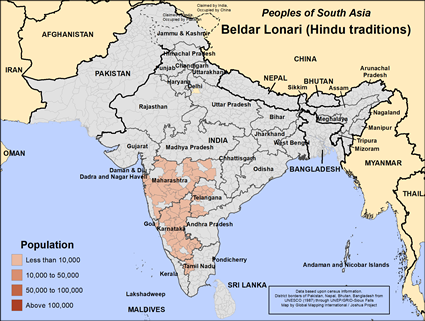
The Beldar Lonari are a community traditionally associated with stone quarrying, lime production, and construction-related work. Their name reflects their occupational heritage, with "Lonari" linked to lime-making. Historically, they were spread across Maharashtra and neighboring regions, often living near quarries and construction sites. Over time, their skills in masonry and lime preparation became integral to local economies, though modernization has reduced reliance on traditional lime-making.
The Beldar Lonari people often live in extended family households, where work and family life are closely intertwined. Men typically engage in quarrying, stone cutting, and construction, while women may assist in lime preparation or manage household responsibilities. Celebrations revolve around Hindu festivals such as Diwali, Holi, and Ganesh Chaturthi, which are marked with communal gatherings, food, and rituals. Their diet is simple, often consisting of grains, pulses, and seasonal vegetables, with meat consumed occasionally depending on region and family tradition. Social life is shaped by caste identity, kinship ties, and community solidarity, though economic pressures have led many younger members to seek alternative employment in cities.
The Beldar Lonari follow Hindu traditions, worshiping deities such as Shiva, Ganesh, and local village gods. Rituals and festivals are central to their spiritual life, with offerings made at temples and shrines. Religious identity is reinforced through community participation in festivals and rites of passage. While Hinduism provides the framework for their beliefs, many also hold to folk practices and local traditions that blend with mainstream Hindu worship.
Economic challenges remain significant, as traditional lime-making has declined with industrial alternatives. Access to stable employment, education, and healthcare is limited in rural areas, leaving families vulnerable to poverty. Social mobility is hindered by caste-based discrimination, which restricts opportunities and reinforces marginalization. Spiritually, the Beldar Lonari need exposure to the message of Christ's mercy, which offers hope beyond material struggles. Workers are needed to share the gospel and disciple those who respond, so that they may become part of the global mission force.
Pray for improved access to education and healthcare, so families can thrive physically and socially.
Ask the Lord to raise up workers who will bring the gospel to the Beldar Lonari, offering hope and transformation through Jesus Christ.
Pray that those who come to faith will grow strong in discipleship and join the mission force to bless other communities.
Lift up families facing economic hardship before God and ask him to open opportunities for sustainable livelihoods and experience God's provision.
Ask God to send intercessors possessing spiritual openness, that traditional barriers will be broken and hearts will be receptive to Christ's love.
Scripture Prayers for the Beldar Lonari (Hindu traditions) in India.
Singh, K.S. People of India: Maharashtra. Anthropological Survey of India, 1996.
Joshua Project. Beldar Lonari, Hindu traditions.
Gazetteer of Bombay Presidency, Vol. 17, 1884.
| Profile Source: Joshua Project |




