




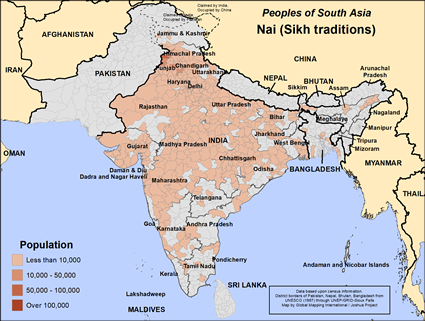
The Nai are a traditional occupational community found throughout northern India, especially in Punjab, Haryana, Rajasthan, Uttar Pradesh, and nearby regions. Among Sikh communities, the Nai have historically been associated with barbering, grooming, matchmaking, ceremonial assistance, and service roles connected to family and village life. The word "Nai" comes from a Sanskrit term related to barbering and grooming occupations. Most Sikh Nai speak Punjabi and are deeply shaped by Punjabi culture and Sikh religious traditions.
Historically, the Nai held an important social role in village society. Beyond cutting hair, they often served as messengers between families, assisted during weddings and funerals, and helped arrange marriages. Though traditionally considered a lower-status occupational caste within broader South Asian society, they remained closely integrated into daily community life because of the essential services they provided.
Over time, economic modernization and expanded educational opportunities led many Sikh Nai families into professions far beyond their traditional occupation. Today, Nai may work as farmers, teachers, engineers, government employees, drivers, business owners, healthcare workers, and professionals in urban and rural settings alike. Despite these changes, family identity, Punjabi language, Sikh tradition, and community relationships continue to play important roles in social life.
The lives of Sikh Nai vary between rural villages and urban centers across Punjab and neighboring states. Some families continue barbering or salon-related work, while many others now work in farming, transportation, government service, education, military careers, business, and skilled trades. Education is generally valued within Sikh society, and many younger Nai pursue professional careers and technical training.
Family and community relationships remain central within Sikh Nai society. Marriages are generally arranged with family involvement, though younger people increasingly participate in the decision-making process. Extended families often remain closely connected, and newly married couples may live near or with the husband's family for a period of time. Community councils and caste associations sometimes continue to help preserve traditions and settle disputes.
Meals commonly include flatbreads, lentils, vegetables, yogurt, tea, and Punjabi regional foods. Sikh festivals, weddings, gurdwara gatherings, and seasonal celebrations remain important social events. Many Sikh Nai communities are economically stable compared to some marginalized rural groups, though poorer families and laborers still face challenges related to employment, education, and urban migration.
The Sikh Nai primarily follow Sikhism and participate in gurdwara worship, Sikh festivals, prayer, community meals, and the teachings of the Sikh Gurus. Sikh belief emphasizes devotion to one God, equality before God, honest labor, service to others, and remembrance of God through prayer and worship. Sikh identity is often closely connected to Punjabi culture, family heritage, and community belonging.
Although Sikhism formally rejects caste distinctions, caste identity and community boundaries still influence marriage patterns and social relationships among many Punjabi Sikhs, including the Nai. Traditional Sikh teachings also place strong importance on maintaining uncut hair, especially among baptized Sikhs, though levels of observance vary widely in modern society.
The Nai hold a notable place in Sikh history because Bhai Sahib Singh, one of the original Panj Pyare who answered Guru Gobind Singh's call in 1699, came from the Nai community. Even with strong religious identity, many Sikh Nai have never encountered the biblical gospel clearly explained. Jesus may be respected as a teacher or prophet, but many do not understand the biblical teaching that Jesus Christ is the crucified and risen Son of God who alone provides forgiveness of sins and reconciliation with God.
The Sikh Nai need faithful gospel witness presented with humility, wisdom, and cultural understanding within Punjabi-speaking contexts. Because Sikh identity is deeply connected to family, history, and community belonging, interest in Christianity may bring strong social pressure or fear of rejection. Long-term relationships, respectful dialogue, and consistent Christian character are especially important when sharing the gospel among Sikh communities.
Spiritually, many Sikh Nai have never heard a clear biblical explanation of grace, repentance, forgiveness, and salvation through Jesus Christ alone. Punjabi-language Scripture resources, discipleship materials, mature local believers, and culturally sensitive churches are needed so Sikh Nai families can clearly hear and understand the gospel. Existing Punjabi Christians and Sikh-background believers also need encouragement and training so they can faithfully share biblical truth with compassion and courage.
Pray that the Sikh Nai people will hear and understand the gospel clearly in the Punjabi language and place their faith in Jesus Christ.
Pray that God will raise up mature Punjabi-speaking believers who can lovingly and wisely disciple Sikh Nai families and establish biblically faithful churches among them.
Pray that Sikh Nai communities facing social pressure, spiritual confusion, or resistance to the gospel will encounter the truth of Scripture and the transforming grace of Christ.
Pray that the Sikh Nai people will be adopted through the People Group Adoption program so that ongoing prayer, evangelism, discipleship, and church planting efforts will continue among them.
Scripture Prayers for the Nai (Sikh traditions) in India.
https://en.wikipedia.org/wiki/Nai_(caste)
https://www.sikhcoalition.org/about-sikhs/faq/
https://en.wikipedia.org/wiki/Sahib_Singh_(Sikh_martyr)
https://en.wikipedia.org/wiki/Sikhism
| Profile Source: Joshua Project |




