




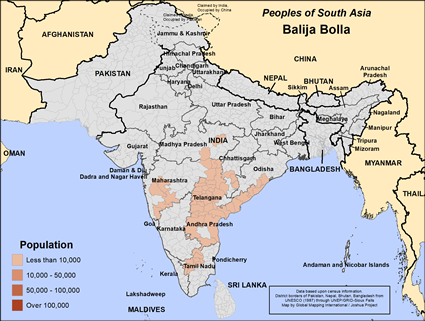
The Bolla Balija are a Telugu-speaking community found primarily in the southern Indian states of Andhra Pradesh, Karnataka, Tamil Nadu, and Telangana. They are part of the broader Balija social grouping, a large and historically influential Telugu community associated with trade, agriculture, administration, and military service throughout South India. The Bolla Balija are also known by several regional names and titles, reflecting the diversity found within the wider Balija identity.
According to traditional community legends, the Bolla Balija originated when the goddess Chamundeshwari cast rice into a sacrificial fire and warriors emerged from it. Historical accounts describe sections of the Balija community as "warrior merchants" who served as traders, tax collectors, governors, and military leaders during the Vijayanagara and Nayaka periods in South Indian history. Some Balija families rose to positions of political authority and regional administration.
Over time, many Balija subgroups, including the Bolla Balija, shifted toward agriculture, craftsmanship, trade, and village occupations. The community became widely dispersed across South India and absorbed influences from different regional cultures. Despite their long history and broad distribution, many Bolla Balija have had limited exposure to clear biblical teaching and long-term Christian discipleship.
Most Bolla Balija families today are involved in agriculture, trading, small business, manual labor, or traditional crafts. Some continue occupations connected to ornament-making, bangle work, and local commerce, while others work in transportation, government service, or urban employment. Rural families often depend heavily on farming and seasonal labor for income.
Family and kinship ties remain very important within Bolla Balija society. Marriages are commonly arranged through family networks, and respect for elders continues to shape community life. Extended families often maintain close relationships even when younger generations migrate to cities for education or employment opportunities.
Food commonly includes rice, lentils, vegetables, spicy curries, chutneys, and regional meat dishes. Festivals, weddings, and temple celebrations are major social events and often include music, dance, communal meals, and religious ceremonies. Telugu language and cultural identity remain central even among families living outside Andhra Pradesh.
Many Bolla Balija communities have faced economic hardship and social marginalization. Some groups are regarded as socially and economically disadvantaged, especially in rural regions where access to education, healthcare, and stable employment may be limited. Modernization and migration are also reshaping traditional community structures and occupations.
The Bolla Balija are primarily Hindu. Their religious life includes temple worship, devotion to Hindu gods and goddesses, festival observances, offerings, prayers, and rituals connected to family and community life. Traditional beliefs often emphasize gaining blessing, protection, prosperity, healing, or success through devotion and ritual practice.
Many families combine formal Hindu worship with folk religious customs, local deities, and traditional spiritual practices. Religion is closely tied to social identity, family loyalty, and cultural heritage. Community legends connected to divine origins and warrior ancestry also remain part of their historical identity.
Although some Christian resources exist in Telugu, very few Bolla Balija are known to follow Christ personally. Many have never heard a clear presentation of the gospel centered on repentance, grace, and salvation through Jesus Christ alone. Social pressure and fear of family rejection can also make conversion to Christianity difficult.
The Bolla Balija need greater access to the gospel through faithful local-language evangelism, discipleship, and Scripture teaching. Many have little understanding of the biblical message of salvation or personal relationship with Christ. Long-term Christian workers willing to build relationships patiently within the community are greatly needed.
Practical needs also remain significant in many areas, including educational opportunity, economic stability, healthcare access, and vocational development. Families living in poorer rural communities may especially struggle with unstable employment and limited resources.
The Bolla Balija would benefit from Telugu-language Scripture resources, oral Bible teaching, compassionate community ministry, literacy assistance, and mature discipleship efforts. There is also a need for believers from nearby Telugu-speaking churches to share the gospel faithfully and lovingly among Bolla Balija communities.
Pray that the Bolla Balija people would hear the gospel clearly and come to place their faith in Jesus Christ alone for salvation.
Pray that God would raise up faithful Christian workers who are willing to serve among the Bolla Balija with wisdom, humility, and perseverance.
Pray that the Bolla Balija would be adopted through the People Group Adoption program so they receive sustained prayer, ongoing gospel engagement, and future discipleship efforts.
Pray that Telugu-speaking believers throughout South India would grow bold in sharing the truth of Christ with the Bolla Balija and neighboring communities.
Scripture Prayers for the Balija Bolla in India.
https://en.wikipedia.org/wiki/Balija
https://alipiri.blogspot.com/2013/01/the-balijas-from-castes-and-tribes-of.html
https://balija.in/page/about-us
https://en.wikipedia.org/wiki/Linga_Balija
https://en.wikipedia.org/wiki/Settibalija
| Profile Source: Joshua Project |




