


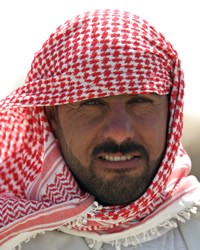

Iraq was home to some of the oldest civilizations known to man. This land was part of what was known as the Fertile Crescent where agriculture and trade flourished. It was the place where some of the early developments of Western civilization began; the invention of the wheel, the planting of the first cereal crops, the development of mathematics, astronomy, etc. Babylon was a state in Lower Mesopotamia was founded by a powerful Amorite king by the name of Sumuabum in 1894 BC. One of the Amorite dynasties was established in city state of Babylon which would eventually emerge as the first Babylonian empire. A later Babylon Empire was noted for its moral evil, but also its great flourishing in economics, agricultural production, architectural projects, the arts, and science. During the early days of the spread of Islam and Arab civilization, Iraq became Arabized and Muslim. It was at that point that one could say the people living there were "Arabs," though the Kurds remained separate. Baghdad, the capital of Iraq, was an important center for trade during the "Golden Age of Islam," the 9th and 10th centuries. It remained a world class city for hundreds of years despite being destroyed by the Mongols in 1258 and later by the Turks in 1401 when it fell under the rule of the Ottoman Empire. It remained part of the Ottoman Empire until the 20th century when it fell under the control of the British. Iraq officially gained her independence in 1932.
When we think of Iraqi Arabs, we think of all Arabs of that country. Iraqi Arabs speak different dialects of Arabic. North Iraqi Arabs are defined by their language: North Mesopotamian Arabic. Most live in Iraq, Syria, or Jordan, in that order. Iraqis began to flee to Europe in the 1990s with the first Gulf War. For the next 20 years, that number increased greatly as their country destabilized and new governments began to marginalize those from other religious communities. Others have had to flee because of persecution from rival clans. Others have settled in European countries such as Germany, Sweden, Norway, and Greece.
As would be expected, the Northern Iraqis who are allowed to stay in Europe are usually better educated and wealthy than most other Northern Iraqis. Most speak English and have marketable skills … in Iraq. In Europe, they often run into problems with not being fluent in the local language, and the training they received in Iraq is no longer accepted. Commonly, they must take low-paying jobs and hope their children will thrive.
Iraqis in Norway have a high rate of criminal offenses.
Islam has greatly influenced the lives of the Iraqi Arabs. Most are either Sunni or Shia Muslim, the latter being unusual for Arabs. There has been great strife between the Sunni and Shia Muslims for political control for many years. The Shias are allied with their religious counterparts over the border in Iran. They are in the category of the "Twelvers," meaning they follow 12 imams (teachers), the 12th being Muhammad ibn al-Hasan, whom they believe will someday return to bring peace and justice to the world. Shia Muslims also stress victimhood and martyrdom, and they commemorate events where their leaders were killed. The latter might be a possible bridge to the death of Christ on the cross. There are also some traditional Christians among the Iraqi Arabs.
Iraqi Arabs in Europe are often struggling to learn new languages. Often they are underemployed because they lack language skills. They are Muslim Arabs adjusting to a secular culture.
Many have endured the trauma of war, persecution, and displacement, so trauma-informed pastoral care and counseling are critical for healing emotional and psychological wounds.
To meet the deep spiritual needs of North Iraqi Arabs, there must be a clear and winsome presentation of the gospel—one that is thoughtfully contextualized to the Arabic linguistic and cultural environment. This ensures that individuals from both Muslim and nominally religious backgrounds can encounter the message of Christ without unnecessary cultural barriers or offense.
Spiritual ministry must be accompanied by practical expressions of Christ's love through tangible support—housing assistance, mental health care, family reconciliation services, and strong community networks that guard against isolation and despair.
Pray for a spiritual hunger that will lead Iraqi Muslims to Jesus Christ as the answer to their spiritual needs.
Pray for an unstoppable movement to Christ among Iraqi Arabs in Europe.
Pray for the Lord to give dreams and visions of the Risen Christ to Northern Iraqis, leading them to seek and find Jesus Christ.
Scripture Prayers for the Arab, North Iraqi in Norway.
https://en.wikipedia.org/wiki/Iraqis_in_Norway
https://www.ssb.no/en/befolkning/innvandrere/statistikk/innvandrere-og-norskfodte-med-innvandrerforeldre
https://www.ssb.no/en/befolkning/artikler-og-publikasjoner/immigrants-and-norwegian-born-to-i
| Profile Source: Joshua Project |



