




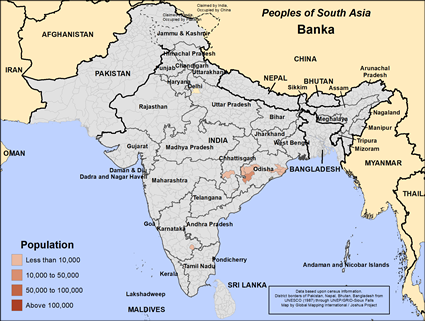
The Banka are a Hindu community found primarily in the Indian state of Odisha, with related populations in neighboring eastern Indian regions. They are part of the broader social and caste-based structure that has shaped village life in India for centuries. Historical information about the Banka is limited, and much of their background has been preserved through oral tradition, local customs, and family lineage rather than written historical records.
Traditionally, the Banka have lived in rural communities where agriculture and manual labor formed the foundation of daily life. Like many smaller caste communities in eastern India, they have experienced social and economic challenges connected to limited educational opportunity, poverty, and restricted access to resources. Village councils and elder leadership structures have historically played an important role in resolving disputes and guiding community affairs.
The Banka live within the broader cultural world of eastern India, where Hindu traditions, extended family systems, and village-centered social life remain highly influential. Despite the long presence of Christianity in parts of India, many Banka families have had little exposure to clear evangelical teaching or long-term discipleship.
Most Banka families work in agriculture or as day laborers. Farming, seasonal labor, and manual work provide income for many households, especially in rural villages where economic opportunities are limited. Financial instability can make it difficult for families to provide higher education for their children, even when education is highly valued within the community.
Family and kinship relationships are very important within Banka society. Elders and community councils often help settle disputes and approve major family decisions. Marriage customs include acceptance of cousin marriage in some areas, and remarriage is generally permitted for widowed or divorced individuals with community approval. Inheritance traditionally passes through the male line, with the oldest son often becoming head of the household after the father's death.
Food commonly includes rice, lentils, vegetables, flatbreads, and locally available foods typical of eastern India. Families may use both traditional remedies and modern medicine depending on availability and financial resources. Community festivals, weddings, and Hindu religious celebrations remain important social gatherings that strengthen family and village ties.
Many younger Banka increasingly face pressure to leave village life in search of work and education in larger towns and cities. This gradual migration has contributed to changing family structures and growing tension between traditional customs and modern economic realities.
The Banka are primarily Hindu. Their religious life includes temple worship, participation in Hindu festivals, devotion to various gods and goddesses, ritual offerings, and observance of family-centered ceremonies. Hindu beliefs concerning karma, rebirth, ritual purity, and devotion strongly influence daily life and moral expectations.
Like many rural Hindu communities, the Banka may also incorporate folk religious practices involving local deities, ancestral customs, blessings, curses, astrology, and fear of spiritual powers. Religious traditions are deeply connected to family identity and village culture.
Very few known believers exist among the Banka. Many have never heard a clear biblical explanation of sin, grace, repentance, and salvation through Jesus Christ alone. Access to Christian discipleship, biblical teaching, and local fellowship remains very limited.
The Banka need greater access to the gospel through culturally understandable evangelism, Scripture resources, and long-term discipleship. Many still have little understanding of biblical Christianity or the message of salvation through faith in Christ. Faithful Christian workers willing to build patient relationships within Banka communities are greatly needed.
Practical needs also remain significant. Many Banka families struggle with poverty, unstable employment, educational barriers, and limited healthcare access. Parents often desire education for their children but lack the financial means to support long-term schooling.
The Banka would benefit from literacy programs, educational assistance, medical outreach, vocational support, and compassionate community ministry rooted in biblical truth. Audio Scripture resources and oral Bible teaching may also help reach families with limited literacy access.
Pray that the Banka people would hear the gospel clearly and come to trust in Jesus Christ alone for salvation.
Pray that God would raise up faithful Christian workers who are willing to serve among the Banka with humility, wisdom, and perseverance.
Pray that the Banka would be adopted through the People Group Adoption program so they receive sustained prayer, ongoing gospel engagement, and future discipleship efforts.
Pray that believers in eastern India would grow bold in sharing the truth of Christ with the Banka and neighboring communities.
Scripture Prayers for the Banka in India.
https://ncbc.nic.in/Writereaddata/addodh12.pdf
https://peoplegroups.org/
https://en.wikipedia.org/wiki/Caste_system_in_India
https://newsletter.blogs.wesleyan.edu/2020/11/23/south-asias-caste-system-discussed-by-scholars-students/
| Profile Source: Joshua Project |




