


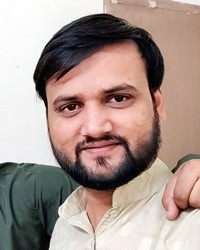

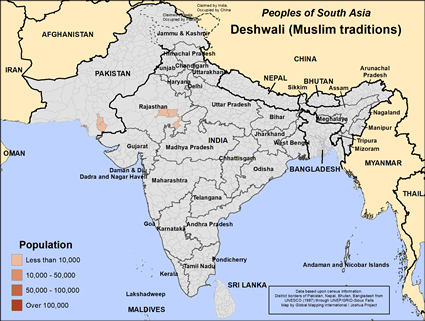
The Deshwali (Muslim traditions) are a people group primarily residing in the western and central regions of India, with significant populations in Rajasthan, Madhya Pradesh, and Maharashtra. Their communities are often found in both rural villages and urban neighborhoods. The Deshwali are a Rajput subcaste that lives in Punjab and Rajasthan. Their name is a combination of two Persian words which together mean "landlord" or "feudal lord."
Historically, the Deshwali trace their roots to local Hindu communities who embraced Islam generations ago, blending elements of local culture with Islamic traditions. Over time, they have developed a distinct identity, maintaining close-knit social networks and a strong sense of community belonging. At one time they were members of the private army of Prithvi Raj Chauhan. They were among the first peoples to adopt Islam in India which came to them from the preaching of Moinuddin Chishti, a Sufi saint.
The Deshwali primarily speak Hindu; secondary languages include Hindi, Mariwari (India), Urdu, and Dhundari, reflecting the linguistic diversity of their surroundings. The most prominent of the secondary languages are Hindi and Marwari.
Deshwali families are typically large and extended, with several generations living together or nearby. Elders are respected and play a central role in guiding family decisions and preserving cultural values. The majority of Deshwali earn their livelihoods through agriculture, animal husbandry, or small-scale trade. They are medium- to large-scale farmers, though there are a small number of sharecroppers and landless farmers among them. Some own small businesses, and more of them are acquiring advanced education. In urban areas, some work as artisans, laborers, or in service industries. Community life is vibrant, with social gatherings, weddings, and religious festivals providing opportunities for connection and celebration.
Hospitality is a cherished value, and guests are warmly welcomed into their homes. Despite economic challenges, the Deshwali display resilience and resourcefulness, supporting one another through both hardship and joy.
The Deshwali people are Sunni Muslims who believe in Allah, who revealed his will through the prophet Mohammed. They seek to live righteously by following the teachings of the Koran and the Hadith. Their religious life is centered around the mosque, which serves as a place of worship, learning, and community gathering. Core practices include reciting the Shahada (statement of faith), praying five times daily facing Mecca, fasting during Ramadan, giving alms to the poor, and making a pilgrimage to Mecca if possible. Muslims are expected to avoid alcohol, pork, gambling, theft, slander, and idolatry. The mosque is central to their religious life, especially for Friday prayers, and their main holidays are Eid al Fitr and Eid al Adha.
In daily life, many Deshwali also rely on folk practices and spiritual traditions, such as using charms or amulets, to seek protection or favor from spiritual forces. This reflects their belief that while Allah determines eternal destiny, spirits can influence everyday well-being.
The Deshwali community faces a range of physical and spiritual needs. Many live in areas where access to quality education, healthcare, and economic opportunities is limited. Children may leave school early to help support their families, and women often bear a significant share of household and agricultural labor. Improved access to clean water, sanitation, and vocational training would greatly benefit their communities and open doors to a brighter future.
The Deshwali people need to submit to Jesus Christ so they can experience the abundant life he offers them in John 10:10.
Intercede for the Deshwali people, that they would be supported by a Christian individual or church through the People Group Adoption program to improve their access to the teachings of Jesus Christ.
Pray for workers who are driven by the love and boldness of the Holy Spirit to go to the Deshwali people and share the salvation message of Jesus Christ with kindness and love.
Pray for the Deshwali people, that the Holy Spirit would open their hearts to the King of Kings, compel them to pursue salvation in Jesus no matter the obstacles.
Pray that the Deshwali people would experience increased access to schools, medical care, and sustainable livelihoods, empowering them to rise above the challenges of poverty.
Scripture Prayers for the Deshwali (Muslim traditions) in India.
https://peoplegroups.org/people_groups/PG041576/
https://en.wikipedia.org/wiki/Deshwali
https://www.britannica.com/topic/Islam
| Profile Source: Joshua Project |




