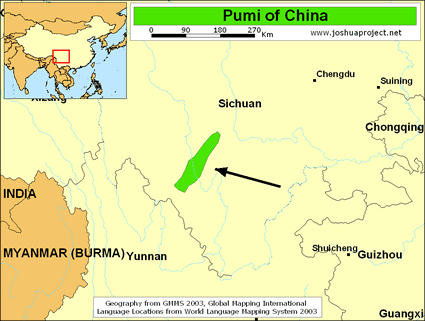

According to Pumi legends and historical records, the ancestors of the Pumi were a nomadic tribe who roamed areas hundreds of miles farther north of their present location. They were forcibly moved to Yunnan by the Mongolians in the 1300s. Others live in Sichuan Province.
The Pumi are one of China's officially recognized minority groups. In 1960 the government combined various tribes and labeled them Pumi. Prior to that, each tribe called themselves by a different name, including Boukhai. The Pumi today call themselves a name which means "white men." The Chrame people in Sichuan Province speak a language related to Pumi, but they have been counted in the Tibetan nationality. Pumi - which has five dialects - is a member of the Tibeto-Burman language family. Some scholars believe it was originally a Qiangic language. Today after centuries of interaction, 15% of Pumi vocabulary consists of Chinese loanwords.
At the age of 13, Pumi youth are considered adults. When a Pumi dies, they blow a conch three times to beckon villagers. A shaman then holds a Gei Yangzi Yishi (Sheep Guide) rite. The Pumi believe a sheep will lead the spirit of the deceased into the land of their ancestors.
On the 15th day of the first month of the Pumi calendar, all Pumi, "clad in their holiday best, go camping on mountain slopes and celebrate around bonfires. The holidays are devoted to sacrifices to the 'god of the kitchen'. They celebrate with wild feasting, horse racing, shooting contests and wrestling."
The Pumi believe that failing to honor the spirits properly can bring illness or natural disaster. According to their traditions, the gods of heaven once sent soldiers to guard the human world. Over time, these soldiers became mountain deities who continue to watch over the Pumi. Each year, on the fifteenth day of the seventh lunar month, these mountain deities are said to gather for a contest. The winner brings a good harvest, while the loser signals hardship. On that morning, community members rise early to climb the mountains and burn incense, sending the deities off and praying for a favorable outcome. This tradition gave rise to the festival known as the Mountain Pilgrimage Festival.
The Pumi live in fear of the spirit world. If offended, the deities can release a deluge of fierce, predatory beasts against their livestock. All Pumi worship Suoguonaba, the god of the mountains. They worship this powerful spirit on the 5th, 15th, and 25th day of each lunar month. They also practice ancestor worship. The Pumi do not eat until food has been placed on the guozhuang, or tripod, to signify an invitation to the ancestors to eat first. They believe that spirits dwell in the wooden center post of their homes.
Because of their linguistic variety and isolated communities, the Pumi have been largely neglected with the gospel. Prior to 1949, German missionaries reportedly witnessed to the Pumi, but little fruit remains. Although there is no organized church among the Pumi today, visitors report that they are a people "ripe unto harvest." In the early 1990s several Pumi were baptized by a Mosuo believer near Lugu Lake. There was a potential breakthrough in 1997 when 30 Pumi people prayed to receive Christ after viewing the JESUS Film in Mandarin. We have not heard of a breakthrough coming from this.
Pray for the Holy Spirit to move powerfully in Pumi communities.
Ask God to send workers to build upon the foundation of baptisms and the JESUS Film, leading them to a movement to Christ.
Ask God to remove their fears and to fill those places with faith in Jesus, the Lord of lords.
Ask God to give them a great spiritual hunger as they learn about Christ.
Scripture Prayers for the Pumi in China.
Operation China, Asia Harvest, Copyrighted © Used with permission.
Mission Pathway prayer guide, May 2026
| Profile Source: Joshua Project |