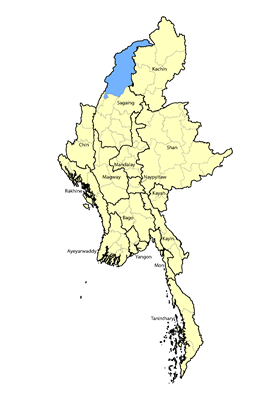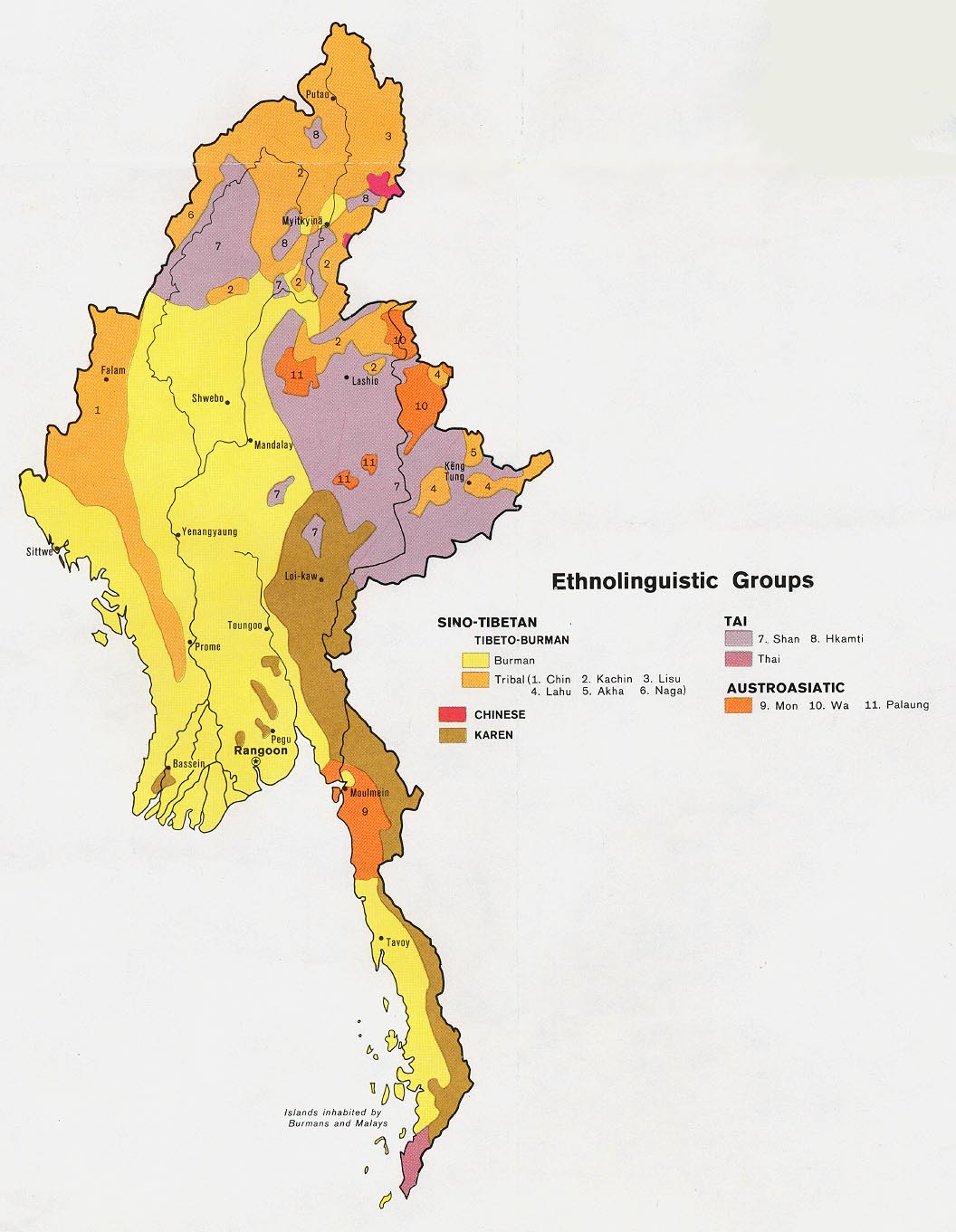

The Lao Nagas inhabit three villages along the border between Myanmar's Sagaing Region and India. Despite living immediately on the border, there is no indication of Lao Naga communities inside India, at least not called by that name. While the Lao Nagas dwelling in the mountains of Lahe Township face difficulties as they try to eke out a living from the land, their environment is much better than in neighboring Hkamti Township, where "the inhabitants of Aung Mye village do their best to resolve the issue of the polluted river. Gold mining turned the clean water that was once abundant in fish into a perilous sewer, causing a variety of cancers."
Other tribes in the area sometimes refer to the Lao Naga as the "Law" people, which is the name of their main village. Considered by some to be an offshoot of the larger Lainong or Konyak Naga groups, the Lao Naga language reveals that they are a distinct people. Of the Naga tribes in the area, "the Lao are the least known, and occupy a cluster of villages on the western flank of the Lainong and to the north of the Paungnyuan Nagas."
The Lao Naga language is used vigorously among the tribe, most of whom also understand Lainong Naga, so "when Lainong and Lao Naga people meet, the Lao immediately switch to Lainong. On the other hand, "Lainong people do not understand the Lao Naga language at all." Recent research has concluded that the Lao Naga vernacular appears to also be related to Chen-Kayu Naga and the Chuyo and Gaqkat dialects of Tangshang.
Although the history of the Lao Naga tribe is uncertain because of their lack of a written language, some have speculated that "The Lao Naga were part of migrations from Pesao in today's Indian state of Nagaland, along with the Lainong and others." Although Pesao and the current Lao Naga homeland in Lahe are only about 40 miles (65 km) apart in a straight line, travel between the two is virtually impossible due to the high mountains, thick jungle, and lack of roads. Foreign and domestic tourists are not permitted to enter the Lao Naga area at the present time due to military clashes and the presence of armed militia groups on both sides of the border.
Nagas living in the Lahe area are skilled at weaving clothes, baskets, and handicrafts on looms called jiya. In addition, "agricultural products are mostly sold locally. They raise chickens and pigs, while hunting for wild animals provides an additional source of meat. Traditionally, the successful hunter shares the meat with other villagers and keeps the animal's head for himself."
Today most Lao Naga families follow Christ, with a smattering of Buddhists and animists in their midst. A 2009 report detailed how the Burmese army severely beat six people for the whole day in Lahe for converting from Animism to Christianity, and as a result two of them died…. The cruel treatment of the military during the decades of exploitation of Naga people included forced labor for army projects. There have also been many reported cases of rape and torture."
Today, an estimated 85 percent of Lao Naga people are professing Christians belonging to the Baptist denomination. Without any Scripture or other gospel resources in their language, however, there is a risk of Lao Naga believers having a nominal faith, which is a common trait among many tribes in western Myanmar. The possible future existence of a Lainong Naga Bible appears to be the best chance the Lao Naga must be able to read the Scriptures in a language they understand.
Pray for strong, healthy Lao Naga families and for people to have their spiritual hunger satisfied in Christ alone.
Pray that Christian believers within the Lao Naga community would be encouraged and equipped to serve their neighbors with humility and compassion.
Pray for them to become Christ's ambassadors to a dying world.
Pray for Lao Naga Christians to walk in the fruit of the Holy Spirit, drawing many to the Lord of lords.
Scripture Prayers for the Naga, Lao in Myanmar (Burma).
Asia Harvest, Copyrighted 2026 © Used with permission
| Profile Source: Joshua Project |
| Other PDF Profile |