


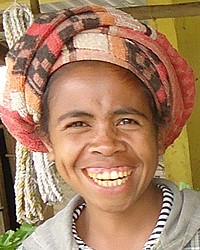

The Tetun Dili are the urban Tetun-speaking people centered in and around Dili, the capital of Timor-Leste. Their language is Tetun Dili, also called Tetun Prasa, the city-based form of Tetun that developed in the capital through long contact with Portuguese speakers and later wider national use. Unlike more rural Tetun varieties, Tetun Dili grew as an urban and interethnic speech form, and it became the best-known everyday lingua franca of the country. Public linguistic sources consistently describe Tetun Dili as the Dili-centered variety that spread well beyond the capital because it became the common language of trade, education, media, and public life.
Historically, this makes the Tetun Dili somewhat different from many small village-based peoples. They are tied not just to ancestry and locality but also to the rise of Dili as the colonial and then national center of Timor-Leste. As the capital grew in political and cultural importance, Tetun Dili expanded from a local urban speech form into a unifying national language used across many ethnic backgrounds.
Because the Tetun Dili are concentrated in and around the capital, their daily life is more urban and mixed than that of many other Timorese groups. Family life is still strongly relational, as is typical in Timor-Leste, but it is shaped by city realities: wage work, schooling, church life, markets, government offices, transport hubs, and constant interaction with people from many other language groups. In Dili and its surrounding neighborhoods, households may still be closely tied to extended family, yet city life usually means more exposure to formal education, media, migration, and economic pressure than in rural mountain villages.
Their language is used widely in ordinary life. Tetun Dili is the everyday speech of the capital and functions as the main shared language across much of the country. It is also the form of Tetun commonly used in schools, media, and public communication. Because of its urban history, it carries strong Portuguese influence, and many people also move comfortably between Tetun Dili, Portuguese, Indonesian, and sometimes English depending on setting, age, and education. Meals and recreation in Dili are shaped by a city environment: market food, rice, maize, cassava, fish, meat when affordable, church gatherings, family celebrations, music, and neighborhood social life rather than strictly village-based routines.
The Tetun Dili are mostly Christian, and the dominant form of Christianity among them is Roman Catholicism. They should not be treated as a people with little or no gospel witness. There is already a substantial Christian presence among them, and that changes how they should be understood spiritually.
At the same time, outward Christian identity does not automatically mean deep biblical faith. In Timor-Leste, inherited custom, ritual habit, and older spiritual assumptions can remain influential beneath formal Christian affiliation. Where that is true, the issue is not first exposure to Christianity but deeper repentance, biblical clarity, and wholehearted trust in Jesus Christ rather than nominal or inherited religion. Scripture resources are reported as available in their language.
The Tetun Dili need spiritually mature churches, biblically faithful leaders, and believers who know the gospel clearly rather than merely identifying with inherited Christianity. Because they already have a broad Christian base, the deepest need is not simple exposure, but stronger discipleship, sound teaching, and households shaped by repentance, holiness, and confidence in Christ rather than ritual or cultural religion.
They also face practical needs that come with urban life in and around Dili. City populations often carry pressures related to housing, employment, youth opportunity, education, and access to stable health care. Urban growth can bring mobility and access, but it can also produce instability, shallow religion, and social fragmentation. Practical help matters, but in a people with a strong Christian presence, it should strengthen—not replace—the need for mature churches and durable biblical witness.
Pray that Tetun Dili believers would move beyond nominal religion into deep, biblical faith in Jesus Christ.
Pray that the Lord would raise up faithful pastors, teachers, and spiritually mature families among them.
Pray for stronger access to stable work, education, health care, and family stability in the urban communities around Dili.
Pray that Tetun Dili Christians would become a gospel force to peoples in Asia who still lack a clear witness to Christ.
Scripture Prayers for the Tetun Dili in Timor-Leste.
https://en.wikipedia.org/wiki/Tetun_language
https://en.wikipedia.org/wiki/Languages_of_Timor-Leste
https://timor-leste.gov.tl/?lang=en&p=547&print=1
https://chl.anu.edu.au/language-tetum
https://ulpa.edu.au/languages/individual/tetum
| Profile Source: Joshua Project |



