




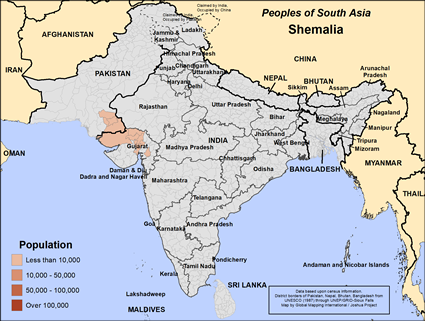
The Shemalia are a small people group in India associated with the Gujarati-speaking regions of western India. Historical information about the Shemalia is limited, but their identity has been preserved through family lineage, community customs, and long-established social relationships within regional Hindu society. Like many smaller caste and occupational communities in India, they developed within a framework where social identity, marriage patterns, and livelihood were closely tied together across generations.
The Shemalia have lived within the broader cultural influence of Gujarat, a region known for strong family structures, trade traditions, and deeply rooted religious life. Even as economic modernization and urban migration have changed many aspects of Indian society, smaller communities such as the Shemalia often continue to maintain distinct customs and community ties.
Many Shemalia families likely live in villages, market towns, or urban neighborhoods where work may involve labor, agriculture, trade, transportation, artisan work, or small business activity. Extended family relationships are important, and family honor often carries strong social significance. Several generations may remain closely connected even when younger family members move to larger cities for employment opportunities.
Gujarati culture strongly shapes daily life through food, language, celebrations, and social customs. Meals commonly include flatbreads, rice, lentils, vegetables, yogurt, and spiced regional dishes. Community gatherings during weddings, religious festivals, and family events are central to social life and reinforce community identity.
Economic circumstances may vary considerably. Some families may experience stability through business or skilled labor, while others face challenges related to low wages, inconsistent work, education, or healthcare access. In more traditional settings, social expectations connected to caste and family background can continue to influence marriage and occupation.
Despite these challenges, community loyalty, hospitality, and maintaining strong family relationships remain deeply valued.
The Shemalia primarily follow Hindu traditions shaped by both mainstream Hindu practice and local folk customs. Religious life may include temple worship, household shrines, offerings, fasting rituals, festival observances, and devotion to various Hindu gods and goddesses.
As in many traditional Hindu communities, religious practice may also include syncretistic beliefs involving ancestral customs, local spiritual powers, fear of harmful influences, astrological guidance, and rituals intended to seek protection or blessing. Religion is often woven directly into daily family and community life rather than separated from it.
Most Shemalia have had little opportunity to hear a clear explanation of the biblical gospel. Many may know very little about Jesus Christ beyond limited cultural awareness and may never have encountered believers who can explain salvation through Christ according to Scripture.
The Shemalia need faithful gospel witness presented in a culturally understandable and compassionate way. They need access to Scripture, discipleship, and mature Christians willing to build genuine long-term relationships within their communities. Because family and community identity are strong, those who become interested in Christianity may face social pressure or resistance.
Practical needs may include improved access to education, healthcare, vocational opportunities, and economic stability for struggling families. In both rural and urban settings, families can face uncertainty related to employment, rising costs, and limited opportunities for advancement.
There is also a need for biblically grounded local believers who can disciple others, establish healthy churches, and faithfully share the gospel with neighboring communities.
Pray that the Shemalia people will hear a clear presentation of the gospel in a language and setting they can understand.
Pray that God will raise up compassionate and biblically faithful workers to serve among the Shemalia community.
Pray that the Shemalia people will be adopted through the People Group Adoption program so that sustained prayer and future gospel engagement will continue among them.
Pray that any believers living near the Shemalia community will grow in spiritual maturity and boldly share the truth of Jesus Christ with surrounding peoples.
Scripture Prayers for the Shemalia in India.
https://peoplegroups.org/people_groups/pg041772/
https://en.wikipedia.org/wiki/Gujarati_people
https://www.britannica.com/place/Gujarat-state-India
https://www.india.gov.in/topics/culture-heritage/communities
| Profile Source: Joshua Project |




