


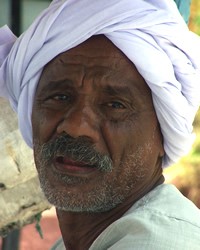

The Saidi Arabs originate from Upper Egypt and are known for their unique dialect and cultural practices. The Saidi people have developed a distinct ethnic identity, primarily due to the isolation of the upper Egyptian region, which has resulted in less foreign influence and more conservative attitudes. The Nile valley from which they originate is often described as rural and arid, which has resulted in a greater preservation of the nation's ancient Egyptian and Arabic heritage. The language itself is a distinct dialect of Arabic like other Egyptian Arabic dialects. While intelligible to other Egyptians, the Saidi dialect is different from traditional Arabic in both pronunciation and vocabulary.
In recent years, some Saidi Arabs have migrated to Greece, often as refugees or economic migrants. They tend to form close-knit communities to maintain their cultural identity and language.
Saidi Arabs maintain their traditional values and family heritage, observing cultural celebrations and ceremonies, and speaking Saidi Arabic. Saidi cultural expressions includes traditional dances, weddings, and tahtib, a form of stick fighting. They are commonly looked down upon by upper-class Egyptians for their dialect and their rural ways. Many Saidi Arabs have migrated from the Upper Egyptian region to escape poverty and find better opportunities in bigger cities.
Saidi Arabs have two separate religious communities. Some are Sunni Muslims while others are Coptic Christians. As usually happens, the two religious communities have little social contact.
One of the first strains of Christianity is Coptic Christianity. They credit St. Mark for taking the gospel to Alexandria, Egypt. Alexandria is still the center of their faith, and the home of their patriarch, who holds a similar position to the Roman Catholic pope. From Alexandria, the Coptic Church spread throughout Egypt, and even Ethiopia, where it takes on an Ethiopian flavor. Coptic Christian leaders attended important early ecumenical councils, including Nicea in 325.
Coptic Christians believe in the Holy Trinity; God the Father, the Son (Jesus) and the Holy Spirit. They believe that Jesus Christ has one united nature, both fully divine and fully human. This is a Miaphysite Christology. Like other forms of Christianity, they believe that salvation comes from the death and resurrection of Jesus Christ, the only one who can pay for our sins and bring reconciliation between God and humankind.
Coptic Christianity is deeply rooted in Egyptian history, and it is an important part of their identity. They value monasticism and martyrdom. It survived the Arab invasions of the 600s, which ultimately made Islam the primary religion of Egypt. Retaining their own language, they pride themselves on having the ancient Egyptians as their ancestors.
Literacy rates are a challenge, making gospel resources less accessible. Coptic Christians had the Scriptures in the local language, which helped them survive the religious onslaught. For those who speak Saidi Arabic, all they have are Bible portions and recordings by the Global Recordings Network and Arabic Bible Outreach Ministry. There are complete Bible materials in other Egyptian Arabic languages.
Pray for the Holy Spirit to move powerfully among Coptic Christians, drawing them closer to the Lord of lords.
Pray for Coptic Christian Saidi Arabs to take the gospel to their Muslim neighbors no matter how steep the cost.
Pray for the Lord to protect them from those who may wish to cause them harm.
Pray for the Lord to direct them to new ways to make a living that will not force them to leave their homeland.
Scripture Prayers for the Arab, Saidi - Muslim in Egypt.
Baker, Raymond William, Holt, Peter M., Little, Donald P., Smith, Charles Gordon, Goldschmidt, Arthur Eduard, Hopwood, Derek. "Egypt". Encyclopedia Britannica, 22 Sep. 2025, https://www.britannica.com/place/Egypt.
Accessed 23 September 2025. Catherine Miller. Between Myth and Reality: the Construction of a Saidi identity. N. Hopkins &R. Saad. Upper Egypt, Identity and Change American University of Cairo Press, pp.25-54, 2004.halshs-00150403Eberhard,
David M., et al. "Arabic, Saidi Language (AEC) – L1 & L2 Speakers, Status, Map, Endangered Level & Official Use | Ethnologue Free."
https://www.cjpme.org/fs_120
Ethnologue, 2025, www.ethnologue.com/language/aec/."Saidi Arab."
Prayercast, 23 July 2024, prayercast.com/prayer-topic/saidi-arab/.
https://en.wikipedia.org/wiki/Sa%27idi_people
https://en.wikipedia.org/wiki/Coptic_Orthodox_Church
https://en.wikipedia.org/wiki/Coptic_identity
| Profile Source: Joshua Project |



