


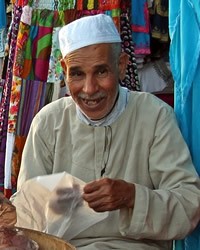

Arabs represent the largest, most diverse, and most politically influential Muslim ethnic grouping in the world. There are several characteristics that determine if a person is a true Arab. The early Islamic period was a time when "Arab identity" meant that all Arabs had descended from a common male ancestor. Thus, being an Arab brought recognition, honor and certain privileges. Their physical, geographical and religious aspects all vary greatly. However, the ability to speak Arabic (or an Arabic dialect) and identification with the Arabian cultural heritage are, perhaps, the two most essential elements.
Things became more complicated as Arab armies stormed through North Africa. They eventually blended with Berber peoples, causing local Arabic to include Berber words. That was the case in Morocco, on the western edge of the Arab Empire. Moroccan Arabs often don't identify with the Arab world as much as someone from the Arabian Peninsula.
Arabs are the majority people in many countries in the Arabian Peninsula, the Maghreb, and all of North Africa. From there, Arab and Berber armies turned northward, and conquered the Iberian Peninsula (i.e. , Spain and Portugal), and held all or part of it till 1492. Arabs were not as much of a threat to northern European countries like Belgium, the Netherlands, Norway, Sweden, Germany, and Switzerland. Today Moroccan Arabs have come to Europe seeking job opportunities and a better life than they had in Morocco.
The Moroccan Arab diaspora is usually located in urban centers where they usually hold low paying jobs. Many find it difficult to obtain secondary or tertiary education. Moroccans living in Switzerland have to interface with a secular-humanist culture. Moroccan Arab traditional family and tribal ties are breaking down. There are fewer arranged marriages, greater freedom for women to leave the home, and less social pressure to conform to traditional religious practices. Women as well as men have greater educational and employment opportunities in Europe than they had in Morocco. These changes bring about much tension. It is harder for the second and third generation to accept Arab culture when they have encountered freedom in Switzerland.
It is difficult for Moroccan Arabs in secularized Switzerland to maintain their Islamic identity. To do this, they immerse themselves in Muslim activities and avoid the European culture around them. Still, those who want to fit in with Swiss culture probably become more secularized. It is hard to imagine where the Moroccan Arabs will be spiritually in a generation or two. Most likely, they will maintain their identity with Islam, but it will not affect their lives like it did for their grandparents in Morocco.
People who genuinely follow Christ will need to patiently and lovingly take the opportunity to take Christ to the Moroccan Arabs in Switzerland. They can make friends with them, perhaps through a common interest like sports.
Pray that God will raise up faithful intercessors who will stand in the gap for Moroccan Arabs in Switzerland. Pray that the loosening of their traditional culture will soften their hearts so they will hunger for the truth and eagerly accept it when they hear it.
Pray for a movement to Christ among Moroccan Arabic speaking people in Switzerland that will show others the transforming power of the gospel in their lives.
Ask the Lord to raise up strong local churches and discipleship movements among Diaspora Arabs in Norway.
Scripture Prayers for the Arab, Moroccan in Switzerland.
References
| Profile Source: Joshua Project |



