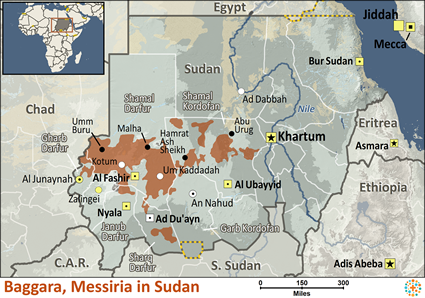

The Messiria are one of the Baggara tribes of Sudan. Baggara means "cattle people." They are thought to be partly descended from Arab tribes who settled the region from the fourteenth to the eighteenth century.
The Messiria Baggara of Sudan are traditionally semi-nomadic pastoralists, and their work life is centered on the raising and management of cattle. Livestock, especially cattle, are the foundation of their economy and hold both practical and cultural importance. Herding requires constant movement in search of grazing land and water, and many Messiria families migrate seasonally between northern and southern pastures depending on rainfall and environmental conditions.
Men are primarily responsible for the care and protection of the herds. They spend long periods moving with the cattle, guiding them across open grazing lands and safeguarding them from theft, disease, or environmental dangers. This work demands endurance, knowledge of the land, and an ability to adapt to changing conditions. Younger boys are often trained from an early age to assist in herding, learning the skills necessary to continue this way of life.
Unlike other tribes, the Baggara women work to provide the income needed to maintain the households. A married woman owns her tent as well as all its housekeeping contents. While men are often away with the herds, women remain closer to semi-permanent camps or villages. They are responsible for milking the cattle, processing dairy products such as butter and cheese, preparing food, and maintaining the household. In addition, women may engage in small-scale trade, exchanging dairy goods or other products in local markets to support the family.
Although cattle herding is central, some Messiria Baggara also participate in supplementary economic activities, such as limited farming, trading, or labor, especially when environmental conditions make pastoral life more difficult. In recent years, factors such as drought, conflict, and land pressure have at times disrupted traditional migration patterns, requiring some families to adapt by seeking alternative income sources.
The Messiria Baggara of Sudan are predominantly Muslim, and their beliefs are rooted in the teachings of Islam as expressed through the Koran. Their faith shapes both their worldview and daily life, influencing moral values, social relationships, and community structures.
As Muslims, they observe the central practices of Islam, including reciting the Shahada, participating in daily prayers, fasting during the month of Ramadan, giving to those in need, and honoring important religious festivals. Religious leaders and elders play an important role in guiding spiritual life and helping interpret Islamic teaching within the context of their community.
At the same time, among the Messiria Baggara, Islamic belief is often practiced alongside traditional spiritual perspectives. There may be an awareness of spiritual forces, concerns about unseen influences, and practices connected to protection, healing, or blessing. These elements are not separate from their faith but are often integrated into how they understand the world and respond to life's challenges.
Religion is closely tied to identity, and being Muslim is an important part of what it means to belong to the Messiria community. Their faith provides structure, meaning, and unity, especially within a lifestyle that involves seasonal movement and strong tribal relationships.
Sudan is often in turmoil and can be a very difficult environment for anyone. Pray for stability and peace.
Pray the material and physical needs of the Messiria will be met and that they will be able to provide for their families.
Pray for the followers of Christ among the Baggara tribe to fellowship together and grow in the nurture and admonition of the Lord.
Pray that a strong movement to Jesus will bring whole Messiria families and communities into a saving relationship with God.
References
Scripture Prayers for the Baggara, Messiria in Sudan.
| Profile Source: Joshua Project |