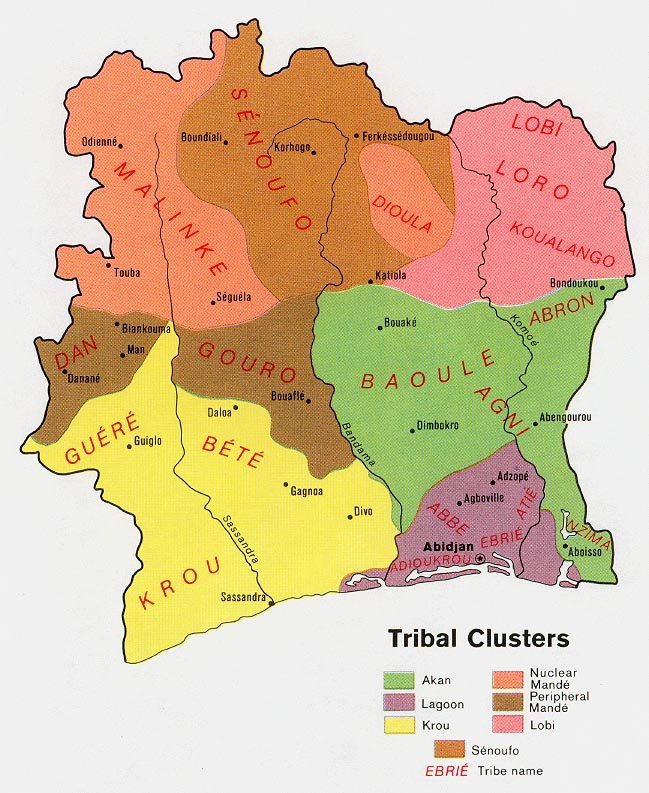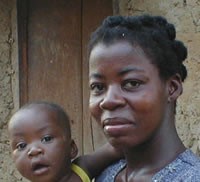

The Glaro-Twabo are a small Kru people group living on the border of two West African nations—Liberia and Côte d'Ivoire. In Liberia, they are concentrated in the southeastern corner of Grand Gedeh County, and a smaller community lives across the border in neighboring Côte d'Ivoire. Their name reflects their linguistic reality: Glaro-Twabo is formed from the two main dialects—Glaro and Twabo—that together constitute the language. Like their Kru-speaking neighbors, the Glaro-Twabo are sometimes called Krahn in Liberia and are closely related to the Wè (Guéré) peoples in Côte d'Ivoire. Their language, also called Glaro-Twabo, belongs to the Western Kru subgroup of the Niger-Congo language family. A Bible translation in Glaro-Twabo has been started but is not yet complete.
The ancestors of the Glaro-Twabo migrated to the West African forest belt in the fifteenth and sixteenth centuries, moving southwestward from the interior under pressure from expanding kingdoms and shifting populations in what is now Sudan. They settled in the fertile forest zone the Portuguese had called the "Grain Coast," living as hunters and subsistence farmers well outside the reach of centralized states. European contact intensified in the nineteenth century when France expanded inland and signed treaties with coastal rulers, incorporating much of what is now Côte d'Ivoire as a colony in 1893. The French encountered stiff resistance from indigenous forest peoples, and revolts were frequent. More recently, the Liberian civil wars of the 1990s and 2000s drove waves of Krahn refugees—including some Glaro-Twabo speakers—across the border into Côte d'Ivoire, adding political and social complexity to communities already living near the frontier.
The Glaro-Twabo live in small villages of mud-walled, thatch-roofed homes grouped around a central court that serves as a shared gathering space. Most families are subsistence farmers, growing rice—the dietary staple—alongside cassava, yams, plantains, and maize. Hunting in the surrounding forest supplements the food supply, and where rivers are nearby, fishing adds protein to the diet. In more recent decades, some families have shifted toward working on rubber plantations or in diamond camps as the broader regional economy has penetrated the forest zone and traditional livelihoods have become harder to sustain.
Family and village life follow a patrilineal clan structure. Several extended families make up a settlement, with each led by a headman who manages disputes, represents the family in village affairs, and carries out ceremonial duties. A village chief or religious leader presides over the broader community. Many men take more than one wife, and kinship obligations extend broadly across the community. Ceremonies mark births, initiations, marriages, and deaths, drawing extended families together and reinforcing the social bonds between generations. Masks hold a central place in Glaro-Twabo ceremonial life—carved to represent powerful spirits, they appear at important community gatherings and serve as instruments of both religious expression and social order.
Christianity is the primary religious affiliation among the Glaro-Twabo, though a segment of the community continues to practice ethnic religion. The Christian community in Liberia is more developed than among those living across the border in Côte d'Ivoire, where traditional beliefs remain stronger. Evangelical believers represent a real but modest portion of the community.
Traditional Glaro-Twabo spirituality reflects a worldview shared with neighboring Kru peoples: a high god exists but is considered too distant for direct worship, so spiritual life centers on mediating with spirit beings and ancestors who are believed to govern daily affairs. Bush spirits inhabit the untamed forest, and venturing beyond the village without proper spiritual precautions is considered dangerous. Ancestral spirits are consulted for guidance and protection, and each family headman offers sacrifices on behalf of his household. Masks serve as physical vessels for spiritual presences during ritual occasions. Even where Christianity has taken hold, these beliefs often persist alongside Christian practice, pointing to an urgent need for deep biblical discipleship.
The Glaro-Twabo need a complete Bible in their own language; without it, believers rely on French or neighboring-language Scriptures and cannot fully access God's Word as it speaks to their own hearts and lives. Healthcare access in the remote forest communities of Grand Gedeh County and southeastern Côte d'Ivoire remains severely limited, and clean water and sanitation infrastructure are largely absent in rural villages. Decades of regional instability—including the Liberian civil wars and the political violence in Côte d'Ivoire in the early 2000s—have left communities with weakened institutions and limited economic opportunity. Young people are increasingly drawn to urban centers, where the ties to community, language, and faith can quickly unravel. The sizable but not yet firmly discipled Christian community needs pastors and teachers who know both the language and the people.
Pray that the Glaro-Twabo Bible translation would be completed soon, and that God's word in the Glaro-Twabo language would bring saving faith and lasting transformation.
Pray that Glaro-Twabo believers—especially those in Liberia, where the Christian community is stronger—would deepen their discipleship and send workers across the border to reach Glaro-Twabo communities in Côte d'Ivoire.
Pray for Glaro-Twabo Christians to boldly share the gospel with neighboring Kru and Wè communities who have even fewer believers, becoming a gospel-sending people.
Pray for healthcare, clean water, and economic opportunity in isolated Glaro-Twabo villages, and for peace and stability throughout the border region so that communities can flourish.
Scripture Prayers for the Glaro-Twabo in Côte d'Ivoire.
https://en.wikipedia.org/wiki/Krahn_people
https://en.wikipedia.org/wiki/Kru_people
https://www.britannica.com/topic/Kru
https://www.101lasttribes.com/tribes/krahn.html
https://www.refworld.org/docid/4954ce5823.html
https://johnvictorsingler.wordpress.com/wp-content/uploads/2022/12/singler-2015-language-and-ethnicity-in-liberia.pdf
https://www.ethnologue.com/language/glr
| Profile Source: Joshua Project |