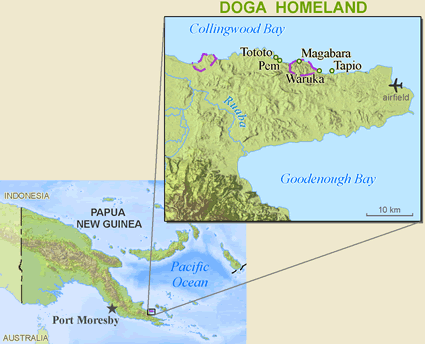
The Doga people reside along the coastal and inland areas of Milne Bay Province, Papua New Guinea. Their villages are often found near rivers or nestled among the lush, tropical forests that characterize the region. The Doga language, part of the Austronesian language family, is spoken in daily life, while Tok Pisin and, to a lesser extent, English are used for broader communication. The Doga trace their ancestry through oral histories, with elders recounting tales of migration, clan origins, and significant events that have shaped their community. Despite the gradual influence of modernization, the Doga have preserved many of their traditional customs, adapting as needed while maintaining a strong sense of identity.
Doga society is built around extended families and close community ties. Homes are constructed from local materials such as sago palm, bamboo, and thatch, often raised on stilts to protect against flooding. The Doga are skilled gardeners, cultivating taro, yams, bananas, and other crops in the fertile soil. Fishing and gathering shellfish from nearby rivers and the sea are important sources of protein. Pigs and chickens are also kept for food and ceremonial purposes. Daily life is marked by cooperation, with families working together in gardens and sharing the fruits of their labor. Festivals and communal gatherings are important occasions, featuring traditional music, dance, and storytelling. Children are raised collectively, learning practical skills and cultural values from both parents and elders.
The Doga are almost entirely Christian, with churches established in most villages and Christian worship forming a central part of community life. While the majority of Doga people identify as followers of Jesus, some traditional beliefs and practices continue to influence their worldview. Elements of ancestral spirituality may be seen in certain ceremonies or rituals, reflecting a blend of old and new. Nevertheless, the Doga's faith is rooted in the gospel, and church gatherings are well attended. The message of Christ has brought transformation to many, and the Doga seek to live out their faith in daily life, supporting one another and reaching out to those in need.
The Doga face ongoing challenges related to their remote location. Access to healthcare is limited, with few clinics and long distances to medical facilities. Clean water is not always available, leading to health concerns, especially among children. Educational opportunities beyond the primary level are scarce, making it difficult for young people to pursue further studies or vocational training. Improved infrastructure, such as better roads and communication networks, would greatly benefit the Doga, opening doors to essential services and new opportunities.
Pray that the Doga would continue to grow in their faith and understanding of God's Word.
Ask God to inspire Doga believers to share the hope of Christ with neighboring groups who have not yet heard the gospel.
Pray for creative solutions to the challenges of healthcare, clean water, and education in Doga communities.
Pray that the Doga church would be a source of encouragement and blessing to other ethnic groups in Papua New Guinea.
Scripture Prayers for the Doga in Papua New Guinea.
https://www.ethnologue.com/language/dgg
https://www.peoplegroups.org/explore/GroupDetails.aspx?peid=12351
Lithgow, D. Languages of the Milne Bay Province. Pacific Linguistics, 1976.
| Profile Source: Joshua Project |