




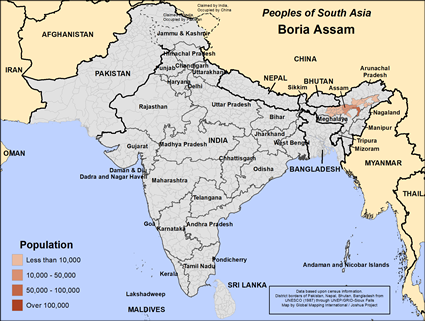
The Boria Assam are a lesser-known community whose history is closely tied to the broader cultural and social developments of northeastern India. Like many small groups in Assam, their origins are connected to migration and settlement patterns that unfolded over centuries as different peoples moved into the Brahmaputra Valley and surrounding regions. Over time, the Boria Assam developed a distinct identity while interacting with neighboring ethnic groups and adapting to the local cultural environment.
Historically, their society has been organized around village life, with authority often resting in family or community elders rather than centralized political systems. Their traditions, customs, and social structures have been preserved through oral transmission, with stories, rituals, and community practices reinforcing a shared sense of identity. The community has also been shaped by wider regional influences, including the spread of Hindu traditions in Assam, which have played a significant role in shaping their religious and cultural life.
During the colonial period, British administration introduced changes in land use, governance, and economic systems across Assam. While these changes affected many communities, the Boria Assam largely continued their traditional rural lifestyle, with only gradual exposure to outside systems. In the modern era, government policies, education, and increased connectivity have brought new opportunities and challenges, yet the Boria Assam continue to maintain many elements of their traditional way of life.
Their name is derived from a term for widow. They live in the Brahmaputra Valley of India's Assam state. They speak, read and write in Assamese.
The work life of the Boria Assam is centered primarily on agriculture, reflecting a strong dependence on the land. Most families are engaged in farming, cultivating crops such as rice, which is the staple food of the region. In addition to rice, they may grow vegetables, pulses, and other locally suitable crops. Their agricultural practices are often seasonal, with activities such as planting, tending, and harvesting structured around the monsoon cycle.
Because landholdings may be small, many Boria Assam supplement their income through agricultural labor, working in the fields of others during busy seasons. Some individuals may also engage in fishing, small-scale trading, or manual wage labor, depending on local opportunities. In certain cases, seasonal migration to nearby towns provides additional income when work in the village is limited.
Labor is typically shared within the family. Men often take on tasks such as plowing, land preparation, and marketing produce, while women contribute heavily through transplanting, weeding, harvesting, and processing food. Women also carry primary responsibility for household duties, including cooking, childcare, and managing daily domestic needs. Children assist with chores and agricultural work from a young age, gradually learning the skills necessary for adult responsibilities.
The Boria Assam eat rice and meat, fish and eggs. Widows, widowers and divorced can marry again. After the father's death, his property is divided equally among the sons. Like most Hindu communities, the Boria Assam practice cremation for their deceased.
The Hindu beliefs of the Boria Assam people reflect a blending of mainstream Hindu traditions with localized practices that have developed within the cultural setting of Assam. This combination gives their religious life a distinct character that is both recognizable within Hinduism and uniquely shaped by regional influences.
One unique aspect of their belief system is the strong integration of folk religious elements alongside classical Hindu worship. While the Boria Assam may honor widely recognized Hindu deities such as Shiva, Vishnu, or local forms of the goddess, their practices are often expressed through village-level rituals and traditions that emphasize the immediate spiritual environment. These may include reverence for local deities, spirits associated with the land, and ancestral influences, all of which play a significant role in daily life.
Their religious expression tends to be practical and community-centered rather than highly formalized. Rituals are often conducted at the household or village level rather than in large temple settings. Offerings, prayers, and seasonal observances are closely tied to agricultural cycles, reflecting a worldview in which spiritual well-being is directly connected to the success of crops, protection from illness, and harmony within the community.
Another distinctive feature is the role of traditional religious specialists or village priests, who may guide rituals that combine Hindu elements with older, indigenous practices. These leaders often serve as mediators between the community and the spiritual world, addressing concerns such as sickness, misfortune, or spiritual imbalance.
Festivals also illustrate the unique nature of their beliefs. While broader Hindu festivals may be observed, they are often adapted to local customs and accompanied by traditional music, dance, and communal participation. These celebrations reinforce both religious devotion and cultural identity, blending spiritual meaning with social unity.
There are so few Christ followers among the Boria Assam that they will need to hear the gospel from outsiders. There are vibrant Christians in most parts of Northeastern India who can fill this void.
Pray that Indian Christians will lead the Boria Assam to salvation, disciple them and thrust them out to others.
Pray that the council leaders come to Jesus Christ and lead others to him.
Pray for them to have clean and adequate drinking water.
References
Scripture Prayers for the Boria Assam in India.
| Profile Source: Joshua Project |




