

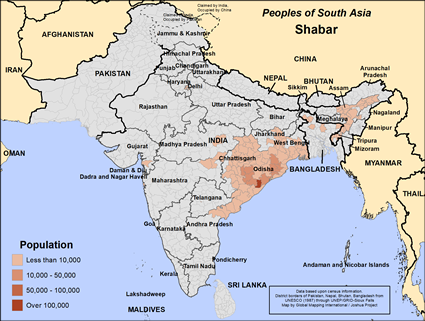
Shabar in India

The Shabar have only been reported in India
Population
Main Language
Largest Religion
Christian *
Evangelical
Progress
Progress Gauge
* Data can be from various sources including official census, agencies, and local research. Data from these sources can sometimes differ even by orders of magnitude. Joshua Project attempts to present a conservative, balanced estimate.

Subgroups: 1

Subgroup Name Population
Nadua 75,000

Introduction / History

The Shabar, also known as Saora or Sabara, are an indigenous people group primarily residing in the eastern states of India, such as Odisha, Jharkhand, and West Bengal. Their roots stretch deep into the forests and hills, where they have lived for centuries as one of India's recognized Scheduled Tribes. Traditionally, the Shabar have been forest dwellers, known for their skills in hunting, gathering, and shifting cultivation. Over time, many have adapted to settled agriculture, though their connection to the land and forest remains central to their identity. Oral storytelling, folk songs, and dance are vital in preserving their history and passing down ancestral wisdom from one generation to the next.


What Are Their Lives Like?

Life among the Shabar is closely tied to the rhythms of nature. Many families depend on small-scale farming, growing crops like millet, rice, and maize, while supplementing their diet with forest produce such as fruits, roots, and honey. Some still practice traditional hunting and gathering, though this is less common due to changing laws and shrinking forests. Homes are typically constructed from mud, bamboo, and thatch, blending seamlessly into the landscape. Family bonds are strong, with extended families often living together or nearby. Community celebrations are vibrant, marked by music, dance, and colorful attire, especially during festivals and harvest times. Marriage rituals and seasonal festivals are occasions for communal joy, reinforcing social ties and cultural identity.


What Are Their Beliefs?

The Shabar people hold a worldview shaped by animistic faith, placing their trust in a variety of spiritual forces and deities believed to inhabit the natural world. They worship ancestral spirits, village gods, and nature spirits, seeking their favor and protection through rituals, sacrifices, and festivals. Sacred groves and specific trees or hills are often regarded as dwelling places of these spirits. Shamans or spiritual leaders play a key role in mediating between the community and the spiritual realm, conducting ceremonies to ensure health, fertility, and safety. While these beliefs are deeply woven into daily life, the truth of the gospel proclaims that salvation and hope are found in Jesus Christ alone, who offers deliverance from fear and brings true peace with God. Some of them realize this, and they can


What Are Their Needs?

The Shabar face significant challenges, including limited access to education, healthcare, and clean water. Many live in remote areas where government services are scarce, making it difficult to break cycles of poverty and illiteracy. Economic opportunities are few, and dependence on the forest is increasingly threatened by deforestation and land disputes. Spiritually, the Shabar need to hear the message of Jesus Christ in their own language and cultural context. There is a need for compassionate outreach, discipleship, and the establishment of fellowships where new believers can grow in faith and community.


Prayer Items

Pray for improved access to education, healthcare, and clean water in Shabar villages.
Ask God to send workers who can share the gospel in culturally sensitive ways.
Pray for the translation and distribution of Scripture and Christian resources in the Shabar language.
Request that those who come to faith in Christ would be strengthened and encouraged in fellowship with other believers.


Scripture Prayers for the Shabar in India.


References

https://www.peoplegroups.org/
https://www.operationworld.org/


Profile Source:   Joshua Project  

People Name General Shabar
People Name in Country Shabar
Alternate Names Byadha Shabar; Nadua Shabar; Nadva Shabar; शबर
Population this Country 563,000
Population all Countries 563,000
Total Countries 1
Indigenous Yes
Progress Scale Progress Gauge
Unreached No
Frontier No
GSEC 6  (per PeopleGroups.org)
Pioneer Workers Needed
PeopleID3 18080
ROP3 Code 113581
Country India
Region Asia, South
Continent Asia
10/40 Window Yes
National Bible Society Website
Persecution Rank 12  (Open Doors top 50 rank, 1 = highest persecution ranking)
Total States on file 14
Largest States
Odisha
543,000
Andhra Pradesh
5,500
Chhattisgarh
2,500
West Bengal
2,500
Assam
2,300
Jharkhand
1,800
Delhi
300
Telangana
100
Tripura
100
Maharashtra
80
Nagaland
40
Madhya Pradesh
40
Gujarat
30
Bihar
10
Districts Interactive map, listing and data download
Specialized Website South Asia Peoples
Country India
Region Asia, South
Continent Asia
10/40 Window Yes
National Bible Society Website
Persecution Rank 12  (Open Doors top 50 rank, 1 = highest persecution ranking)
Total States 14
  Odisha 543,000
  Andhra Pradesh 5,500
  Chhattisgarh 2,500
  West Bengal 2,500
  Assam 2,300
  Jharkhand 1,800
  Delhi 300
  Telangana 100
  Tripura 100
  Maharashtra 80
  Nagaland 40
  Madhya Pradesh 40
  Gujarat 30
  Bihar 10
Website South Asia Peoples
Primary Religion: Hinduism
Major Religion Estimated Percent *
Buddhism
0.02 %
Christianity
9.13 %
Ethnic Religions
0.00 %
Hinduism
90.58 %
Islam
0.11 %
Judaism
0.00 %
Non-Religious
0.00 %
Other / Small
0.02 %
Sikhism
0.00 %
Unknown
0.15 %
* From latest India census data.
Current Christian values may substantially differ.
Primary Language Odia (385,000 speakers)
Ethnologue Language Code ory
Ethnologue Language Familly Indo-European
Glottolog Language Family Indo-European
Written / Published Yes   (ScriptSource Listing)
Total Languages 41
Secondary Languages
(only 15 largest shown)
Sora
89,000
Mal Paharia
38,000
Pengo
5,900
Telugu
4,100
Kuvi
2,900
Hindi
2,500
Bengali
600
Chhattisgarhi
500
Munda
400
Kharia
200
Assamese
200
Duruwa
200
Kurux
200
Ho
200
Mundari
200
Primary Language Odia (385,000 speakers)
Ethnologue Language Code ory
Ethnologue Language Familly Indo-European
Glottolog Language Family Indo-European
Written / Published Yes   (ScriptSource Listing)
Total Languages 41
Secondary Languages (only 15 largest shown)
  Sora 89,000
  Mal Paharia 38,000
  Pengo 5,900
  Telugu 4,100
  Kuvi 2,900
  Hindi 2,500
  Bengali 600
  Chhattisgarhi 500
  Munda 400
  Kharia 200
  Assamese 200
  Duruwa 200
  Kurux 200
  Ho 200
  Mundari 200

Primary Language:  Odia

Bible Translation Status  (Years)
Bible-Portions Yes  (1811-1956)
Bible-New Testament Yes  (1809-2000)
Bible-Complete Yes  (1815-2021)
FCBH NT (www.bible.is) Online
YouVersion NT (www.bible.com) Online
Possible Print Bibles
Amazon
World Bibles
Forum Bible Agencies
National Bible Societies
World Bible Finder
Virtual Storehouse
Resource Type Resource Name Source
Audio Recordings Audio Bible teaching Global Recordings Network
Audio Recordings Oral Bible stories One Story
Film / Video God's Story video God's Story
Film / Video Indigitube.tv Video / Animation Create International
Film / Video LUMO film of Gospels Bible Media Group/LUMO
Film / Video World Christian Videos World Christian Videos
General Bible and Resources in text or audio or video Internet Publishing Sevice
General Bible for Children Bible for Children
General Bible in text or audio or video Internet Publishing Sevice
General Bible in text or audio or video South Asia Bibles
General Biblical answers to your questions Got Questions Ministry
General Faith Comes By Hearing - Bible in text or audio or video Faith Comes by Hearing
General Scripture Earth Gospel resources links (Oriya) Scripture Earth
General Voice of the Martyrs resources Voice of the Martyrs
General YouVersion Bible versions in text and/or audio YouVersion Bibles
General Zume Training Zume Project
Mobile App Android Bible app: Odia YouVersion Bibles
Mobile App Android Bible app: Odia (Oriya) / English Bible (AKJV) General / Other
Mobile App Android Bible App: Odiya Bible (ଓଡିଆ ବାଇବେଲ) Indian Revised Version (IRV) Operation Agape
Mobile App Android Bible app: Oriya Study Bible Grace Ministries and Dusty Sandals
Mobile App Android Bible Radio app: Odiya Bible Radio Shalom Design S2dio
Mobile App Children's Bible app Bible4Kidz
Mobile App Download audio Bible app as APK file Faith Comes by Hearing
Mobile App Download audio Bible app from Google Play Store Faith Comes by Hearing
Mobile App iOS Bible app: Odia YouVersion Bibles
Mobile App iOS Bible Radio App: Odiya Bible Radio iOS Revive India
Text / Printed Matter Children and youth resources One Hope
Text / Printed Matter Jesus Messiah comic book General / Other
Text / Printed Matter The Ancient Path Live Global
Text / Printed Matter tools for gospel conversations Cru
Text / Printed Matter Topical Scripture booklets and Bible studies World Missionary Press
Map Source People Group data: Omid. Map geography: UNESCO / GMI. Map Design: Joshua Project.  
Profile Source Joshua Project 
Data Sources Data is compiled from various sources. Learn more.

