


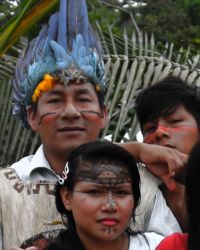

The Zaporo, more commonly known today as the Sápara, are an Indigenous people of the western Amazon rainforest, living primarily in Ecuador's Pastaza Province near the border with Peru. Their ancestral territory lies among winding rivers, dense jungle, and remote floodplains that have shaped their culture for generations. Historically, the Zaporo were part of a larger ethno-linguistic cluster that occupied a vast region of the Amazon basin long before European contact. Over time, disease, enslavement, warfare, and forced displacement decimated their population and fractured their communities.
The Zaporo language is part of the Zaparoan language family and is now critically endangered. Only a handful of elders retain fluency, while most community members communicate in Amazonian Quechua or Spanish. Oral tradition has long been the primary means of passing down knowledge, with history, ecology, and identity preserved through storytelling, dreams, and ritual speech. Despite immense cultural pressure, the Zaporo continue to assert their identity and connection to the land, even as their linguistic and spiritual heritage faces erosion.
Zaporo communities are small, scattered, and accessible mainly by river travel. Daily life revolves around subsistence activities closely tied to the rainforest. Families fish in nearby rivers, hunt small game, and cultivate gardens with crops such as manioc, plantains, and fruits native to the Amazon. Food is simple and seasonal, often prepared over open fires and shared communally.
Households are typically extended family based, with elders holding respected roles as keepers of memory and tradition. Children learn through observation and participation rather than formal instruction, although limited schooling is available in some communities. Social life includes storytelling, singing, and the recounting of dreams, which are treated as meaningful sources of guidance. Community gatherings may mark planting cycles, healing rituals, or moments of collective decision-making, reinforcing strong relational bonds within the group.
Though about two-thirds identify as Christian, the Zaporos are almost entirely adherents of traditional spiritual beliefs rooted in animism and shamanism. Zaporo have had exposure to Christianity—often through contact with neighboring groups or occasional outside workers—Christian beliefs are typically blended with traditional practices rather than replacing them. Trust remains firmly placed in ancestral spirits, dream revelation, and ritual power, not in Jesus Christ as Savior and Lord.
Their worldview centers on the conviction that the forest is alive and filled with powerful spirits that influence every aspect of life. Animals, rivers, trees, and even dreams are understood to possess spiritual agency. Shamans serve as mediators between the physical and spirit realms, interpreting dreams, diagnosing illness, and restoring balance through rituals and chants. Dreams are especially significant and are believed to be messages from the spirit world that guide personal choices, community decisions, and hunting practices.
The Zaporo face ongoing physical and social challenges linked to their isolation and limited infrastructure. Access to consistent medical care is extremely restricted, leaving preventable illnesses and treatable injuries as serious threats. Clean water systems are minimal, and river contamination from outside economic activity poses growing health risks. Educational opportunities beyond basic levels are rare, limiting literacy development and vocational skills for younger generations.
Transportation barriers make it difficult for communities to reach markets, clinics, or government services. At the same time, growing external pressure on their land threatens both food security and long-term stability. Sustainable development that respects Zaporo territory, along with culturally appropriate healthcare and education, remains an urgent need.
Pray that the Zaporo people would encounter Jesus Christ as the true Lord over all creation, greater than every spirit they fear.
Ask God to raise up compassionate workers who will serve among the Zaporo through healthcare, education, and discipleship.
Pray for protection over Zaporo communities and their lands amid ongoing environmental and political pressures.
Pray that any Zaporo believers would grow strong in Scripture and eventually carry the gospel to other unreached peoples.
Scripture Prayers for the Zaporo in Ecuador.
https://joshuaproject.net/people_groups/20959/EC
https://en.wikipedia.org/wiki/Sápara
https://ich.unesco.org/en/RL/oral-heritage-and-cultural-manifestations-of-the-zapara-people-00007
http://www.ecuador.nativeweb.org/zaparo/
https://www.naku.com.ec/sapara-history-1
| Profile Source: Joshua Project |




