


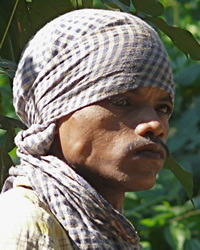

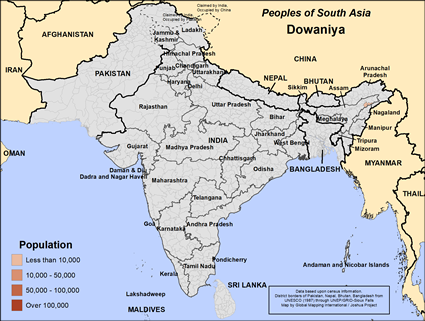
The Dowaniya are a small ethnic community living in the northeastern Indian state of Assam, particularly in areas of the upper Assam plain near the Brahmaputra River. They are closely related to the Singhpo people, whose ancestors migrated from present-day Myanmar (Burma) into northeastern India during the late eighteenth century. According to historical accounts, the ancestors of the Dowaniya were among these early settlers. Over time, some Singhpo who had previously lived in conditions of servitude formed a distinct community that became known as the Dowaniya.
The Dowaniya share many cultural and historical connections with the Singhpo, although they now maintain their own identity. Assamese is their primary language, and they use the Assamese script for writing. Living among a variety of ethnic groups in Assam has influenced their culture, yet they have retained many of their traditional customs and practices.
Because they have not received the same level of official recognition as some neighboring tribal groups, the Dowaniya have often remained overlooked by the broader society. As a result, little research has been conducted about them, and they remain one of the lesser-known peoples of northeastern India.
The Dowaniya have preserved many elements of their traditional way of life. Those living in rural areas tend to maintain customs that have been passed down through generations. Their communities are typically centered around family relationships and village life, where cooperation and mutual support are highly valued.
Traditional skills continue to play an important role in their culture. The Dowaniya are known for their craftsmanship, particularly in woodwork, basket making, and weaving. These skills are both practical and artistic, providing household necessities while also preserving cultural identity.
Like many people in Assam, the Dowaniya depend on agriculture and related occupations for their livelihood. Rice is a staple food, often accompanied by vegetables, fish, and locally available foods. Family life is important, and elders are generally respected for their wisdom and experience. Community celebrations, religious observances, weddings, and funerals provide opportunities for social interaction and reinforce cultural traditions.
Despite increasing contact with the modern world, many Dowaniya continue to value their ancestral customs. Those living farther from urban centers have generally been more successful in preserving traditional practices and resisting outside cultural pressures.
The Dowaniya trace their religious heritage to Theravada Buddhism, which was brought into the region by their Singhpo ancestors. Buddhism continues to shape many aspects of their religious life, including ceremonies connected with birth, marriage, and death.
However, their Buddhism is often blended with traditional folk beliefs and animistic practices. Many people believe that spiritual beings influence daily life and that various rituals are necessary to maintain harmony with the unseen world. This mixture of Buddhism and traditional spirit beliefs creates a form of religious syncretism that differs from orthodox Buddhist teaching.
Buddhist monks hold an honored place within the community. They conduct important religious ceremonies, provide spiritual guidance, and help preserve ancient Buddhist texts and traditions. Despite their religious devotion, there is little evidence that the Dowaniya have had meaningful access to the message of Jesus Christ or to a sustained Christian witness among their people.
The Dowaniya have significant spiritual needs. Very few, if any, followers of Christ are known among them, and access to biblical teaching in ways that are understandable and culturally relevant remains extremely limited. They need opportunities to hear the gospel clearly and to encounter Christians who demonstrate the love of Christ through both word and action.
In practical terms, communities in rural Assam often face challenges related to healthcare, education, transportation, and economic opportunity. Greater access to quality schools, medical services, and community development initiatives could improve daily life for many families.
The Dowaniya would benefit from long-term relationships with believers who are willing to learn their culture, serve their communities, and help make the message of Christ available in forms they can understand. As both spiritual and practical needs are addressed, opportunities may emerge for lasting transformation within the community.
Pray that the Dowaniya people will be adopted through the People Group Adoption program so that sustained prayer, loving engagement, and future gospel witness will reach their community.
Pray that Christians will be led by the Holy Spirit to build genuine relationships with the Dowaniya and faithfully share the good news of Jesus Christ with them.
Pray that a deep spiritual hunger will arise among the Dowaniya, leading many to seek Jesus Christ and follow Him no matter what the cost.
Pray that the Dowaniya communities will experience improvements in healthcare, education, clean water, and other essential services that strengthen families and improve daily life.
Scripture Prayers for the Dowaniya in India.
https://www.britannica.com/place/Assam
https://www.britannica.com/topic/Theravada
https://en.wikipedia.org/wiki/Singpho_people
| Profile Source: Joshua Project |




