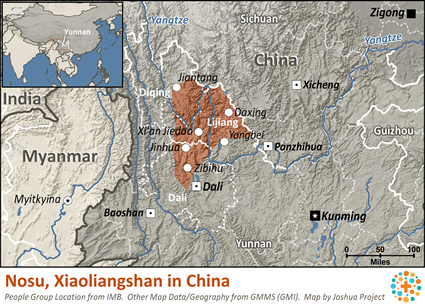

The Xiaoliangshan Nosu are a subgroup of the larger Nosu, or Northern Yi, people of southwestern China. They live primarily in the Xiaoliangshan ("Lesser Cool Mountains") region, which extends across parts of northern Yunnan Province and southern Sichuan Province. The Nosu are one of the major branches of the Yi ethnic group, one of China's largest recognized minority peoples. Their primary language is Xiaoliangshan Nosu, a variety of the Northern Yi language family closely related to other Nosu languages. Despite increasing use of Mandarin Chinese, many continue to speak their traditional language in daily life.
The Xiaoliangshan Nosu have a distinctive history shaped by mountain isolation and a complex social structure. Prior to the reforms of the 1950s, their society was organized around hereditary classes, clans, and tribal relationships. A system of slavery existed among the Nosu, creating social divisions that continued to influence community relationships long after the practice was abolished. Historical records indicate that many Xiaoliangshan Nosu migrated from the larger Liangshan region of Sichuan over several centuries, establishing communities throughout the mountainous areas of northwestern Yunnan. Today, clan identity and family lineage remain important aspects of social life.
The Xiaoliangshan Nosu primarily inhabit rugged mountain regions where agriculture and livestock raising have long been central to daily life. Families commonly cultivate crops adapted to highland environments and raise animals such as goats, sheep, cattle, and pigs. The mountainous terrain has historically limited transportation and economic development, causing many villages to remain relatively isolated from larger urban centers.
Family and clan relationships are extremely important. Extended families often live near one another, and clan loyalty continues to influence social interactions, marriage patterns, and community decision-making. Traditional clothing, music, festivals, and oral traditions remain important parts of Nosu identity. The Xiaoliangshan Nosu also possess a rich knowledge of local plants, agriculture, and the natural environment that has been passed down through generations.
In recent decades, improved education, transportation, and economic development have created new opportunities for younger generations. Some have moved to towns and cities for employment, while others continue to maintain traditional agricultural lifestyles in their ancestral villages. Even with these changes, many Nosu retain a strong sense of cultural identity and connection to their heritage.
The Xiaoliangshan Nosu primarily follow their traditional ethnic religion, often referred to as Bimoism or Nosu ethnic religion. Religious life centers on the spirit world, ancestor veneration, ritual ceremonies, and the work of religious specialists known as bimo. These priests conduct rituals intended to communicate with spirits, seek blessings, provide healing, avert misfortune, and guide the souls of the dead.
Many Nosus believe that unseen spiritual forces influence daily life and that harmony with these forces must be maintained through sacrifices, rituals, and observance of traditional customs. Ancestors are honored and remembered, and spiritual concerns often influence major life decisions. While some Nosu have encountered Buddhism, Christianity, or other religions, traditional ethnic religion remains deeply rooted within the Xiaoliangshan Nosu community.
Xiaoliangshan Nosus have had little exposure to the biblical message. Their worldview is shaped primarily by traditional spiritual beliefs, leaving many without a clear understanding of salvation through Jesus Christ and His death and resurrection.
The Xiaoliangshan Nosu need greater access to the gospel through culturally appropriate communication, Scripture resources, and believers who are willing to build long-term relationships within their communities. Because many villages are in mountainous and relatively isolated areas, access to Christian teaching and discipleship opportunities remains limited.
Practical needs include educational opportunities, economic development, healthcare access, and continued infrastructure improvements in remote regions. Younger generations often face challenges balancing traditional culture with modern economic realities. Efforts that strengthen families, improve livelihoods, and provide compassionate service can help meet tangible needs while creating opportunities for meaningful relationships.
Above all, the Xiaoliangshan Nosu need opportunities to encounter Jesus Christ through God's word, understand the gospel clearly, and experience the transforming power of God through healthy fellowships of believers.
Pray that the Xiaoliangshan Nosu would have opportunities to hear a clear presentation of the gospel in their own language and understand the saving work of Jesus Christ.
Pray that God would raise up faithful workers who will build genuine relationships among the Xiaoliangshan Nosu and communicate biblical truth with wisdom, humility, and love.
Pray that the Xiaoliangshan Nosu would be adopted through the People Group Adoption program so that churches and believers will commit to ongoing prayer, outreach, and future gospel engagement among them.
Pray that the small number of existing Nosu believers would be strengthened in their faith, find fellowship with one another, and be equipped to share the gospel throughout the Xiaoliangshan region.
Scripture Prayers for the Nosu, Xiaoliangshan in China.
https://peoplegroups.org/people_groups/pg007337/
https://people-groups.asiaharvest.org/China/chinaPeoples/N/NosuXiaoliangshan.pdf
https://en.wikipedia.org/wiki/Yi_people
https://en.wikipedia.org/wiki/Nuosu_language
| Profile Source: Joshua Project |