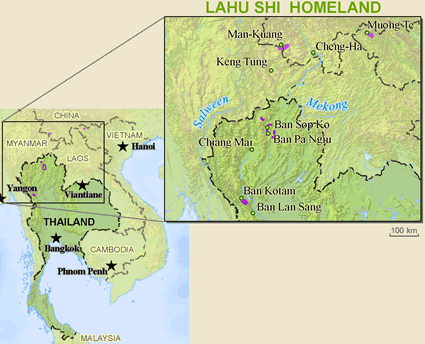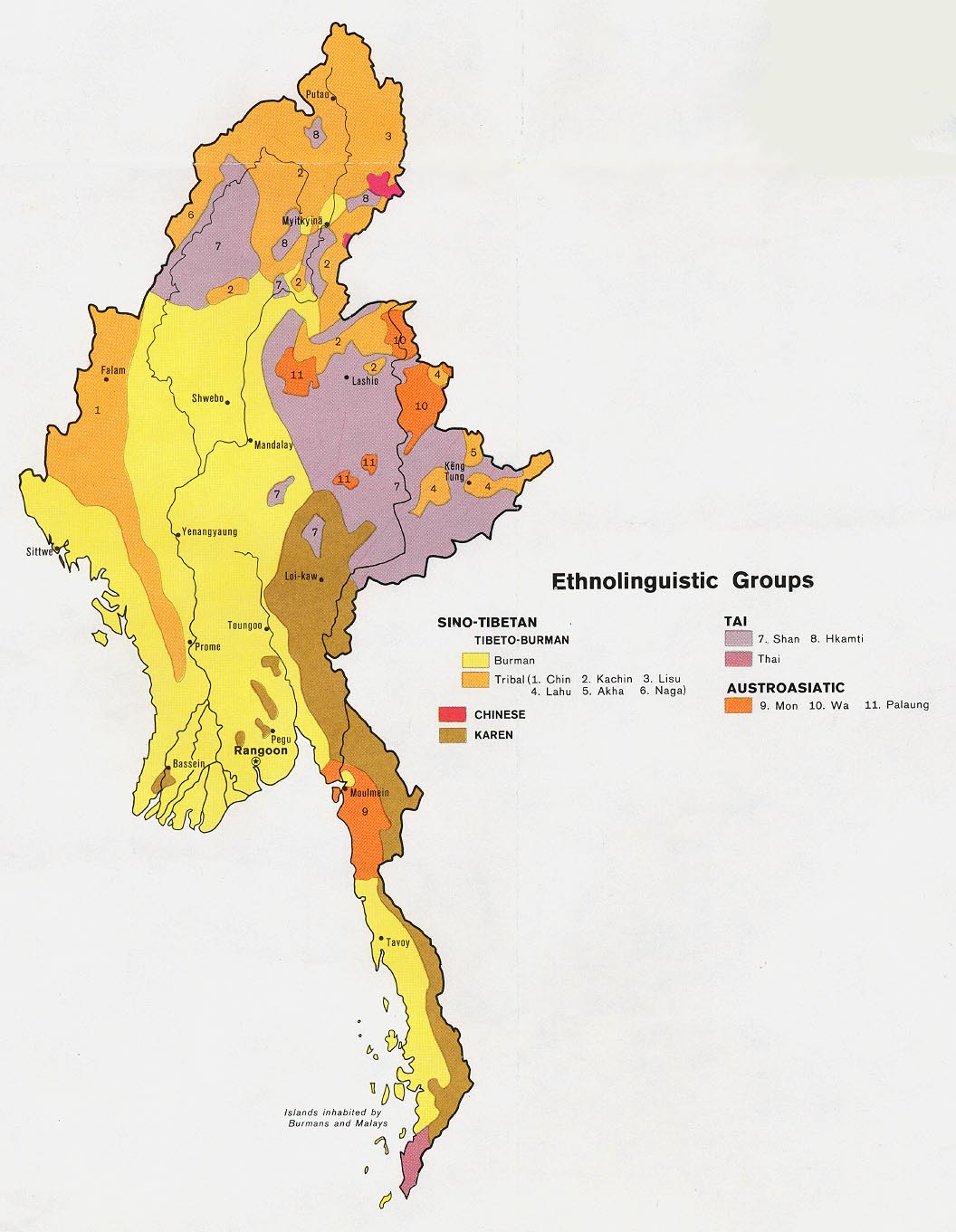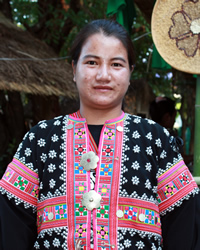

The majority of Lahu Shi people are found in southwest China's Yunnan Province, but thousands of others live in Thailand, Laos, and Myanmar. The Bakeo are the larger of two Lahu Shi groups in Myanmar, distributed throughout three districts of northern Shan State. They share three of their five townships with their Lahu Shi Balan counterparts, but only the Bakeo live in Mong Khet and Monghpyak.
The two Lahu Shi groups are commonly called "Yellow Lahu" in English, but their language and history differ significantly from other Lahu in Asia. Within Myanmar, the Lahu Shi Bakeo and the Lahu Shi Balan differ in terms of their dialects, self-identity, clothing, and histories. In China, where the Lahu Shi are known as the Kucong, the condescending Chinese authorities have long viewed them with disdain, saying, "They have lived in dire poverty for generations. Their lives were primitive, like wild animals, until they were discovered in the virgin jungles by their civilized compatriots when they were on the verge of extinction."
Although there is little variation between the Lahu Shi vernaculars spoken in Myanmar and Thailand, a linguist has noted: "Whereas most Lahu Shi in Myanmar still use the Lahu orthography, the new Lahu Shi script is mainly used outside Myanmar, especially in the U.S. and Thailand." In China, the Lahu Shi language changed during many generations of isolation from other Lahu after "they fled from the banks of the Honghe River to escape the centuries-long plunder of the ruling classes."
Between the 14th and 19th centuries, the Lahu waged wars of resistance against their Han and Tai rulers, but they splintered after a loss in 1799. The defeat "caused the Lahu to flee into the mountains, and from that point on they fragmented as a people. The Black Lahu claim to be pure Lahu and express contempt for the Lahu Shi for having surrendered to the Qing army."
Lahu Shi families in Myanmar today lead simple lives growing crops and fishing and hunting for animals and birds. Their standing in Myanmar society is much better than in China, where in the 1980s it was reported: "All Lahu Shi women have their heads shaven. When they go into town they wear hats, embarrassed that the people will mock them for their baldness."
Approximately 80% of Lahu Shi Bakeo people in Myanmar are Christians, with others still clinging to their animistic traditions, especially elderly villagers who feel obliged to maintain the faith of their ancestors. There are no Buddhists among the Lahu Shi in Myanmar, despite some sources erroneously suggesting they are a majority Buddhist group.
In Myanmar, the Lahu Shi first heard the gospel during an extraordinary movement to Christ among the Lahu and Wa in 1903. By May 1905, American missionary William Young had reportedly "baptized 1,623 converts, from both the Lahu Shi and Lahu." The 1931 census of Burma returned 3,837 "Kwi" (Lahu Shi) people, of whom 2,353 were Christians (61.3%). This reflected a much stronger response to the gospel than the larger Lahu group, who were 13.4% Christian at the time. Although the Lahu Shi New Testament was published in 2015, to avoid disunity, most Lahu Shi Bakeo believers obey the Baptist hierarchy by using the standard Lahu Bible despite difficulties in comprehension due to many words being different.
Pray that traditional fears of spirits and ancestral powers will be replaced by confidence in Jesus Christ as Lord and protector.
Pray for the Holy Spirit to send a powerful revival to Lahu Shi homes and churches.
Pray for Lahu Shi Christians to be filled with the fruit and the power of the Holy Spirit.
Pray for Lahu Shi Christians to excel in love, joy, and peace as they take Christ to others.
Pray for them to have patience and kindness as they minister the gospel.
Scripture Prayers for the Lahu Shi in Myanmar (Burma).
Asia Harvest, Copyrighted 2026 © Used with permission
| Profile Source: Joshua Project |
| Other PDF Profile |