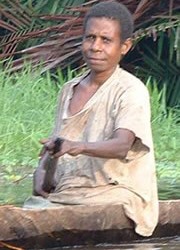

The Langam people live in the East Sepik region of Papua New Guinea, where their identity has been shaped by long-standing ties to the land and to neighboring communities. Their language, known as Pondi, belongs to the Mongol–Langam language family, which is part of the wider Ramu–Keram linguistic grouping found in this region.
As with many communities in the Sepik area, their history is preserved primarily through oral tradition, kinship ties, and patterns of settlement that have developed over generations. Published information remains limited, but their location within the East Sepik places them among the diverse societies that inhabit riverine and forested environments throughout the area.
Many communities in this part of Papua New Guinea rely on subsistence activities adapted to river and forest settings. Daily life commonly includes gardening, fishing, hunting, gathering wild foods, and exchanging goods among related clans. Houses are typically built from local materials such as wood, bamboo, and thatch, reflecting long-standing architectural traditions suited to the climate.
The Langam live in a linguistic environment that includes both their own language, Pondi, and the wider use of Tok Pisin as a regional lingua franca. Communities often maintain close social relationships centered on extended families, shared responsibilities, and cooperation in farming and community events. Access to education, health care, and outside economic opportunities can vary depending on proximity to larger towns.
The Langam people primarily follow traditional ethnic religions. Some within the community identify with Christianity, though traditional beliefs continue to shape their worldview and practices. Because detailed information is limited, it is best to describe their beliefs in broad terms: respect for ancestral customs, a worldview connected to the natural environment, and community practices that reinforce social harmony.
No clear, publicly verifiable information is available regarding Scripture in the Langam language, so no statement is made about translation or availability.
Like many small and remote communities, the Langam face both spiritual and practical needs. Sustaining their language and cultural identity while engaging with broader social and economic changes can be challenging. Access to education, reliable medical care, and opportunities for stable livelihoods is often limited in rural areas.
Spiritually, where Christian faith is present, there is a need for continued growth in biblical understanding and local fellowship. Strengthening families, nurturing wise leaders, and deepening commitment to God's word—where available—are essential for long-term spiritual health.
Pray that the Langam believers grow in their understanding of God's truth and live in unity within their community.
Pray for local leaders to guide with wisdom and for families to pass on what is good and true to the next generation.
Pray for a deepening engagement with scripture wherever it is accessible, and that it will shape their daily lives.
Pray that believers among the Langam will develop a vision to share Christ with neighboring peoples who have little knowledge of the gospel.
Pray for perseverance, hope, and peace in their daily responsibilities, especially where physical challenges are significant.
Scripture Prayers for the Langam in Papua New Guinea.
https://www.ethnologue.com/language/lnm/
https://www.wikiwand.com/en/articles/Mongol%E2%80%93Langam_languages
| Profile Source: Joshua Project |