


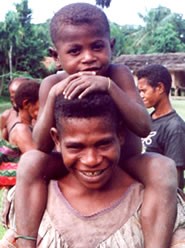

The Yinibu Iteri are a very small people group of around 900?individuals living in Papua New Guinea, particularly in East?Sepik Province (northwest Ambunti?Dreikikir District) and Sandaun Province (Rocky?Peak Mountains). Their identities are tied to long?standing village life and close family connections in rugged terrain where geographic isolation has historically preserved distinct cultures and languages.
They speak the Yawuno Teneyo language, part of the Left?May (Arai) language family, one of several Papuan languages spoken in the remote Rocky?Peak region between rivers and forested hills. This setting has limited outside influence and helped retain community distinctiveness through generations.
The Yinibu Iteri live in small villages within mountainous and forested landscapes. Homes are typically simple structures built from local materials such as wood, palm, and thatch. Daily life centers on subsistence activities, with families gardening for staple crops, gathering plants from the forest, and supplementing diets with fishing and hunting in nearby waterways and bush.
Because roads and modern infrastructure are minimal or absent, travel beyond the local area usually involves footpaths or simple watercraft. Formal services like secondary schooling and healthcare require travel to distant towns, making self?sufficiency and strong community cooperation essential for daily survival. Relationships within and between extended families provide practical support in food production, childcare, and shared tasks.
The Yinibu Iteri are primarily identified with ethnic religions—traditional spiritual systems that include belief in unseen powers associated with nature, ancestors, and spiritual forces affecting daily life. A smaller portion identify as Christian, though this affiliation does not always mean a deep understanding of the gospel.
In their Yawuno Teneyo language, portions of the Bible and the New?Testament have been translated, but the complete Bible is not yet available. Some audio teaching materials exist, yet audio Bible and Jesus Film resources are limited or unavailable. Access to Scripture in their language remains a bridging need for discipleship.
The Yinibu Iteri need a clear and faithful presentation of the gospel that leads to personal faith in Jesus Christ and ongoing spiritual growth grounded in Scripture rather than mixed with traditional beliefs. Where Christian identification exists, deeper biblical teaching and discipleship will help transform belief into life change.
Further completion and distribution of the Bible in the Yawuno Teneyo language is important so that individuals and families can engage directly with God's Word in the language spoken within their communities.
There is also a need for trained local leaders who can teach sound doctrine, disciple others, and help establish strong, biblically grounded churches.
Practically, the remote and rugged setting limits access to healthcare, education, and transport. Improved access to these basic services would support both physical well?being and opportunities for spiritual and community development.
Pray that the Yinibu Iteri people would come to a clear and saving faith in Jesus Christ.
Pray that those who identify as Christians would grow in biblical understanding and not blend Christian teaching with traditional spiritual beliefs.
Pray for the completion and availability of the full Bible in the Yawuno Teneyo language so that the community can engage directly with God's word.
Pray for faithful local church leaders to be raised up who can teach, disciple, and shepherd others.
Pray that traditional spiritual beliefs would be replaced by a firm trust in the truth of Scripture.
Pray for improved access to healthcare, education, and reliable transportation in their remote, mountainous region.
Scripture Prayers for the Iteri, Yinibu in Papua New Guinea.
| Profile Source: Joshua Project |



