


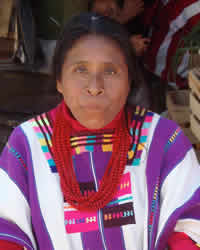

The Tzeltal are a Maya-descended Indigenous people primarily living in the highlands of Chiapas, Mexico, with Oxchuc as one of their major towns. They call themselves Winik atel ("working people" or "people of the word"). Oxchuc itself means "Three Knots" in the Tzeltal language and was an important pre-colonial political-ceremonial center.
Historically, Tzeltal communities participated in indigenous uprisings against Spanish rule (e.g., part of the 1712 Tzeltal Rebellion against colonial authorities).
Cultural identity has always been dynamic — oscillating between Indigenous traditions, influences of colonialism, and resistance movements. Oxchuc experienced sociocultural transformation throughout the 20th century, with collective actions adapting to changing economic and political realities while preserving core cultural elements.
Beyond colonial resistance, the Tzeltal people of Oxchuc have maintained a strong tradition of community governance and collective identity. Their political system has historically blended Indigenous leadership structures with imposed municipal systems from the Spanish and later the Mexican state. In recent decades, Oxchuc has drawn national attention for asserting Indigenous self-governance and the right to choose local authorities according to traditional customs (usos y costumbres). This reflects a long-standing commitment to autonomy, cultural preservation, and communal decision-making that continues to shape their identity today.
Oxchuc has a majority Indigenous Tzeltal population. A significant percentage of residents speak the Tzeltal language, often alongside Spanish. The Tzeltal language has two main dialect groups, with Oxchuc representing the highland variant.
The main economic activity remains small-scale agriculture, especially maize (corn) cultivation, with families often working fragmented, steeper lands that yield limited crops.
Because agriculture alone often doesn't meet family needs, people sometimes seek wage labor outside the community, or engage in artisan craftwork (textiles, huipiles, pottery) for sale.
Literacy and educational completion rates vary, with many adults having completed only primary schooling or less, and some monolingual Tzeltal elders.
Basic infrastructure like paved road access, water systems, and reliable healthcare can be limited, especially in smaller rural communities.
Daily life in Oxchuc often centers around family, agriculture, and community responsibilities. Many households depend on subsistence farming of maize, beans, and squash, while women frequently contribute through weaving traditional textiles that carry symbolic designs tied to community identity. Migration—temporary or long-term—has become more common among younger generations seeking work in urban centers. Despite economic hardship, community life remains tightly knit, with strong kinship networks, shared labor systems, and participation in religious and civic festivals that reinforce social bonds.
Traditionally, Tzeltal spirituality is syncretic — combining Maya cosmology with Christian elements. Many communities blend Catholic practices with ancestral beliefs about nature, the land, and spirits. Ritual life often includes ceremonies tied to agriculture cycles, fiestas patronales (local festivals), and communal celebrations such as the Carnaval in Oxchuc, which combines play, ritual symbolism, and communal identity.
Maya-derived concepts such as the spiritual essence of life, earth, ancestors, and natural forces inform how people relate to the world. Traditional healers (curanderos), spiritual practitioners, and ritual specialists hold roles in community life.
Agriculture alone often doesn't suffice for basic family needs. Families need greater access to improved farming techniques, fair market access, and alternative income streams. Artisanal goods, ecotourism, and community cooperatives need stronger support and market connections. Increased access to quality education (bilingual and intercultural) would improve opportunities.
Better access to healthcare, clean water, and infrastructure is essential to well-being.
Programs that empower local youth with language, arts, and cultural transmission help sustain identity.
The Tzeltal worldview reflects a deep respect for the interconnectedness of humanity, nature, and the spiritual realm. Traditional beliefs include the concept that individuals possess a spiritual essence linked to the natural world, and harmony must be maintained between people, the earth, and unseen forces. Even among Christianized communities—Catholic or Evangelical—elements of indigenous cosmology may continue to influence daily practices, healing rituals, and community ceremonies. Religious festivals, saints' days, and agricultural rites serve not only spiritual purposes but also reinforce cultural continuity and communal unity.
Many Tzeltal communities practice Christianity blended with indigenous belief systems. Evangelical expressions exist alongside Catholic traditions, but genuine spiritual transformation and clarity about Christ could be areas of deeper engagement.
In addition to material poverty, many Tzeltal communities face challenges related to marginalization, limited political representation, and language barriers within broader Mexican society. Economic vulnerability can increase migration pressures and strain family structures. Socially, youth may experience tension between preserving tradition and adapting to modern opportunities. Spiritually, where syncretism is common, there is space for clearer biblical teaching and culturally sensitive discipleship that respects identity while presenting the gospel faithfully.
Pray that essential gospel materials will be translated, understood, distributed, and embraced in the Tzeltal language, allowing the community to hear and respond to Christ in their heart language.
Pray for discernment between cultural syncretism and biblical truth, that the Tzeltal might know Christ fully and put all their faith in him.
Pray for young people's hearts and education, that they might find hope in Christ and remain rooted in their culture without losing opportunity.
Pray for local disciples who make disciples, strengthening local churches that plant more churches.
Pray that soon they will become Christ's ambassadors to other groups that lack the hope that is only in Christ.
Pray that God provides educational opportunities, healthcare improvements, and sustainable livelihoods that demonstrate Christ's compassion in practical ways.
Scripture Prayers for the Tzeltal, Oxchuc in Mexico.
https://en.wikipedia.org/wiki/Tzeltal_people
https://revistas-filologicas.unam.mx/estudios-cultura-maya/index.php/ecm/article/view/900
https://atlas.inpi.gob.mx/tseltales-tzeltales-etnografia/
https://dbs.org/en/research/languages/tzh/
https://mexicanlibrary.org/the-tzeltal-library-mexican-library/
| Profile Source: Joshua Project |



