


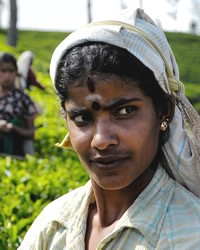

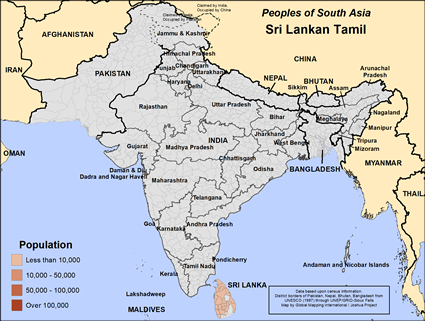
Separated from southern India by the narrow Palk Strait — barely 30 kilometers at its closest point — Sri Lanka's Tamil population has inhabited the island's Northern and Eastern Provinces for at least two millennia. Archaeological and epigraphic evidence points to Tamil-speaking settlements as early as the 2nd century BCE, when merchants and fishermen crossed the strait for trade and pearls. Over centuries, waves of immigration from the Indian subcontinent, including settlers from Kerala as well as Tamil Nadu, shaped a population that, while linguistically and culturally connected to the Indian mainland, evolved in relative isolation and developed its own distinct character.
The Sri Lankan Tamils speak Tamil, one of the world's oldest living languages, belonging to the Dravidian family and carrying a literary tradition spanning more than two thousand years. The variety spoken in Sri Lanka is notably archaic — preserving vocabulary and grammatical forms that have fallen out of use on the mainland — a result of the community's long relative isolation from the great cultural centers of South India. Tamil is used alongside Portuguese, Dutch, and English influences absorbed during successive colonial periods. Today Tamil and Sinhala are both official languages of Sri Lanka.
Modern Sri Lankan Tamil identity was forged in large part through the political upheavals of the post-independence era. After Sri Lanka gained independence in 1948, the 1956 Official Language Act declared Sinhala the sole language of government, shutting Tamils out of civil service positions they had long occupied and inflaming ethnic tensions. Decades of marginalization, anti-Tamil pogroms, and the 1981 burning of the irreplaceable Jaffna Public Library radicalized a generation of Tamil youth, ultimately fueling the 26-year civil war between the Tamil Tigers (LTTE) and the government, which ended with the military defeat of the LTTE in May 2009. The war's final stages were catastrophically violent — UN estimates place the death toll at 40,000 or more in the closing months alone. Hundreds of thousands were displaced; communities in the north and east were shattered. Tamil families are still searching for answers about loved ones who disappeared, and accountability for alleged wartime atrocities remains deeply unresolved.
The heartland of Sri Lankan Tamil life is the Jaffna Peninsula and the surrounding Northern Province, along with the Eastern Province — an arid coastal landscape of palmyrah palms, rice paddies, lagoons, and fishing villages. The north is predominantly agricultural; the east has historically been more diverse in occupation, with significant communities of fishermen, traders, and farmers. Agriculture and fishing remain foundational, though decades of war disrupted land use, and many families continue to rebuild livelihoods scattered by displacement.
Family and kinship sit at the center of Tamil social life. Marriage is typically arranged within caste lines, with the ceremony conducted at a Hindu temple and presided over by a Brahman or non-Brahman priest. The bride's family bears the wedding costs and provides a dowry; the tying of the gold thali necklace around the bride's neck is the central ritual moment. Households are multigenerational, and family networks extend to diaspora members in Canada, the United Kingdom, Australia, France, and beyond — relatives who send remittances and remain emotionally and financially connected to their communities at home.
Education has been a hallmark Tamil value for generations. Beginning in the 19th century, English-language schools built by American missionaries in Jaffna — culminating in Jaffna College — gave Tamil students a competitive edge in colonial civil service examinations and professional fields. This culture of educational aspiration has persisted through the war years and into the present. Tamils in the north face real obstacles — military checkpoints, land occupied by the security forces, ongoing surveillance of activists and journalists — but the determination to see children through school and into professions is undiminished.
Jaffna cooking is distinctive and celebrated — built on the seafood-rich waters of the Bay of Bengal and the products of the palmyrah palm, coconut milk, green gram, moringa, and the generous heat of dried chillies. The food culture carries the memory of the war years within it: a dish called mithivedi (named after a landmine) entered the local lexicon during the conflict, and wartime scarcity shaped food customs in ways that persist in the north. Tamil festivals bring families and communities together throughout the year. Thai Pongal in January — a harvest celebration honoring the sun and the agricultural cycle — is one of the most beloved, marked by the communal cooking of a rice dish in clay pots.
The vast majority of Sri Lankan Tamils are Shaivite Hindus, with a significant Christian minority — primarily Roman Catholics and Methodists — who regard themselves as fully Tamil in culture and identity. Hindu practice among Sri Lankan Tamils is at once philosophical, devotional, and deeply practical. Shiva is the supreme deity, but within Shaiva Siddhanta — the theological tradition dominant among the educated Hindu elite — he is understood as beyond direct approach; his grace operates by drawing the soul toward eventual reunification with him. Popular worship is directed not at Shiva himself but at accessible deities: Murugan (son of Shiva and perhaps the most beloved deity in Sri Lanka), Pillaiyar (Ganesh), and the village goddesses — Mariyamman, Kannakiyamman, and others — who are petitioned for help with illness, examinations, legal problems, infertility, and family conflict. Semi-demonic spirits are also propitiated, believed to demand sacrifice if neglected.
For the educated classes, the formal theology of Saiva Siddhanta has provided intellectual scaffolding and has historically served as a bulwark against Christian conversion; 19th-century reformer Arumuka Navalar restructured Tamil Hinduism along austere textual lines specifically to resist missionary pressure while preserving the community's religious identity. At the village level, however, folk Hinduism predominates — rooted in local shrines, hereditary priests (pucar?s) sometimes chosen through spirit possession, and a thick web of astrological consultation. Astrologers are routinely sought at birth, marriage, illness, and times of crisis, operating from the conviction that a person's fate is "written on one's head" (talai viti) and that the divine must be navigated rather than simply trusted. Trust is placed in the gods of the Hindu pantheon and the guidance of the stars, not in Jesus Christ as the one living Lord and Savior.
Sri Lankan Tamils carry the wounds of a generational war that took tens of thousands of lives, displaced hundreds of thousands, and left a landscape of trauma, broken families, and unanswered questions. Many in the north and east still lack information about family members who forcibly disappeared.
The healthcare system in the Northern Province, severely damaged during the war, is still recovering. Mental health needs are acute and dramatically underserved — post-traumatic stress is widespread, particularly among women who lost husbands and sons and who carried families through years of siege, displacement, and violence. Economic development in the north has lagged far behind the south. Access to quality higher education and professional training, while historically a Tamil strength, has been complicated by decades of disrupted schooling and brain drain through emigration. Clean water, sanitation, and housing reconstruction remain needs in some rural areas.
Pray for the Holy Spirit to work powerfully through Tamil Christians already in Sri Lanka, healing the deep wounds of war and demonstrating that the God of the Bible is the true Comforter, the one who sees and answers every cry that rises from the human heart.
Pray for genuine political reconciliation and justice — that those responsible for wartime atrocities would be held accountable, that disappeared persons' families would receive truthful answers, and that the Sri Lankan Tamils would find lasting peace grounded not in ethnic grievance but in the dignity of bearing God's image.
Pray for Tamils across Sri Lanka to discover in Jesus Christ the one who is not approached through ritual negotiation, but who draws near with grace.
Scripture Prayers for the Sri Lankan Tamil in Sri Lanka.
https://en.wikipedia.org/wiki/Sri_Lankan_Tamils
https://www.everyculture.com/South-Asia/Tamil-of-Sri-Lanka-Religion-and-Expressive-Culture.html
https://www.everyculture.com/South-Asia/Tamil-of-Sri-Lanka-History-and-Cultural-Relations.html
https://factsanddetails.com/south-asia/Srilanka/Ethnic_Groups_and_Minorities_Srilanka/entry-7990.html
https://minorityrights.org/communities/tamils/
https://en.wikipedia.org/wiki/Hinduism_in_Sri_Lanka
| Profile Source: Joshua Project |



.jpg)