




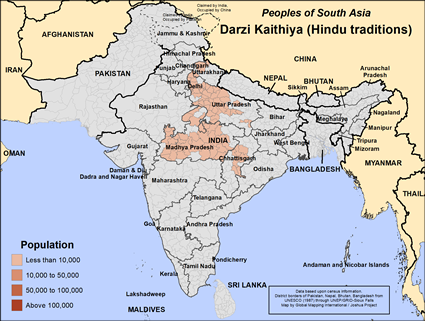
The Darzi originally lived in Central Asia and migrated to India long ago. An Indian legend says that the god Parasurama was pursuing two brothers to destroy them, and they found haven in a Hindu temple. A priest hid them and gave one brother the task of sewing dresses and the other dyeing cloth. The Darzi are said to be the descendants of the first brother and therefore, Darzis are most commonly tailors. Though the majority are Hindu, about one-third have converted to Islam.
Uttar Pradesh and Madhya Pradesh have the largest population of Kaithiya Darzis, but there are sizable populations in several states of India.
Typically, Darzis work in cities and towns practicing their trade of dying, sewing, and making clothing. They sell their clothes in shops and in village markets. Some of them sell ready-made clothes. Darzi women are very adept at embroidery.
They are endogamous, that is, they marry within their group. Darzi young people marry as adults. Monogamy or marriage to one spouse is the general rule while polygamy is accepted. Families often arrange marriages to cement clan ties.
Darzis occupy a middle ground of social status. As tailors they enjoy close relations with other tradesmen. Girls are not encouraged to get an education. Boys strive to obtain a higher education. When they do, they often rise above the status of a tailor.
The Kaithiya Darzi people practice Hinduism, the ancient religion of India. Hinduism is a catch-all term for the local religions of South Asia, so it is very diverse. At the popular level, Hindus worship and serve the gods of the Hindu pantheon. They visit Hindu temples and offer prayers, food, flowers, and incense to their gods in hopes of gaining protection and benefits. They do not have a personal or familial relationship with their gods like Christians or Jews. There are other Hindus who are much more philosophical, especially among the Brahmins.
Almost all Hindus participate in yearly celebrations like Holi, the festival of colors and the start of spring / Diwali, the festival of lights / Navratri, the celebration of autumn / and Rama Navami, Rama's birthday.
Most Darzi are Hindu, the predominant religion of India, but many are Muslim. Many of them are part of the Namdev Sect, which was founded in the 12th or 13th century by a tailor. The Hindus often worship Shiva, Shakti, Kali, Durga, Chandi, and Bhawani. Like other business communities, they are fond of Ganesh, the god who helps one overcome obstacles. Ganesh is especially important to a Darzi who is starting a business since he offers an auspicious start. Darzis often bow to their tools at the beginning of the workday to ensure a profitable day. Like other Hindus they make pilgrimages to holy Hindu temples and shrines. They celebrate the major Hindu holidays of Holi, the spring and color festival, Dwali, the festival of lights and Janamashtami, Krishna's birthday.
Pray for workers to go to the Kaithiya Darzi people, and for their hearts to be ready to receive their Savior.
Pray for networks of believing families and fellowships that will throw the doors open for others to follow Jesus.
Pray that the church can love the Kaithiya Darzi people like God does, enough to offer micro loans and other development programs.
Pray for the Lord to bless the families among the Darzi communities with his presence and mercy.
Pray for believers among this people group to disciple others who will disciple still others.
Pray for Bible believing fellowships and churches among the Hindu and Muslim Darzi people.
Scripture Prayers for the Darzi Kaithiya (Hindu traditions) in India.
https://peoplegroupsindia.com/profiles/darzi/
https://en.wikipedia.org/wiki/Darzi
https://ipfs.io/ipfs/QmXoypizjW3WknFiJnKLwHCnL72vedxjQkDDP1mXWo6uco/wiki/Darzi.html
| Profile Source: Joshua Project |




