



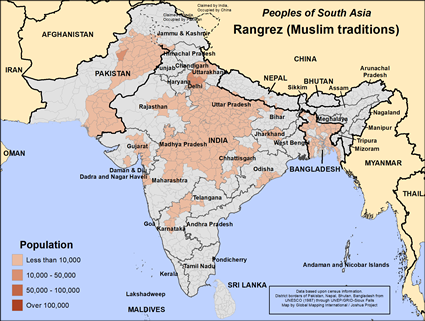
The Rangrez are a Muslim occupational community found primarily in northern and western India, especially in Uttar Pradesh, Rajasthan, Delhi, Madhya Pradesh, Gujarat, and neighboring regions. The name "Rangrez" comes from Persian and refers to dyers or those who color cloth, reflecting the community's historic association with textile dyeing and fabric coloring. Most Rangrez families speak Hindi, Urdu, Rajasthani, or related regional languages depending on where they live. Their identity has long been connected to India's textile and garment trades, especially before the rise of large industrial manufacturing.
Historically, the Rangrez worked with cotton, silk, and other fabrics, using traditional dyeing methods to produce brightly colored garments and textiles for local markets. In many towns they lived near weaving and cloth-trading districts where artisan communities specialized in different stages of textile production. Some traditions connect portions of the Rangrez community with conversions from Hindu artisan castes to Islam over earlier centuries, while others emphasize Persian and Central Asian influence through Islamic trade culture. Over time, modernization and factory production reduced the importance of traditional hand-dyeing work, leading many Rangrez families to diversify into tailoring, shopkeeping, transportation, labor work, and urban employment.
Despite economic changes, family identity, artisan heritage, and Muslim cultural traditions remain strong within many Rangrez communities. In some places, older generations still preserve traditional textile skills and local dyeing knowledge passed down through families.
The daily lives of the Rangrez vary between urban neighborhoods, market towns, and rural settlements. Some families remain involved in textile-related occupations such as tailoring, cloth sales, embroidery, garment work, or fabric processing, while others now work in construction, transportation, small business, factory labor, or government employment. Economic conditions differ widely between households, with some artisan families struggling because of competition from industrial textile production and changing markets.
Family relationships are highly valued, and extended families commonly remain closely connected. Marriages are generally arranged within accepted community and religious boundaries. Meals often include rice, flatbreads, lentils, vegetables, tea, and meat dishes common within North Indian Muslim culture. Religious festivals such as Eid al-Fitr and Eid al-Adha are important community celebrations that reinforce family and social ties.
Educational opportunities have improved for some younger generations, especially in urban areas, though poorer Rangrez neighborhoods may still struggle with overcrowding, unemployment, and limited economic mobility. Women in traditional households may remain primarily responsible for home and family duties, though social patterns continue to change in many cities.
The Rangrez primarily follow Sunni Islam and participate in mosque worship, Ramadan fasting, Islamic festivals, prayers, and religious instruction shaped by Muslim tradition. Religious identity is often closely tied to family heritage, community belonging, and everyday cultural practice. Many Rangrez communities are influenced by South Asian Sunni traditions that include respect for local religious teachers, Islamic scholars, and in some areas, devotion connected to Sufi shrines and saints.
Alongside formal Islamic observance, folk religious practices may also exist in some communities. Charms, blessings, visits to shrines, fear of the evil eye, and belief in spiritual forces such as jinn can influence daily life and religious thinking. Religious instruction often emphasizes obedience to Islamic tradition, family honor, and community identity.
Although the Rangrez know of Isa (Jesus) through Islamic teaching, many have never encountered the biblical message that Jesus Christ is the crucified and risen Son of God who alone provides forgiveness of sins and reconciliation with God. In many cases, exposure to Christianity is limited, and misunderstandings about biblical faith remain common. Long-term relationship-based witness is especially important among Muslim artisan communities.
The Rangrez need continued access to education, healthcare, vocational training, and stable employment opportunities, especially for poorer artisan families affected by economic change in the textile industry. Urban overcrowding, inconsistent work, and limited upward mobility continue to affect many lower-income communities.
Spiritually, the Rangrez need opportunities to encounter the gospel clearly in Urdu, Hindi, and related regional languages. Many have never personally read the Bible or heard a biblical explanation of grace, repentance, forgiveness, and eternal life through Jesus Christ. There is a need for mature believers who can patiently build trust, answer questions respectfully, and demonstrate Christlike compassion within Muslim communities. Scripture access, discipleship, and culturally sensitive outreach are especially important where social pressure or misunderstanding may discourage open interest in the gospel.
Pray that the Rangrez people will hear and understand the gospel clearly in their own languages and come to know Jesus Christ as Savior and Lord.
Pray that God will raise up wise and compassionate believers who can build trusting relationships with Rangrez families and faithfully share biblical truth.
Pray that Rangrez communities facing economic hardship, unstable employment, and educational barriers will experience practical help and lasting hope.
Pray that the Rangrez people will be adopted through the People Group Adoption program so that ongoing prayer, evangelism, discipleship, and church planting efforts will continue among them.
Scripture Prayers for the Rangrez (Muslim traditions) in India.
https://en.wikipedia.org/wiki/Rangrez
https://www.britannica.com/topic/dyeing
https://peoplegroups.org/explore/GroupDetails.aspx?peid=41943
https://en.wikipedia.org/wiki/Textile_industry_in_India
| Profile Source: Joshua Project |




