


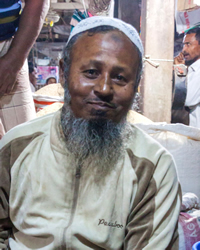

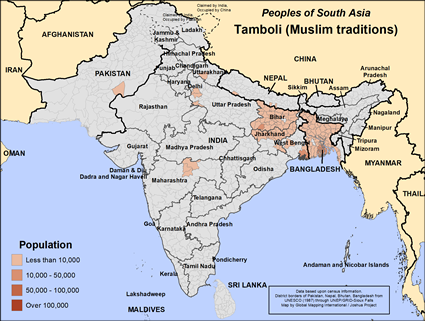
The Tamboli are a Muslim community found in Bangladesh and neighboring parts of South Asia. Their name is derived from a Sanskrit word associated with betel leaves, reflecting the community's historic connection to the cultivation, preparation, packaging, and sale of betel leaves and areca nuts. For generations, the betel trade provided an important source of income and helped establish the community's identity. Although many families continue to participate in this industry, others have expanded into business, retail trade, and a variety of modern occupations. The primary language of the Tamboli in Bangladesh is Bengali, and they share many cultural characteristics with the broader Bengali Muslim population.
Historically, occupational communities such as the Tamboli played an important role in local markets by supplying products used in daily social and cultural life. Chewing betel leaf and areca nut remains a common custom throughout Bangladesh and South Asia, particularly during social gatherings, celebrations, and hospitality events. As economic opportunities have changed, many Tamboli families have diversified their livelihoods while maintaining their distinct community identity.
The Tamboli traditionally earned their livelihood through the betel leaf and areca nut trade. Entire families often participated in various stages of cultivation, preparation, packaging, and sales. In modern times, many have entered small business ownership, retail trade, hardware sales, agriculture, transportation, and other occupations. Some families have achieved economic stability through entrepreneurship and commerce.
They highly value family relationships, and extended family networks frequently provide support during marriages, financial difficulties, and major life events. Community ties remain strong, particularly among families involved in traditional occupations. Daily life generally revolves around work, family responsibilities, religious observance, and participation in community activities.
Food habits reflect the broader culture of Bangladesh, with rice serving as the staple food accompanied by fish, vegetables, lentils, and locally prepared dishes. Hospitality is highly regarded, and social gatherings often include the sharing of food and traditional refreshments. Education is increasingly valued as younger generations seek opportunities in business, professional careers, and government employment.
The Tamboli are Sunni Muslims. Their religious life centers on belief in Allah, reverence for Muhammad as God's prophet, observance of daily prayers, fasting during Ramadan, charitable giving, and participation in the wider Muslim community. Islamic festivals such as Eid al-Fitr and Eid al-Adha are important occasions for family and community gatherings.
Like many Muslim communities in Bangladesh, their faith is shaped by both Islamic teachings and the religious environment of Bengali society. In some areas, folk customs, reverence for religious figures, or local traditions may exist alongside formal Islamic practice. Such influences are common in parts of Bangladesh where cultural traditions and religious beliefs have interacted for centuries.
Most Tamboli have had little opportunity to hear a clear presentation of the biblical message that salvation comes through the death and resurrection of Jesus Christ rather than through religious works or personal efforts. Access to evangelical Christian witness remains limited among many members of the community.
The Tamboli need greater access to the gospel through trusted relationships, Scripture in Bengali, and faithful Christian witnesses who can communicate biblical truth with humility and respect. Although Christian resources exist in Bengali, many Tamboli have never personally encountered a committed follower of Jesus Christ who can clearly explain the gospel.
Practical needs vary by region and economic circumstances. Some families face challenges related to education, healthcare access, employment opportunities, and economic advancement. Those still dependent on traditional occupations may also face difficulties adapting to changing markets and consumer habits. Community development initiatives, educational opportunities, and compassionate service can help strengthen families and open doors for meaningful relationships.
Pray that the Tamboli would have many opportunities to hear a clear presentation of the gospel and understand the saving work of Jesus Christ.
Pray that God would raise up faithful workers who will build genuine relationships among the Tamboli and communicate biblical truth with wisdom, compassion, and perseverance.
Pray that the Tamboli would be adopted through the People Group Adoption program so that churches and believers will commit to ongoing prayer, outreach, and future gospel engagement among them.
Pray that any Bengali-speaking believers who have contact with the Tamboli would be strengthened in their faith and equipped to share the gospel with their own community and neighboring peoples.
Scripture Prayers for the Tamboli (Muslim traditions) in Bangladesh.
https://peoplegroups.org/people_groups/pg048440/
https://www.people-groups.asiaharvest.org/Nepal/TamboliMuslim.pdf
https://berkleycenter.georgetown.edu/publications/religious-landscape-of-bangladesh-a-primer
https://www.banglajol.info/index.php/JASBH/article/view/78646
| Profile Source: Joshua Project |



