



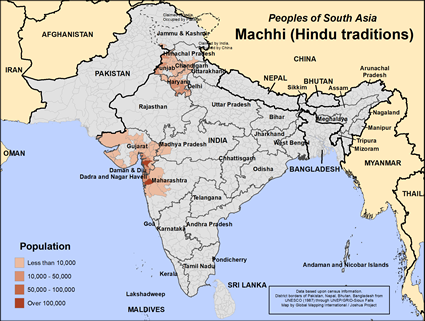
The Machhi are a Hindu fishing community found in several parts of India, especially in western and northern regions. Their name is derived from a word meaning "fish," reflecting their long-standing connection to fishing, rivers, lakes, and coastal waters. Traditionally, the Machhi earned their livelihood through fishing, fish trading, boat work, and related occupations connected to waterways. In different regions they may also be known by local subgroups or related community names.
For generations, Machhi communities have lived close to rivers, reservoirs, and coastal areas where fishing shaped both economic life and social identity. Some communities continue traditional fishing practices using small boats and handmade nets, while others have moved into wage labor, farming, transportation, and urban employment due to changing environmental and economic conditions. Their culture has been shaped by both Hindu traditions and the demanding realities of life connected to water and seasonal fishing patterns.
Fishing remains central to the identity of many Machhi families, though modern pressures have forced some into other forms of labor. Men often work long hours fishing in rivers, lakes, or coastal waters, while women may help repair nets, sell fish in local markets, care for children, and manage household responsibilities. In poorer communities, unstable fishing seasons and declining fish populations can create serious financial hardship.
Rice, fish, lentils, and locally available vegetables are common foods. Community and family ties are usually strong, with marriages commonly arranged within the community. In some regions, child marriage has historically been practiced, though social changes and education have begun to affect these traditions. Many Machhi families value education for their children, but economic pressures often lead young people to leave school early in order to help support the household.
Fishing communities across India often develop close-knit social systems because of the risks and cooperation required in fishing work. Village councils or caste councils may help settle disputes and maintain community traditions. Seasonal storms, environmental changes, debt, and uncertain income can place constant pressure on Machhi households.
The Machhi primarily follow Hinduism mixed with local folk religious practices. Worship commonly includes devotion to Hindu gods and goddesses along with reverence for regional spirits, ancestors, and local deities believed to influence safety, weather, health, and fishing success. Rituals and offerings are often performed before fishing trips or during important festivals in hopes of receiving protection and prosperity.
Like many fishing communities in India, spiritual beliefs may include fear of evil spirits, curses, or unseen supernatural forces connected to the sea and natural world. Religious rituals can become deeply connected to daily survival and livelihood. Belief in karma, rebirth, and ritual purity also shapes their worldview. Though some Machhi may have heard of Christianity, many still have little understanding of the biblical message of salvation by grace through Jesus Christ alone.
Many Machhi communities need greater economic stability, improved education, healthcare access, and support for sustainable livelihoods. Fishing families are often vulnerable to debt, environmental decline, poor sanitation, and fluctuating incomes caused by changing fish supplies and modern industrial pressures. Some communities also experience social marginalization connected to caste identity and limited educational opportunity.
Spiritually, the Machhi need faithful gospel witness presented in their own languages and cultural settings. Many have never heard a clear biblical explanation of sin, repentance, grace, and reconciliation with God through Jesus Christ. Strong local churches, discipleship, Scripture access, and long-term relationship-based ministry are needed among Machhi communities so the gospel can take root across families and villages.
Pray that the Machhi people will hear and understand the gospel clearly in their own language and place their faith in Jesus Christ.
Pray that God will raise up faithful believers and church leaders who can disciple Machhi families and establish biblically grounded churches among them.
Pray that Machhi communities struggling with poverty, unstable fishing livelihoods, and limited educational opportunities will experience practical help and hope.
Pray that the Machhi people will be adopted through the People Group Adoption program so that ongoing prayer, evangelism, discipleship, and church planting efforts will continue among them.
Scripture Prayers for the Machhi (Hindu traditions) in India.
https://en.wikipedia.org/wiki/Fishing_communities_in_Maharashtra
https://en.wikipedia.org/wiki/Dhimar
https://www.fao.org/4/ae496e/ae496e03.pdf
https://serialsjournals.com/abstract/23555_12.pdf
https://www.ayurvedajournals.com/article/fishermen-rituals-in-kerala-01
| Profile Source: Joshua Project |




