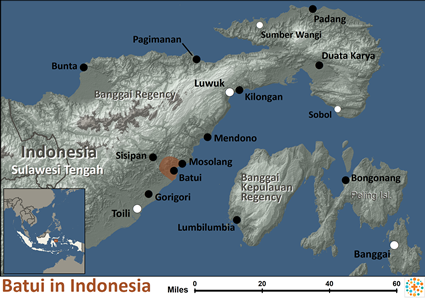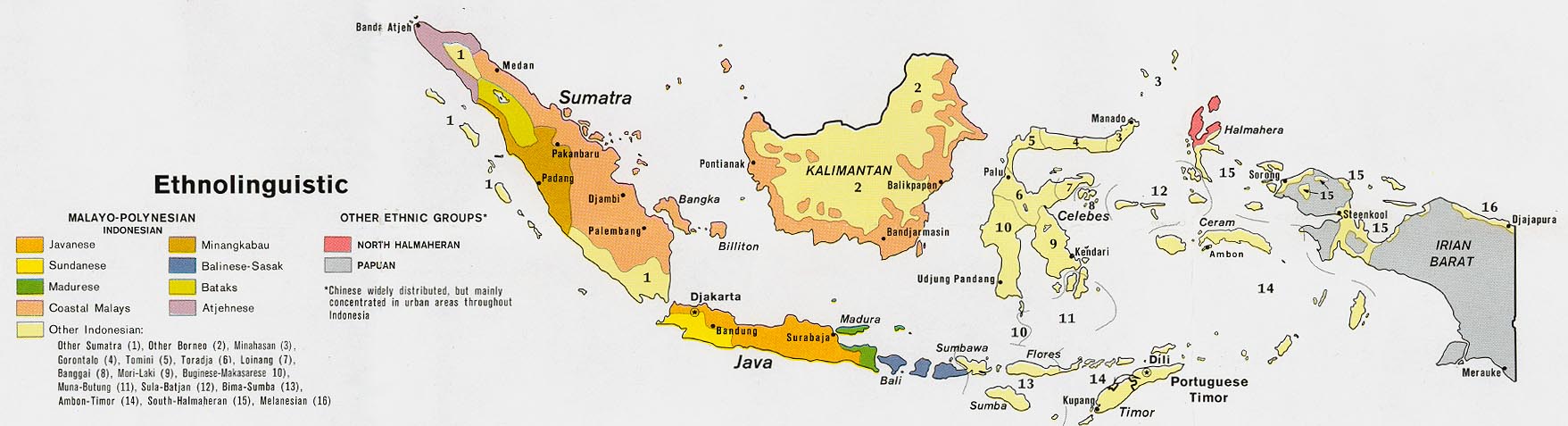

The Batui are a small ethnic group living primarily along the coastal areas of Banggai Regency in Central Sulawesi, Indonesia. They speak the Batui language, an Austronesian language related to other languages of eastern Sulawesi. Over time, the growing use of Bahasa Indonesia has placed pressure on the Batui language, and younger generations are increasingly shifting away from their traditional speech.
The Batui homeland includes areas surrounding the Bakiriang forest, a region that has historically provided natural resources and shaped the community's way of life. In the past, local rulers recognized the importance of preserving this forested region, but more recent economic development and plantation expansion have altered parts of the environment. These changes have affected both traditional livelihoods and cultural continuity among the Batui people.
Like many smaller ethnic groups in Indonesia, the Batui have experienced increasing outside influence through modernization, education, migration, and economic change. Their relatively small population and declining language use place their cultural identity in a vulnerable position. Christian witness among the Batui has remained limited, and many have had little opportunity to hear the gospel clearly in their own language and cultural setting.
Traditionally, the Batui have depended heavily on the surrounding land and forests for their livelihood. Farming, gathering forest products, fishing, and small-scale local trade have shaped daily life for many families. Coastal living and proximity to forested regions have influenced their food, customs, and social patterns for generations.
Village and family relationships remain important within Batui society. Community identity is closely tied to shared traditions and local customs passed down through oral teaching. Daily life often centers around family cooperation, seasonal labor, and participation in village activities. Hospitality and communal responsibility are valued traits throughout many Indonesian rural societies, including among the Batui.
Education and modernization are gradually reshaping Batui life. Schools emphasize Bahasa Indonesia, contributing to the decline of the Batui language among younger people. Economic pressures and changing land use have also encouraged some Batui to seek employment outside traditional village settings. As outside influences increase, many aspects of older Batui culture face gradual erosion.
The Batui primarily follow Islam blended with folk religious practices and animistic beliefs. While Islamic identity is important within the community, many Batui also continue to hold traditional beliefs concerning spirits, unseen powers, and supernatural protection.
Traditional spiritual practices often focus on seeking protection, blessing, healing, or safety from spiritual harm. Allah may be viewed as distant from everyday life, leading many people to rely on rituals and spirit-related practices for practical concerns and daily security. This mixture of Islam and animism creates a strongly syncretistic religious environment.
Because religion is closely connected to family and community identity, following Christ may bring social tension or misunderstanding. Very few Batui believers are known, and access to biblical teaching and discipleship resources remains extremely limited.
The Batui need clear access to the gospel in ways that communicate effectively within their own cultural and linguistic setting. Many have little understanding of biblical Christianity or the message of salvation through Jesus Christ alone. Long-term discipleship and faithful Christian presence are greatly needed among them.
The Batui also face practical challenges connected to language loss, economic transition, and environmental change. As traditional ways of life become less sustainable, many communities need educational opportunity, vocational development, and support adapting to changing economic conditions.
There is a need for Scripture resources, audio Bible materials, and mature Christian workers willing to build relationships among the Batui with humility and perseverance. Compassionate ministry that addresses both spiritual and practical concerns could open meaningful doors for long-term gospel witness.
Pray that the Batui people would hear the gospel clearly and come to place their faith in Jesus Christ rather than in spiritual rituals or fear of unseen powers.
Pray that God would send faithful Christian workers to serve among the Batui with wisdom, compassion, and endurance.
Pray that the Batui would be adopted through the People Group Adoption program so they receive sustained prayer, ongoing gospel engagement, and future discipleship efforts.
Pray that any existing believers in the surrounding regions of Sulawesi would grow bold in sharing the truth of Christ with the Batui and neighboring peoples.
Scripture Prayers for the Batui in Indonesia.
https://en.wikipedia.org/wiki/Batui_language
https://peoplegroups.org/
https://www.ethnologue.com/language/zbt/
| Profile Source: Joshua Project |