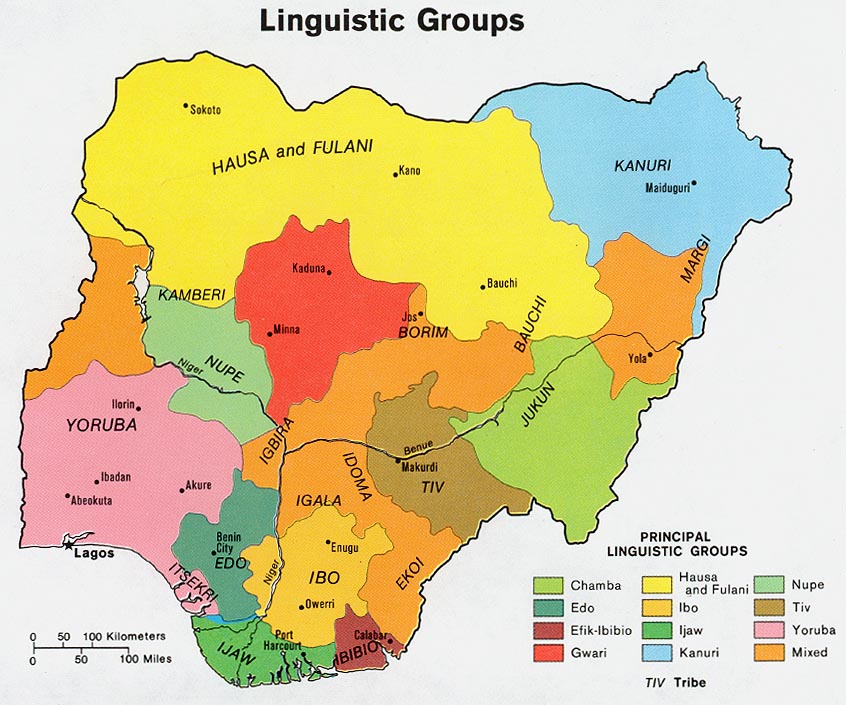
The Bambuka—also known as the Kyak—are an indigenous people of northeastern Nigeria, settled primarily in the Karim Lamido Local Government Area of Taraba State, with smaller communities in Gombe State's Balanga LGA and a sliver of Adamawa State's Lamurda LGA. They inhabit the rugged terrain of the Muri Mountains, a roughly 100-kilometer-long chain straddling the borders of Bauchi, Taraba, and Adamawa states. This mountain landscape has long shaped their way of life, offering both protection and challenge. Two distinct oral traditions explain Bambuka origins. One holds that the people migrated westward from the east, journeying through Suahkwei from a place called Suahsepp. The other is more dramatic: Bipbahgum Mbandana, said to be the father of the Bambuka, descended from the sky onto the rocky hills above a place called JAH Jingkeb yah tang ahh, and his footprint along with his staff—the kapb beinna—are said to remain visible in the rocks to this day. Whether regarded as history or sacred memory, these stories anchor a strong sense of identity and distinctiveness among the Bambuka. They speak Kyak, a Niger-Congo language of the Adamawa branch, which remains the primary tongue of the community. Throughout their history, the Bambuka have placed a high premium on freedom from outside domination. This ethos of independence has defined their relationships with neighboring groups and outside forces alike.
The Bambuka are subsistence farmers, drawing their sustenance directly from the land around them. Sorghum, groundnuts, and rice are among their principal crops, well-suited to the Muri Mountains environment. Like most communities in Taraba State, they may also keep small livestock to supplement household needs.
Family life is organized around polygamous households, a pattern that reflects both social structure and economic strategy in the region. Extended family ties run deep, and community obligations shape the rhythms of daily life. Men take the lead in clearing and preparing fields, while women play a central role in the labor of cultivation and in managing the domestic sphere.
Celebrations and communal gatherings mark the agricultural calendar and significant life events such as marriages and births. These occasions carry social weight, reinforcing kinship bonds and shared identity. The Bambuka's long-standing relationships with neighboring ethnic groups in the Muri Mountains—though historically marked by conflict—have evolved over time into what researchers have described as playful joking relationships, a form of social diplomacy common across West Africa.
Ethnic religion remains the primary belief system among the Bambuka. Many in the community place active trust in spiritual forces tied to the natural world, ancestral powers, and sacred objects. These are not simply customs passed down through generations—they represent a living faith in which unseen spiritual realities are seen as shaping daily life, community wellbeing, and the fate of individuals.
Alongside this, a significant portion of the Bambuka have embraced Islam. Christianity has also gained a foothold, and traditional religious beliefs are gradually giving way in some quarters as Christian influence grows. A small but present Christian community exists within the group, though evangelical believers remain very few. The Word of God is available in audio form through Global Recordings Network in the Kyak language, and Bible translation work has reportedly begun. Still, the community as a whole has not yet been substantially reached with the gospel. Salvation and true reconciliation with God are found only through Jesus Christ, and the Bambuka—like all peoples—need to hear and respond to that good news.
The Bambuka face a shortage of trained religious teachers, ministers, and Christian literature in their own language. The Kyak Bible translation is still in progress, leaving believers without the full counsel of Scripture in their mother tongue. Christians living in Nigeria also face significant pressure, as Nigeria ranks among the countries with the highest levels of persecution against believers. The Bambuka need intercessors, workers, and resources to support both physical flourishing and church growth.
Pray that Kyak Bible translation will be completed and that the Bambuka will encounter God through his word in their own language.
Pray for the training and sending of qualified pastors, teachers, and evangelists to serve the Bambuka community.
Pray that Bambuka Christians will boldly share their faith with neighbors—including those from Muslim and ethnic religious backgrounds.
Pray for protection and peace for believers in Nigeria, where Christians face serious persecution, and ask God to cause the church among the Bambuka to take root and multiply.
Scripture Prayers for the Bambuka in Nigeria.
https://www.ethnologue.com/language/bka
https://www.academia.edu/105891928/The_Bambuka_Kyak_A_collection_of_ethnographic_and_historical_data_from_fieldwork_1989_1993
https://globalrecordings.net/en/language/bka
https://en.wikipedia.org/wiki/Taraba_State
https://www.opendoors.org/en-US/persecution/countries/nigeria
| Profile Source: Joshua Project |