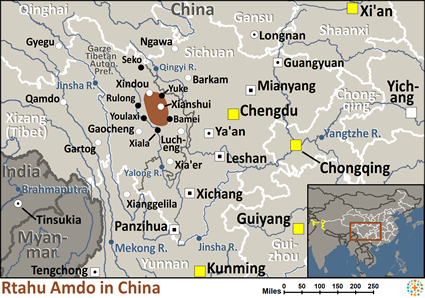

Rtahu Amdo in China

The Rtahu Amdo have only been reported in China
Population
Main Language
Dialect
Largest Religion
Buddhism (Tibetan)
Christian
Evangelical
Progress
Progress Gauge

Introduction / History

The Rtahu Amdo are a Tibetan people group living primarily in Dawu and Luhuo counties of the Garze Tibetan Autonomous Prefecture in western Sichuan Province, China. They speak a form of Amdo Tibetan known as Rtahu, which linguists describe as transitional between the Amdo and Khampa Tibetan language varieties. Although officially classified within the larger Tibetan nationality, the Rtahu maintain their own regional identity and cultural traditions.


The Rtahu inhabit rugged grasslands and river valleys along the Xianshui River. Their homeland lies within the historical Tibetan region of Amdo, one of the major traditional regions of Tibet. Tibetan history, religion, and identity are deeply connected among the Rtahu people. Many continue to preserve strong loyalty to Tibetan cultural heritage, monasteries, and religious leadership.

An eighth-century prophecy attributed to the Tibetan religious teacher Padmasambhava remains well known among Tibetan peoples, including the Rtahu. The prophecy spoke of Tibetans eventually being scattered throughout the world while Buddhist teaching would spread abroad. Historical upheavals during the twentieth century, including Chinese Communist control over Tibetan regions and the flight of the Dalai Lama into exile, deeply affected Tibetan communities throughout Amdo.

Despite outside political and cultural pressures, the Rtahu Amdo have retained strong religious and ethnic identity. Christian witness among them has remained extremely limited, and very few have ever heard a clear explanation of the gospel.


What Are Their Lives Like?

Most Rtahu Amdo communities live in high-altitude pastoral regions where daily life revolves around herding animals and surviving the harsh mountain climate. Yaks, sheep, goats, and horses are central to their economy and culture. Families often live in close-knit communities where clan relationships, hospitality, and loyalty to local traditions remain highly valued.

The environment strongly shapes their way of life. Long winters, isolated settlements, and rugged terrain make travel and communication difficult in some areas. Traditional Tibetan foods such as yak butter tea, roasted barley flour, meat, and dairy products are common staples. Nomadic and semi-nomadic patterns still influence many households, although modernization and government policies have altered aspects of traditional life.

Religion is woven into daily existence. Prayer flags, monasteries, shrines, ritual objects, and Buddhist ceremonies are visible throughout Tibetan regions. Monks and lamas are highly respected, and families may participate in pilgrimages, festivals, and ritual observances throughout the year. Oral storytelling, music, and religious festivals continue to preserve Rtahu identity and history.

Many younger Tibetans face growing tension between preserving traditional culture and adapting to rapid economic and social changes in modern China. Migration for work, language pressures, and outside influence have affected village life and family structure in many Tibetan communities.


What Are Their Beliefs?

The Rtahu Amdo are devoted followers of Tibetan Buddhism mixed with traditional Tibetan folk religion and spirit practices. Their beliefs include reverence for Buddhist teachers, monasteries, sacred texts, and spiritual rituals intended to gain merit, protection, guidance, or favorable rebirth.

Like many Tibetan groups, the Rtahu also incorporate animistic and shamanistic elements into their religious life. Spirits, demons, territorial deities, and unseen powers are often feared or appeased through rituals, offerings, chants, and ceremonial practices. Monks and religious specialists may be consulted for protection, healing, blessings, or spiritual guidance.

Their religious identity is deeply connected to Tibetan ethnic identity, making conversion to Christianity socially costly. Those who openly follow Christ may face rejection from family or community members. Very few known believers live among the Rtahu Amdo, and access to biblical teaching remains extremely limited.


What Are Their Needs?

The Rtahu Amdo need sustained access to the gospel in ways that communicate clearly within their language and cultural framework. Many have never personally encountered a follower of Jesus Christ or heard Scripture explained in a meaningful way. Fear of spiritual powers and strong loyalty to Tibetan Buddhism create significant barriers to gospel witness.

Practical needs also exist in many rural Tibetan communities, including healthcare access, educational opportunity, infrastructure development, and support for families living in isolated mountain areas. Geographic remoteness continues to limit outside engagement in some regions.

There is a need for faithful long-term Christian workers who are willing to learn the language, understand Tibetan culture, and patiently build relationships. Audio Scripture resources, Bible translation efforts, compassionate community assistance, and culturally informed discipleship materials could help open doors for future ministry.


Prayer Items

Pray that the Rtahu Amdo would come to understand that forgiveness and eternal life are found only through Jesus Christ and not through rituals, merit, or reincarnation.
Pray that God would raise up courageous Christian workers who are willing to serve among the Tibetan peoples of western China with wisdom, humility, and perseverance.
Pray that the Rtahu Amdo would be adopted through the People Group Adoption program so that they receive ongoing prayer, long-term gospel engagement, and faithful discipleship efforts.
Pray that any Tibetan believers in nearby regions would grow strong in biblical faith and boldly share the gospel with the Rtahu Amdo and surrounding Tibetan communities.


Scripture Prayers for the Amdo, Rtahu in China.


References

https://people-groups.asiaharvest.org/China/chinaPeoples/A/AmdoRtahu-OC.pdf
https://www.people-groups.asiaharvest.org/China/chinaPeoples/A/AmdoRtahu-PBW.pdf
https://globalrecordings.net/en/language/6957
https://en.wikipedia.org/wiki/Amdo
https://en.wikipedia.org/wiki/Amdo_Tibetan


Profile Source:   Joshua Project  

People Name General Amdo, Rtahu
People Name in Country Amdo, Rtahu
Natural Name Rtahu Amdo
Pronunciation TA-hoo AHM-doe
Alternate Names Amdo; Rtahu; Tahu
Population this Country 100,000
Population all Countries 100,000
Total Countries 1
Indigenous Yes
Progress Scale Progress Gauge
Unreached Yes
Frontier Yes
Unengaged Yes
Pioneer Workers Needed 2
PeopleID3 18395
ROP3 Code 113988
Country China
Region Asia, Northeast
Continent Asia
10/40 Window Yes
National Bible Society Website
Persecution Rank 17  (Open Doors top 50 rank, 1 = highest persecution ranking)
Location in Country Approximately 70,000 Tibetans in northwest Sichuan Province speak the Rtahu Amdo language. They live primarily on grasslands along the banks of the turbulent Xianshui River in Dawu and Luhuo counties. These two counties form part of the huge Garze Tibetan Autonomous Prefecture which is home primarily to the fierce Khampa Tibetans.   Source:  Operation China, 2000
Country China
Region Asia, Northeast
Continent Asia
10/40 Window Yes
National Bible Society Website
Persecution Rank 17  (Open Doors top 50 rank, 1 = highest persecution ranking)
Location in Country Approximately 70,000 Tibetans in northwest Sichuan Province speak the Rtahu Amdo language. They live primarily on grasslands along the banks of the turbulent Xianshui River in Dawu and Luhuo counties. These two counties form part of the huge Garze Tibetan Autonomous Prefecture which is home primarily to the fierce Khampa Tibetans..   Source:  Operation China, 2000
Map of Amdo, Rtahu in China
Ethnolinguistic map or other map

Primary Religion: Buddhism (Tibetan)
Major Religion Estimated Percent
Buddhism
100.00 %
Christianity
0.00 %
Ethnic Religions
0.00 %
Hinduism
0.00 %
Islam
0.00 %
Judaism
0.00 %
Non-Religious
0.00 %
Other / Small
0.00 %
Sikhism
0.00 %
Unknown
0.00 %
Primary Language Tibetan, Amdo (100,000 speakers)
Ethnologue Language Code adx
Ethnologue Language Familly Sino-Tibetan
Glottolog Language Family Sino-Tibetan
Primary Dialect Rtahu
Dialect Code 6957   Global Recordings Listing
Written / Published Yes   (ScriptSource Listing)
Total Languages 1
Primary Language Tibetan, Amdo (100,000 speakers)
Ethnologue Language Code adx
Ethnologue Language Familly Sino-Tibetan
Glottolog Language Family Sino-Tibetan
Primary Dialect Rtahu
Dialect Code 6957   Global Recordings Listing
Written / Published Yes   (ScriptSource Listing)
Total Languages 1
Photo Source (Representative photo)
Copyrighted © 2026  Marcin Szymczak - Shutterstock  All rights reserved.  Used with permission
Map Source Location: Operation China. Imagery: GMI, ESRI, Maxar, Earthstar Geographics, ESRI User Community. Design: Joshua Project.  
Profile Source Joshua Project 
Data Sources Data is compiled from various sources. Learn more.