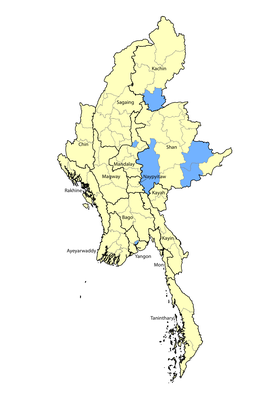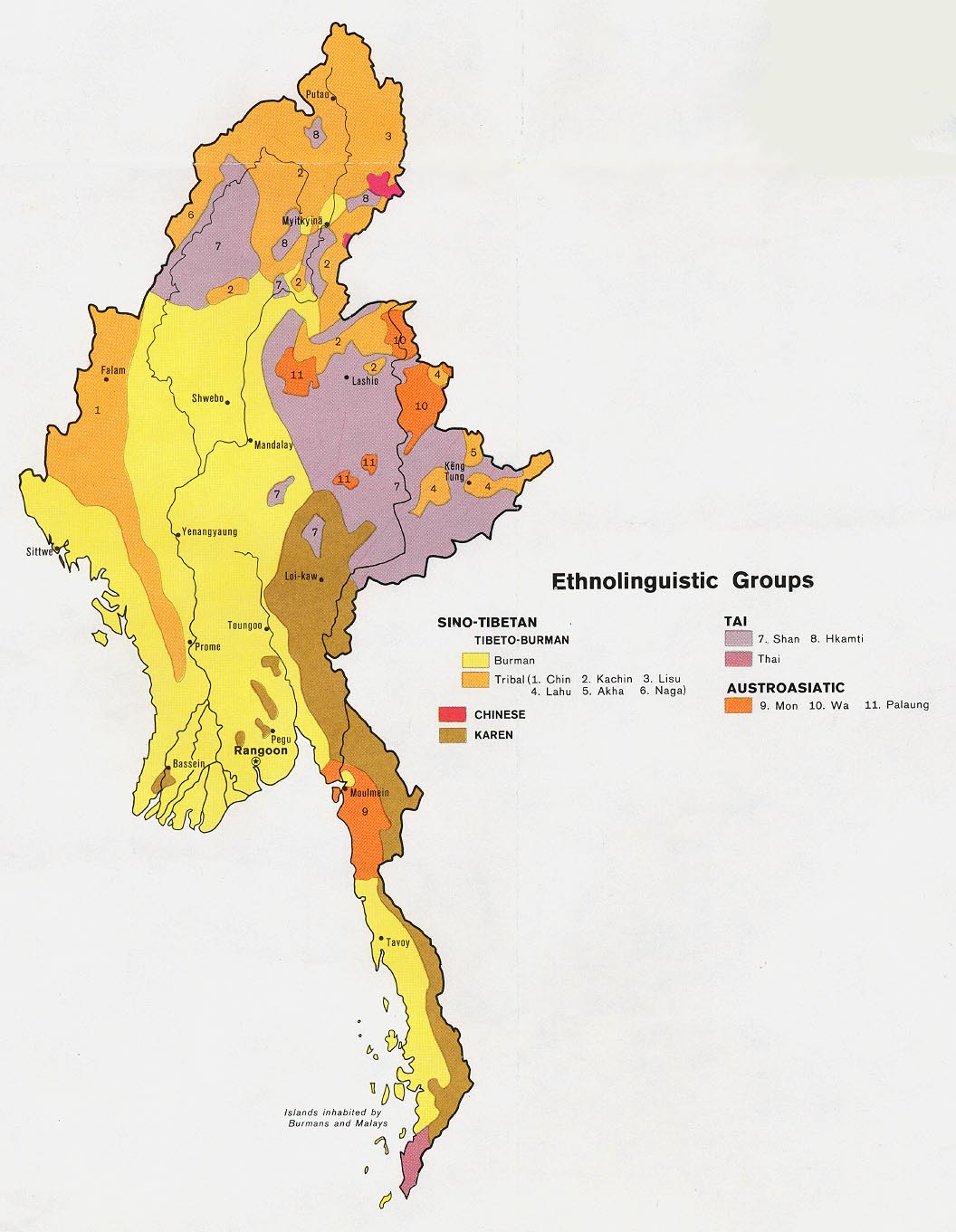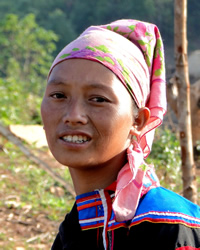

For centuries, the Wa people inhabited the rugged mountains between northeastern Myanmar and China, living in fragmented, independent village-states. Historically known for headhunting rituals believed to ensure fertile crops, their homeland was eventually split in two, leaving most of the Parauk-speaking population under Burmese rule. Although the Communist Party of Burma controlled the region from the 1960s until 1989, the Wa ultimately ousted them. Securing their autonomy, the Wa region functions today as a self-governing nation-within-a-nation, entirely independent of the Myanmar government.
Governed by the United Wa State Party and its military, the region faces deep rural poverty. Most Wa people live in remote, mountainous areas, relying on subsistence farming (rice, maize, and beans) and facing frequent food insecurity. While some have transitioned to long-term cash crops like rubber, tea, or coffee, daily life for most revolves around family-shared agricultural labor. In contrast, urban centers feature diverse trading and technology businesses. Throughout the countryside, traditional bamboo ganlan houses remain common, though the military's presence is constant. Across both rural and urban areas, communities still critically lack reliable farming tools, clean water, and affordable building materials.
The Wa spiritual heritage is a syncretic blend of animism, Buddhism, and Christianity, with animism serving as the foundational framework. Their worldview animates the natural environment, attributing spiritual presence to mountains, rivers, trees, and lightning, which are believed to dictate agricultural yields and personal fortune. Ancestral veneration is central to domestic life, traditionally manifested in the construction of two household hearths—one for utilitarian cooking and the other for ancestral rituals.
While proprietary animal sacrifice was historically prevalent, contemporary Christian Wa populations have abandoned the practice, shifting their social and spiritual focus toward highly cohesive, church-centric communities.
Because of widespread illiteracy in a common language, there is a critical need for basic formal schooling and education. Having been displaced from their traditional mountaintop agriculture, they require help developing skills to navigate a completely new working environment. Specifically, they need training in modern agricultural techniques, financial literacy, and sustainable livelihood programs. Access to basic healthcare is vital, including maternal care, essential medicines, resources for mental health, and support for healing from opium addiction. Many individuals lack citizenship documentation, which severely limits their freedom of movement. There is a deep need for deliverance from the fears born of their traditional animistic beliefs. They live with a constant fear of illness, crop failure, and bad luck, all of which stem from these traditional views.
Thank the Lord for the work of the Holy Spirit that has brought many from darkness to light.
Pray that Wa Christian believers will share their hope and disciple others, spreading new life from family to family.
Pray for access to basic formal schooling and language literacy, and that they would quickly acquire the skills needed for modern agriculture and financial independence.
Pray for available healthcare, maternal care, and essential medicines.
Lift up those battling opium addiction, asking for physical healing and robust mental health resources.
Pray that they will be granted citizenship documentation, ensuring their freedom of movement and full civil rights.
Scripture Prayers for the Wa Parauk in Myanmar (Burma).
Asia Harvest
1 Ralph Covell, The Liberating Gospel in China: The Christian Faith Among China's Minority Peoples (Grand Rapids, MI: Baker Books, 1995), p. 224.
2 As a result, the 1931 census of Burma returned only 10,465 Wa people. Among this small fraction of the actual Wa population, a mere 138 individuals identified as Christians, with the rest being animists and Buddhists.
3 Summer Institute of Linguistics, Ethnologue: Languages of the World (27th edition, 2024), online version. Many of the Parauk Wa dialect groups may qualify as distinct ethno-linguistic peoples, but little or no ethnographic research has been conducted among them due to their remote and dangerous locations. Others in the list may represent clans or village names. One of the best articles written about the Wa languages and dialects is: Gerard Diffloth, "The Wa Languages," Linguistics of the Tibeto-Burman Area (Vol. 5, no. 2, 1980), pp. 1-182.
4 See https://omniglot.com/writing/wa.htm
5 See Andrew Ong, Stalemate: Autonomy and Insurgency on the China-Myanmar Border (Ithaca, NY: Cornell University Press, 2023). The much smaller Wa National Army, with hundreds of soldiers, has operated along the Myanmar-Thai border since 1974.
6 Gillian Cribbs with Martin Smith, "Ethnographical History," in Richard K. Diran, The Vanishing Tribes of Burma (New York: Amphoto Art, 1997), p. 216.
7 Tien Ju-K'ang, Peaks of Faith: Protestant Mission in Revolutionary China (Leiden, Netherlands: E. J. Brill, 1993), p. 17.
8 "Despite never having heard of Jesus, Wa prophets began strongly speaking out messages similar to John the Baptist, telling the people to forsake their head-hunting and violence, and to prepare their hearts for the arrival of the True God. At that time a witch doctor in a certain Wa village owned three white donkeys. He laid his hands on the middle donkey and told the village elders, 'If you follow this donkey it will lead you to the True God.' For weeks the elders followed the donkey a distance of 200 miles across remote terrain, until one day it stopped outside the house of William Young, the American Baptist missionary who was working among the Lahu tribe. Young became the first known Christian to share the Gospel with the Wa. Salvation swept many areas as hundreds of hearts prepared by the Holy Spirit converted to Christ." Asian Minorities Outreach, The 50 Most Unreached People Groups of China and Tibet, p. 19. A slightly different version of the same event appears in Don Richardson, Eternity in their Hearts: Startling Evidence of Belief in the One True God in Hundreds of Cultures Throughout the World (Ventura, CA: Regal Books, 1984), pp. 102-104.
9 "Annual Report from Bana" (Valley Forge, PA: The American Baptist Archives Center, April 12, 1948), pp. 148-151.
10 See https://www.asiaharvest.org/bibles-for-the-wa-people-from-demon-worshippers-to-children-of-god. The composite translation used in the Wa Bible is problematic, with as few as 15-20% of Wa in Myanmar able to understand it because of their incredible diversity of dialects. For the same reason, the Jesus film has never been produced in the Wa language, as any chosen dialect would only be understood by a segment of the Wa population.
11 "The main reasons for this nominalism are the Wa's illiteracy, which results in few having a knowledge of the Scriptures, and an over emphasis by early missionaries on the necessity of attending church rather than a personal walk with Christ." (Personal communication with a Wa missionary, August 1996).
| Profile Source: Joshua Project |
| Other PDF Profile |