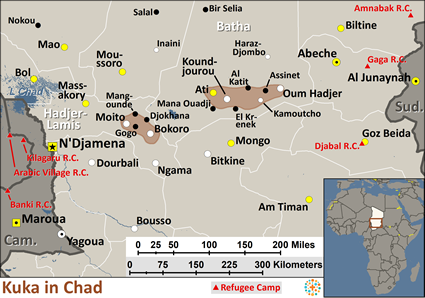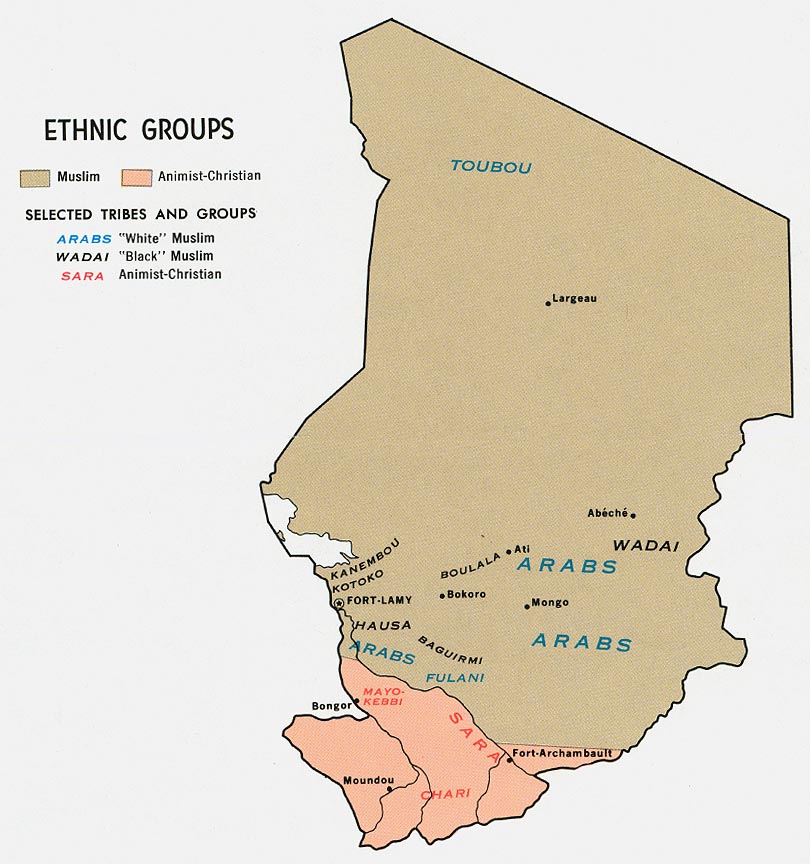

Lisi is a collective term used to describe three ethnic groups living in the same geographical region: the Kuka, the Bilala, and the Medogo. The groups speak similar languages, intermarry, share the same religion, and have similar traditions. They are located around Lake Fitri, Yao, and Oum Hadjer, in the Batha Prefecture of northern Chad. The Kuka are believed to be descendants of the main ethnic groups of the Yao sultanate.
During the 1400s, the state of Yao was founded by the Bilala. The culture and language of the Bilala, unlike those of the other groups, are of Arab origin. However, the Bilala have mixed so much with the Kuka and the Medogo over the centuries that they are included as a Lisi subgroup. In fact, they now speak a Kuka dialect. All Lisi groups speak Sara-Baguirmi languages, which are mutually understandable. Arabic is also spoken as a trade language. During the 1600s, the Bilala conquered the Kuka and settled on their land. Today, they remain the largest and most politically dominant group. It is still helpful to understand each of the Lisi groups separately. One of these is the Kuka.
The Kuka are primarily farmers, growing crops such as millet, sorghum, cotton, and manioc (a shrubby plant widely grown for its large, tuberous, starchy roots). Women usually have their own plots of land near their homes. There, they cultivate vegetables for family consumption or for sale. Wild rice, roots, locust beans, and wild fruits are also gathered from the forests near Lake Fitri.
Some of the Kuka combine farming with livestock production. They often have sheep, horses, camels, and a few cattle. Unlike most of their southern neighbors, the Lisi milk their animals and make butter. This task is performed by the women. Others also engage in small scale hunting and fishing. The men do the hunting, herding, and most of the fishing. The women do some fishing, help the men with the agricultural work, and gather forest produce. In addition, the women are responsible for performing all of the domestic duties such as preparing the meals, collecting the firewood, and caring for the children. The whole region of northern Chad has several local and regional markets. The men usually trade at the larger, regional markets in caravans, while the women engage in petty trade at the local markets near their villages.
The Kuka live in compact villages, each of which is run by a local chief or headman. The chief and the village elders oversee settling disputes between the villagers. The rural Lisi live in round huts which have mudbrick or mat walls and cone-shaped, thatch roofs. In the larger towns, the dwellings are also made of mudbrick, but they have flat roofs made of beaten earth. The villages consist of several fenced-in, rectangular compounds. Each compound contains several huts belonging to an extended family.
Polygyny (the practice of having multiple wives) is common among the Lisi. However, according to Islamic law, no man may have more than four wives. The first wife has a privileged status and is considered the "chief" among the others. Each additional wife has her own hut where her children will live with her until they are old enough to live on their own.
A Kuka girl will live in her mother's hut until she is ready to marry. However, a boy will move out of his mother's hut as soon as he is old enough to build his own hut-usually when he reaches puberty. At this time, he also undergoes his initiation into manhood.
The Kuka are virtually all Muslim. They have been strongly influenced by the nearby Muslim Arab merchants, with whom they trade on a regular basis. Although some of their pre-Islamic practices are still observed, Muslim laws and traditions are strongly followed in conjunction with those practices.
Islam is a religion of works based on five basic teachings or "pillars." Muslims must affirm that "there is no god but Allah, and Mohammed is his prophet." They are also required to pray five times a day, give alms to the poor, fast during the month of Ramadan, and try to make at least one pilgrimage to Mecca.
The Kuka need more educational opportunities and quality health care facilities. Perhaps Christian teachers and medical workers will have the greatest opportunities to share the love of Jesus with them.
The Kuka are also in need of Christian resources in their own language. A majority of the Kukas have never yet had an opportunity to hear a clear presentation of the Gospel.
Additional laborers, Christian broadcasts, and evangelistic literature are greatly needed to effectively reach the Kuka with the gospel. Most importantly, they need people who will begin to faithfully intercede for them, tearing down the strongholds that are keeping them in spiritual bondage. Only then will their hearts be prepared to receive the gospel as it is presented to them.
Ask the Lord of the harvest to send forth laborers into northern Chad to work among the Kukas.
Pray for Indian Christians to adopt the Kukas people for regular prayer and outreach.
Ask the Holy Spirit to grant wisdom and favor to the mission agencies that may be focusing on the Kuka.
Ask God to raise up prayer teams who will begin breaking up the spiritual soil of Chad through worship and intercession.
References
Scripture Prayers for the Kuka in Chad.
| Profile Source: Joshua Project |