


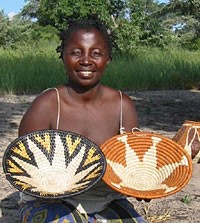

The Fwe are an ethnolinguistic people group living primarily in the Zambezi Region of northeastern Namibia along the border with Zambia. They refer to themselves as Mafwe and speak Chifwe. Their traditional lands include areas such as Kongola, Singalamwe, Sibbinda, and Lizauli near the Zambezi River.
The Fwe language belongs to the Bantu family of the Niger-Congo language group and is closely related to Subia and other Botatwe languages spoken in southern Africa. Linguistic and anthropological research indicates that the Fwe share cultural and historical ties with other Bantu peoples of the Zambezi Basin shaped by centuries of trade, migration, and communal exchange.
Fwe communities live in riverine and floodplain landscapes where livelihoods are strongly influenced by proximity to water and fertile soils. Subsistence agriculture is the foundation of daily life with crops such as maize, millet, sorghum, cassava, and legumes. Seasonal fishing and gathering wild foods supplement household sustenance.
Social life revolves around extended family networks and lineage groups that provide identity, support, and social organization. Elders and traditional leaders guide dispute resolution and communal work. Fwe language and cultural practices are used at home, in markets, and in community gatherings, while English and Lozi are used for wider communication.
Children learn community norms, agricultural practices, and Fwe oral traditions from a young age. Household labor is shared among family members for planting, harvesting, fishing, and livestock care. In larger villages, small-scale trading, craft work, and transport services provide additional livelihoods.
The Fwe practice a combination of traditional indigenous beliefs, Christianity, and some Islamic influence. Traditional religion emphasizes spiritual forces, ancestral spirits, and local deities associated with water, land, and family well-being. Elders and spiritual specialists oversee rituals to maintain harmony between the living and spiritual realms during rites of passage and agricultural cycles. Ancestral veneration and observances tied to natural landmarks are central to the community.
Christianity is present through mission activity in Namibia and Zambia. Many Fwe maintain cultural connections to traditional spirituality, especially in birth, marriage, and funeral ceremonies, reflecting syncretistic religious expression. Overall, evangelical Christian presence is limited, and traditional worldviews remain influential.
Schools are under-resourced and educational materials in Fwe are scarce.
Rural and riverine settlements require improved services for maternal and child health, disease prevention, and emergencies.
Most livelihoods depend on subsistence agriculture and fishing; support for sustainable agriculture and small enterprise development is needed.
Dominant regional languages threaten the use of Fwe; documentation and media support are required.
Traditional beliefs dominate; contextualized discipleship, culturally relevant gospel communication, and church development are needed for them to put their faith in the one who provides life to the full.
Pray for access to quality education that includes support for local language and culture.
Pray for improved healthcare services, especially for mothers and children.
Pray for sustainable economic development and empowerment initiatives.
Pray for culturally sensitive gospel workers to engage Fwe worldviews effectively.
Pray for the growth of biblically grounded churches among the Fwe.
Pray for spiritual openness and community transformation through Scripture and worship.
Pray for unity and encouragement among believers serving in this region.
Scripture Prayers for the Fwe in Namibia.
The Fwe language, also called Chifwe, is a Bantu language spoken in the Zambezi region of Namibia and adjacent Zambia.
Linguistic and anthropological studies describe the Fwe as part of the Bantu, Central-South people cluster with cultural ties to ne
| Profile Source: Joshua Project |



