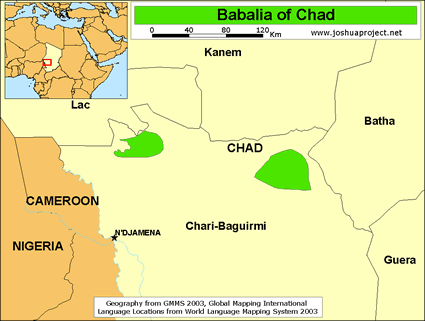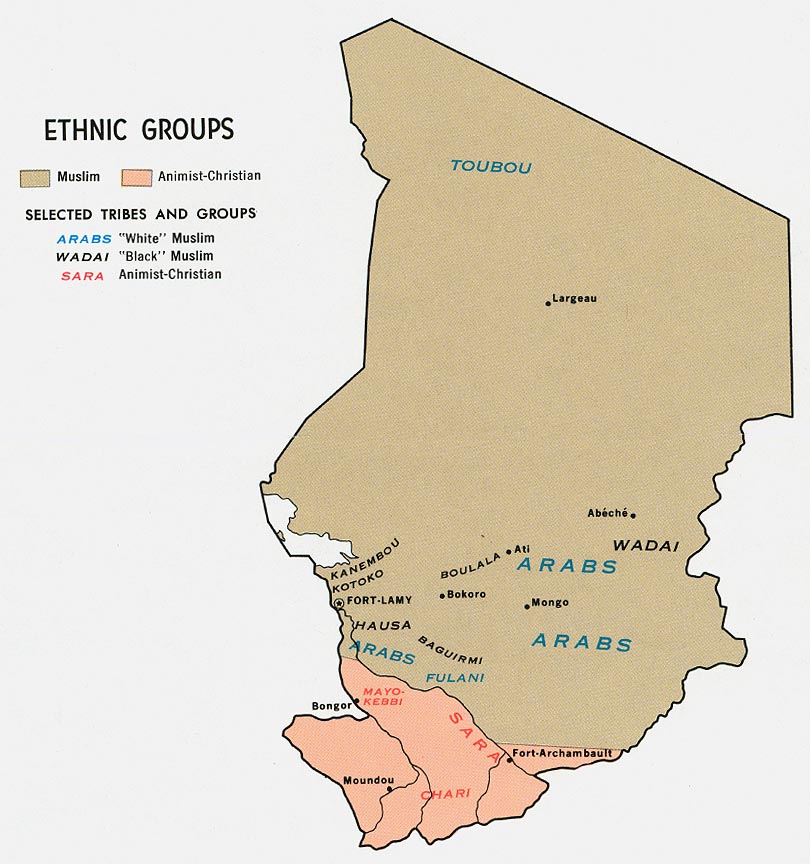
The Babalia are a small ethnic group living in Chad, primarily in the western and central regions near Cameroon and Nigeria. Some sources associate them with the larger Bulala or Bagirmi-related peoples, while others identify them as a distinct subgroup with their own historical identity. Over time, the Babalia have increasingly adopted Chadian Arabic and neighboring regional languages, and their original language, sometimes identified as Berakou or Babalia, has nearly disappeared.
Like many peoples of Chad, the Babalia have been shaped by centuries of migration, trade, Islamic influence, and interaction with neighboring ethnic groups across the Sahel region. Their history has largely been preserved through oral tradition rather than written records. Environmental hardship, regional instability, and outside political pressures have also influenced their development and movement over generations.
The Babalia live in a region marked by ethnic diversity and strong Islamic influence. Although they have interacted with Muslim societies for centuries, traditional spiritual practices have continued to shape aspects of community life and worldview. Christian witness among the Babalia has remained extremely limited, and many have had little opportunity to hear the gospel clearly.
Most Babalia families depend on agriculture and livestock for survival. Common crops include millet, sorghum, maize, and rice, while goats, sheep, and cattle provide food, trade income, and social value within the community. Rural village life remains central for many Babalia households, and daily life is shaped by seasonal farming patterns and the harsh climate conditions of the Sahel region.
Family and clan relationships are important within Babalia society. Elders are respected, and communal cooperation plays a major role in farming, celebrations, and resolving disputes. Music, dance, storytelling, and oral tradition remain valued cultural expressions and help preserve identity across generations.
Life in Chad can be difficult because of drought, economic hardship, limited infrastructure, and political instability. In rural regions, access to healthcare, education, and clean water may be inconsistent. Many communities must adapt continually to environmental pressures and changing economic realities.
The growing dominance of Chadian Arabic and outside cultural influence has also contributed to the decline of older Babalia linguistic and cultural traditions. Younger generations increasingly face tension between preserving traditional identity and adapting to modern life.
The Babalia are primarily Sunni Muslim, but many also maintain traditional spiritual beliefs connected to ancestors, spirits, and unseen powers. This mixture of Islam and folk religion is common in parts of Chad and throughout the Sahel region.
Traditional practices may include rituals seeking protection, healing, blessing, or guidance from spiritual forces. Fear of curses, harmful spirits, and supernatural influence can strongly affect daily decisions and community customs. Religious identity is closely tied to family and social belonging, making conversion to Christianity difficult in many settings.
Very few known Christians live among the Babalia. Access to biblical teaching, discipleship resources, and Scripture in forms understandable to them remains extremely limited. Many Babalia have never personally met a committed follower of Jesus Christ.
The Babalia need faithful access to the gospel presented clearly within their cultural and linguistic setting. Long-term Christian witness, discipleship, and Scripture resources are greatly needed among them. Because their community is small and relatively isolated, sustained ministry efforts may be difficult without committed workers willing to build trust and relationships over time.
Practical needs also remain significant. Many Babalia communities face challenges related to poverty, healthcare access, education, food security, and environmental hardship. Drought and economic instability can place heavy strain on families dependent on farming and livestock.
The Babalia would benefit from compassionate ministry that addresses both spiritual and practical concerns. Medical outreach, educational assistance, agricultural support, and oral Bible teaching could help open doors for meaningful long-term gospel engagement.
Pray that the Babalia people would hear and understand the gospel clearly and come to trust in Jesus Christ alone for salvation.
Pray that God would send faithful Christian workers who are willing to serve among the Babalia with humility, perseverance, and love.
Pray that the Babalia would be adopted through the People Group Adoption program so they receive sustained prayer, ongoing gospel engagement, and future discipleship efforts.
Pray that any believers living in nearby regions of Chad would grow strong in biblical faith and boldly share the truth of Christ with the Babalia and surrounding peoples.
Scripture Prayers for the Babalia in Chad.
https://peoplegroups.org/people_groups/pg011309/
https://en.wikipedia.org/wiki/Berakou_language
https://en.wikipedia.org/wiki/Bagirmi_people
https://www.worldmap.org/uploads/9/3/4/4/9344303/chad_profile.pdf
| Profile Source: Joshua Project |