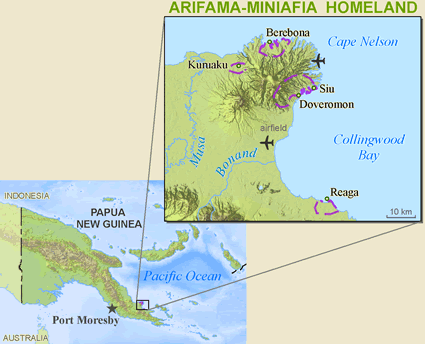
The Arifama-Miniafia are an indigenous people group living along the northern coastal regions of Papua New Guinea, particularly in areas influenced by river systems and nearby rainforest environments. They are often identified as a combined cultural and linguistic grouping, with Arifama and Miniafia representing closely related communities that share similar language patterns and heritage.
Historically, the Arifama-Miniafia have lived in small, semi-isolated villages shaped by the rhythms of the land and sea. Their identity has been preserved through oral traditions, including stories of ancestry, migration, and relationships with neighboring groups. Coastal access has allowed for some interaction with traders and other communities, though geographic barriers have still limited outside influence.
In the 20th century, contact with missionaries and government efforts introduced new structures such as churches, schools, and limited medical services. While these influences brought change, many traditional customs and social patterns have remained part of everyday life.
Life for the Arifama-Miniafia centers on subsistence living and strong community relationships. Fishing is a major part of their livelihood due to their coastal environment, supplemented by gardening. They grow crops such as taro, yams, bananas, and sago, which form the foundation of their diet. Coconut and other local resources are also commonly used in cooking and daily life.
Work is typically divided along family and gender lines, with men often fishing or building and women tending gardens, preparing food, and caring for children. However, cooperation is common, and extended families function as close-knit units where responsibilities are shared.
Family life is deeply communal. Several generations may live near one another, and elders hold positions of respect and influence. Children are raised within the broader family network and learn through observation and participation in daily tasks.
Community gatherings are important social events. Celebrations may include feasts, dancing, singing, and ceremonial practices tied to important milestones such as marriages or seasonal cycles. These gatherings reinforce identity and unity within the group.
Though some modern tools and education have reached the Arifama-Miniafia, many communities still face challenges related to remoteness, including limited transportation and access to broader economic opportunities.
The Arifama-Miniafia traditionally follow animistic beliefs, recognizing spiritual forces present in nature and daily life. They often believe that spirits influence events such as illness, weather, and success in fishing or farming. Ancestor spirits are also significant, and maintaining proper relationships with them is considered important.
Rituals and ceremonies are used to seek protection, healing, or guidance. Spiritual leaders or respected elders may perform these practices, especially during times of uncertainty or hardship. Fear of unseen spiritual forces can shape behavior and decision-making.
Christianity has been introduced and is present among the Arifama-Miniafia, with some individuals identifying as Christians. In many cases, however, traditional beliefs continue alongside Christian practices. This blending can lead to partial understanding of biblical teachings, where older beliefs still influence spiritual perspectives.
There remains a need for deeper understanding of the Christian message and for it to be expressed in ways that connect clearly with their cultural context.
The Arifama-Miniafia have ongoing physical needs, including improved access to healthcare, clean drinking water, and reliable nutrition. Remote living conditions make it difficult to access medical treatment, and preventable diseases can have serious impacts. Education is limited in some areas, reducing opportunities for literacy and long-term development.
Spiritually, there is a need for clear teaching of the Bible in their own language. Many may have some exposure to Christianity but lack a full understanding of the gospel. There is also a need for trained local leaders who can disciple others and provide consistent spiritual guidance.
Infrastructure development, such as better transportation and communication, would help connect these communities to resources and support systems. Meeting practical needs can also open opportunities for meaningful spiritual engagement.
Pray for better access to healthcare, clean water, and education.
Pray for the Bible to be clearly understood in their heart language.
Pray for strong local believers to grow and lead their communities.
Pray that those who follow Christ will share their faith with nearby groups.
Scripture Prayers for the Arifama-Miniafia in Papua New Guinea.
https://www.peoplegroups.org
https://www.ethnologue.com
https://www.pngfacts.com
| Profile Source: Joshua Project |