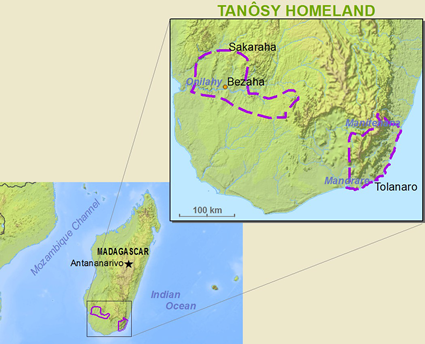

The Tanôsy people live primarily in the Anôsy region in south-west Madagascar, between the Mandrare and the Manantenina rivers. Anôsy means "the island region", and Tanôsy means "the people of Anôsy." Fort Dauphin is the main city in the area, also called Taolañaro or Faradofay.
Around 1845, after the Merina people from central Madagascar conquered Anosy, a large group of Tanôsy emigrated westwards towards the Onilahy river, where they settled on land seized from the Bara and Mahafaly people. The Tanôsy are increasingly infiltrating the land in between these two areas, which is traditionally a Tandroy area.
The Tanôsy originally followed a strong caste system, the noble caste being descendants of Zafi-Raminia, a dynasty of the 13th century, who were immigrants from the Middle East. Their kings held absolute power. In time however the different castes have tended to even out.
Their main economy lies in cattle-raising, agriculture, and fishing. They are known to be hard-working and have often been taken to the Mascareignes to work on the plantations there.
They also enjoy leisure activities. The Antanosy people of southeastern Madagascar incorporate recreation into the rhythms of daily life, often reflecting their close connection to community, land, and tradition. Their recreational activities are typically communal rather than individual, strengthening social bonds and reinforcing cultural identity.
Traditional music and dance play a central role in Antanosy leisure. Gatherings frequently include singing accompanied by locally made instruments such as drums and stringed instruments. These performances are not only entertainment but also a means of preserving oral history and expressing shared values. Dancing is often participatory, with men, women, and children joining in during festivals, celebrations, and informal evening gatherings.
Storytelling is another important recreational activity. Elders pass down histories, moral lessons, and cultural traditions through spoken narratives, often told around fires in the evening. These stories help maintain a strong sense of identity and continuity between generations while providing enjoyment for listeners.
In rural areas, where most Antanosy live, outdoor activities are common. Young people may engage in games, running, or informal sports that require little equipment. Time spent near rivers or coastal areas may include swimming or fishing, blending recreation with everyday subsistence activities.
Market days and communal events also provide opportunities for social interaction and leisurely enjoyment. These occasions allow families and neighboring villages to gather, exchange goods, share meals, and participate in music and conversation, creating a festive atmosphere.
About half of the Antanosy community is Christian. Even among those who attend church there is a great deal of dependence on the spirit world. Most Tanôsy practice a traditional religion, praying to Zañahary and to their ancestors.
The literacy rate is estimated at less than 30%. Some church schools and NGO's complement the inadequate governmental structures in providing literacy training.
Pray for a mighty revival in their churches that will transform their families and communities.
Pray for many to be raised up to evangelize and disciple others.
Pray for their hard work to pay off, and for them to prosper economically and spiritually.
Scripture Prayers for the Antanosy in Madagascar.
Anonymous
| Profile Source: Joshua Project |