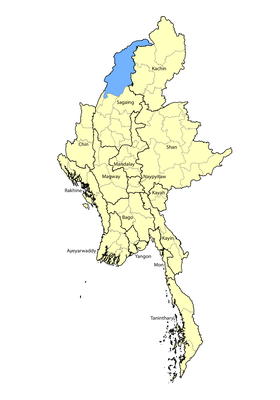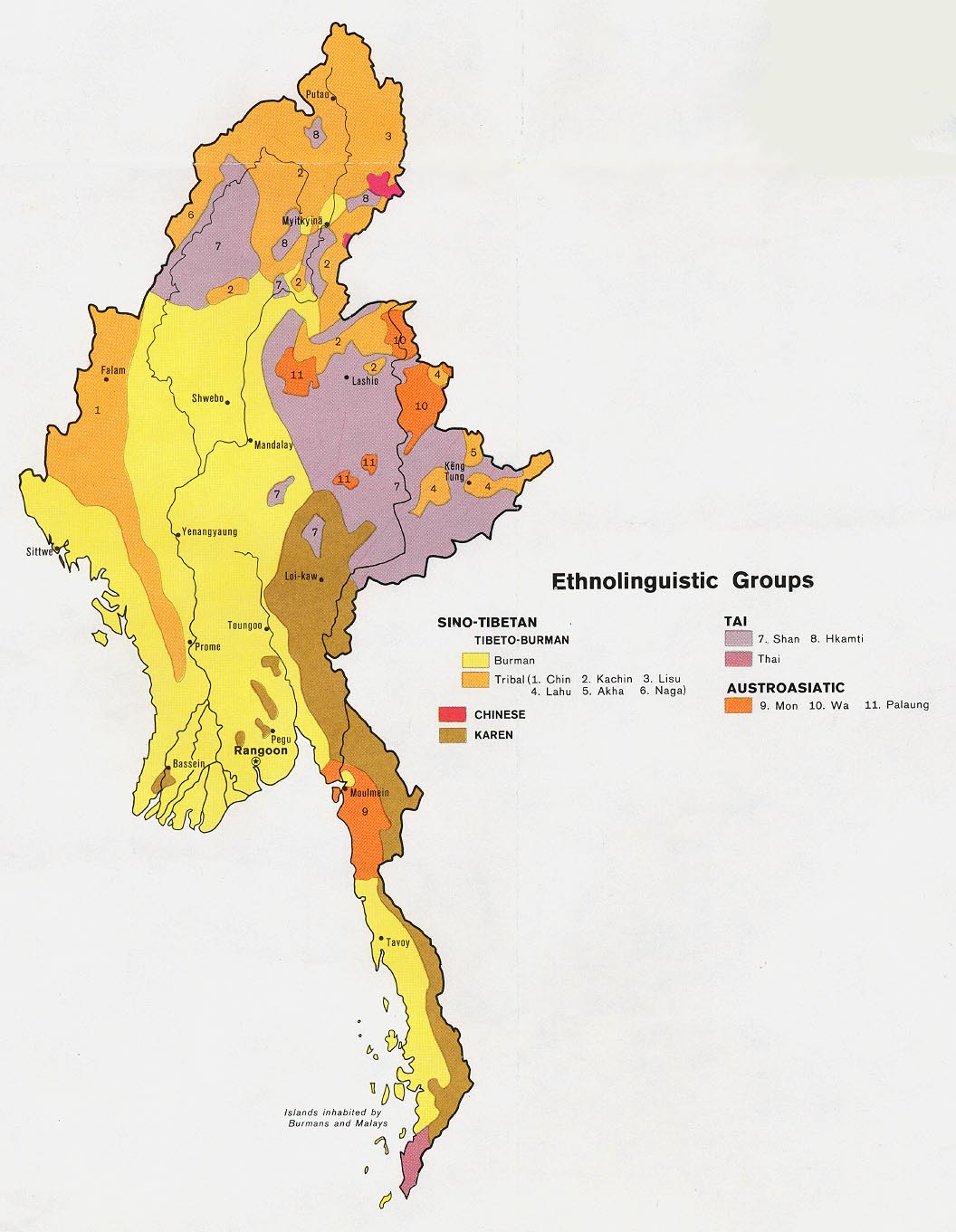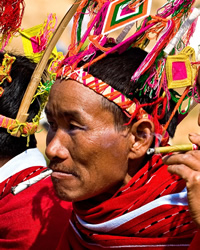

The Raraq people group, previously unknown, resides in the extreme western part of Myanmar bordering the Indian state of Arunachal Pradesh. The region is highly diverse, with villages often home to multiple tribes. Most Raraq people live in Taka village, Nanyun Township, which lies within the Naga Self-Administered Zone. Other Raraq groups are scattered among villages alongside various Tangshang-related tribes, contributing to the region's remarkable ethnic diversity. Despite being culturally linked to the broader Tangshang collective, the Raraq maintain a distinct name, identity, and history, and have not appeared in official lists of Myanmar's ethnic groups—making their documentation important for understanding the nation's diversity.
Linguistically, the Raraq speak a unique dialect within the Sal branch of the Tibeto-Burman language family, closely related to the Drancyi, Gaqha, and Gaqlun varieties, and connected to the Jingpo language spoken further north in Kachin State. Historically, the Raraq and neighboring tribes practiced headhunting, a tradition once common in the region. Some communities in the Nanyun area, however, were known to engage in even darker, spiritually troubling practices, reflecting the complex and sometimes somber aspects of their cultural heritage.
The Raraq people live in small, close-knit villages in the remote hills of Myanmar's Naga Self-Administered Zone. Their homes are built from local materials like bamboo and wood, with thatched roofs to withstand heavy rains. Daily life revolves around family and community. Extended families often live together and share responsibilities such as farming, gathering firewood, and caring for children and elders. The traditional joint family system and the presence of a tribal council, led by a chief, have long shaped their social structure and identity.
Agriculture is central to the Raraq way of life. They practice subsistence farming, growing rice, millet, maize, and vegetables on terraced hillsides, and raising livestock such as chickens, pigs, and goats. Community festivals are often tied to the agricultural calendar, such as planting and harvest celebrations. These events feature communal meals, music, and dance, reinforcing social bonds and cultural heritage. Due to the region's isolation, employment opportunities outside agriculture are scarce, so most Raraq depend on their land and community for sustenance.
For generations, the Raraq lived under the shadow of animistic beliefs and spiritual darkness. This changed dramatically in the 1950s when Kachin evangelists brought the gospel of Jesus Christ to their region. Despite initial resistance, the message of Christ took root. Today the Raraq identify as Christians, with most belonging to Baptist churches. However, they lack Scripture and Christian resources in their own language, relying instead on Burmese translations, which limits their spiritual growth and understanding.
The Raraq have significant spiritual needs, especially the opportunity to hear and understand the gospel in their own language and cultural context. Many live in remote areas with little access to scripture or Christian fellowship, making discipleship and regular teaching essential. Culturally sensitive outreach that respects their traditions is also important. Physically, the Raraq face challenges such as limited access to healthcare, clean water, and education, and their subsistence farming lifestyle leaves them vulnerable to food insecurity and poverty. Practical support through medical care, clean water projects, and agricultural training can help meet these needs. This support can also demonstrate Christ's love in action, reflecting the holistic compassion of Jesus, who cared for both body and soul.
Pray that the Lord would raise up mature believers within the Raraq community to provide training and discipleship, equipping others to encourage and teach the faith.
Pray that the Lord will instill within the Raraq people the desire to share the gospel of Jesus Christ with other local ethnic communities that do not know of his love.
Pray that the Lord will provide translation of the scriptures and other Christian resources within the language of the Raraq.
Pray that the Lord will provide the Raraq community with improved education, healthcare, housing, and new economic opportunities to help improve their lives.
Scripture Prayers for the Raraq in Myanmar (Burma).
Asia Harvest
1 Naga Survey Team, Sociolinguistic Survey of Makyam and Southern Tangshang Varieties in Lahe Township and Dunghi Sub-Township, Myanmar (unpublished report, 2012), p. ix.
2 Graduate Institute of Applied Linguistics, "Fifty-Five Dialects and Growing: Literacy and Comprehension of Vernacular Literature among the Tangshang Naga in Myanmar," (thesis, name withheld, June 2013), p. 10.
3 J. D. Saul, The Naga of Burma: Their Festivals, Customs, and Way of Life (Bangkok: Orchid Press, 2005), pp. 181-82.
4 See https://en.wikipedia.org/wiki/Tangsa_Naga
| Profile Source: Joshua Project |
| Other PDF Profile |