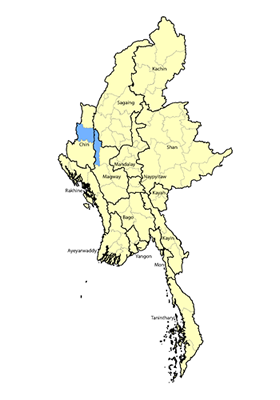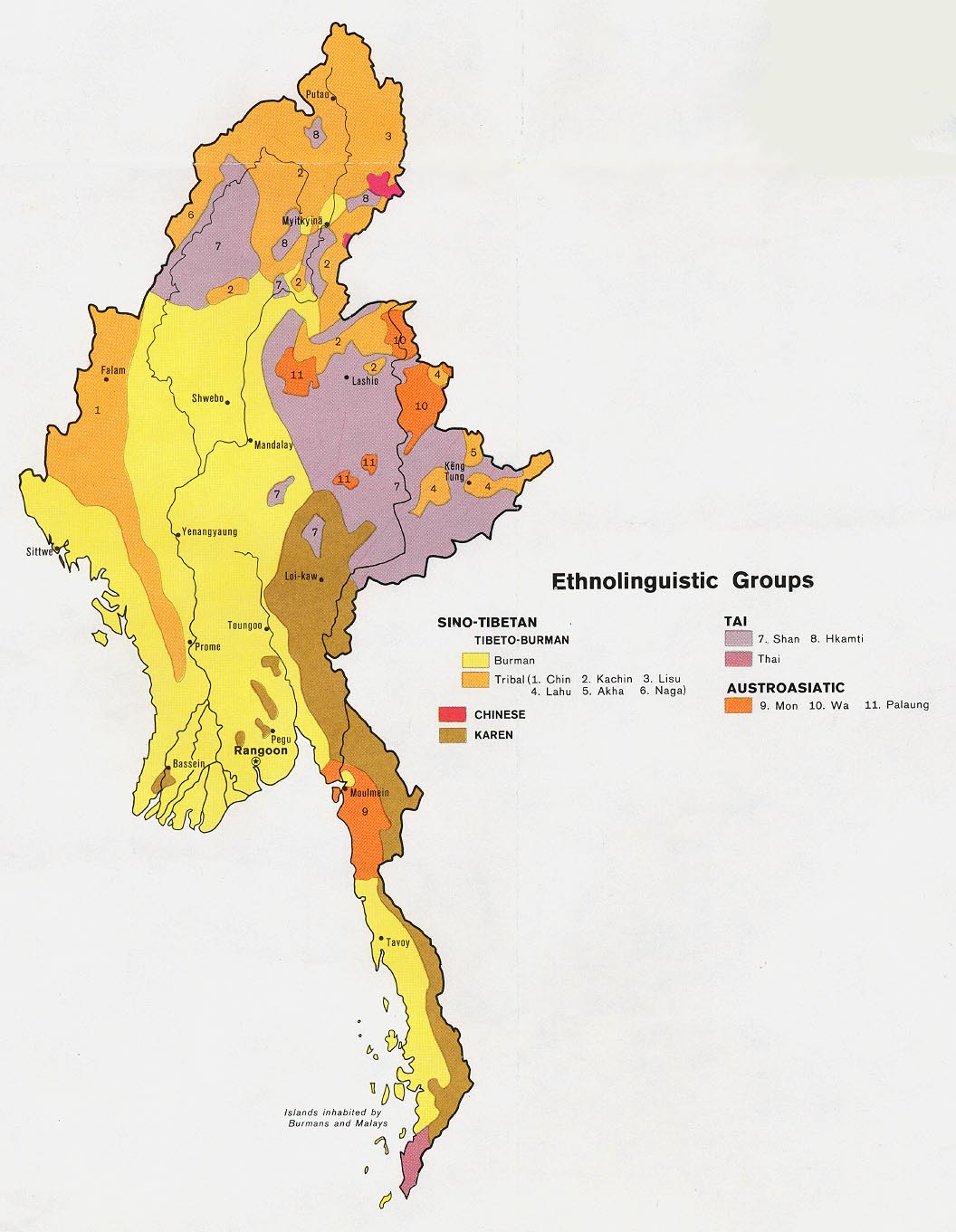

Lai Chin people inhabit a widespread area of northern Chin State in western Myanmar and over the border in neighboring parts of Bangladesh, and 41 villages are in northeast India, where they are officially known as the Pawi tribe. Five thousand Lai Chin people have also migrated to Australia, where most have settled in the city of Melbourne.
The members of this tribe call themselves Lai (meaning "center") or Lai Chin, but almost all other people in the region know them as Hakha Chin, after the name of the township they heavily populate. Several tribes in the area that are often called "Hakha Chin" have been profiled separately under their self-names in this book. During the British colonial era, the Lai looked down on these other tribes, "refused to admit that they belonged to their race and asserted that they are of a different origin."
In the past the Hakha area was home to so many distinct language groups that it was said, "Women from one village may find it difficult to understand the women from another village just a few miles away!" Under British rule, Lai was adopted as the lingua franca of much of Chin State, and the town of Hakha was chosen as the state capital. Today, Lai is used in homes, churches, literature, government work, and business. English is also widely spoken.
The Lai Chin have long been recognized as one of the largest and most important of the Chin tribes. For centuries, the Lai fought a succession of wars against other Chin tribes, the Mizo, Burmese, and against invading armies from India, Britain, and Japan. They gained respect as courageous and resilient fighters. In the past the forests around Hakha were filled with many dangerous animals, and frequent tiger attacks resulted in hundreds of people being carried off and eaten.
The monsoon season runs from April to October each year, followed by the dry season from November to March. Most rural Lai Chin are engaged in slash-and-burn agriculture, earning money by selling produce, pigs, and other livestock in township markets. Many people living in the towns work in shops or hold government and school jobs, while some have gained employment in gold, jade, and ruby mines.
Animism had such a hold on Lai Chin society that at the time of the 1931 census, 92 percent of the population identified as animists, despite the gospel having been among the people for more than three decades.
Generations of Lai Chin perished without any knowledge of Jesus Christ until 1899, when Arthur and Laura Carson of the American Baptist Mission visited Hakha along with six Karen schoolteachers. They were surprised to find people hungry to hear the gospel, and the first churches were soon planted. By 1931, 623 Lai Chin people had become Christians, which represented just 2.6% of the population. The number grew quickly, however, with entire villages turning to Christ as revival swept the area and a thriving Lai Chin church emerged.8 In 1941, 1,100 adults were baptized,9 and by 1966 the Lai Chin church had a total membership of 40,000 out of a population of 56,000. Today, around 90 percent of Lai Chin people are Christians, and many believers are highly educated and have attended one of the many Bible schools in the area. The Lai Chin New Testament was completed in 1940, but another 38 years elapsed until the whole Bible was printed in 1978.
Ask God to raise up Lai Chin leaders who can share the gospel with wisdom and compassion, bridging traditional beliefs and biblical truth.
Pray that the Lai Chin people would experience the love of Christ in ways that affirm their cultural identity and lead them to a closer walk with God.
Pray for them to have such a love for God that they can't help but tell others about him.
Pray for Lai Chin disciples to make more disciples.
Scripture Prayers for the Chin, Lai in Myanmar (Burma).
Asia Harvest, Copyrighted 2026 © Used with permission
| Profile Source: Joshua Project |
| Other PDF Profile |