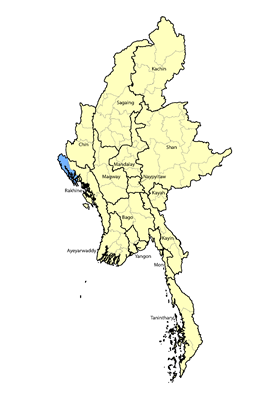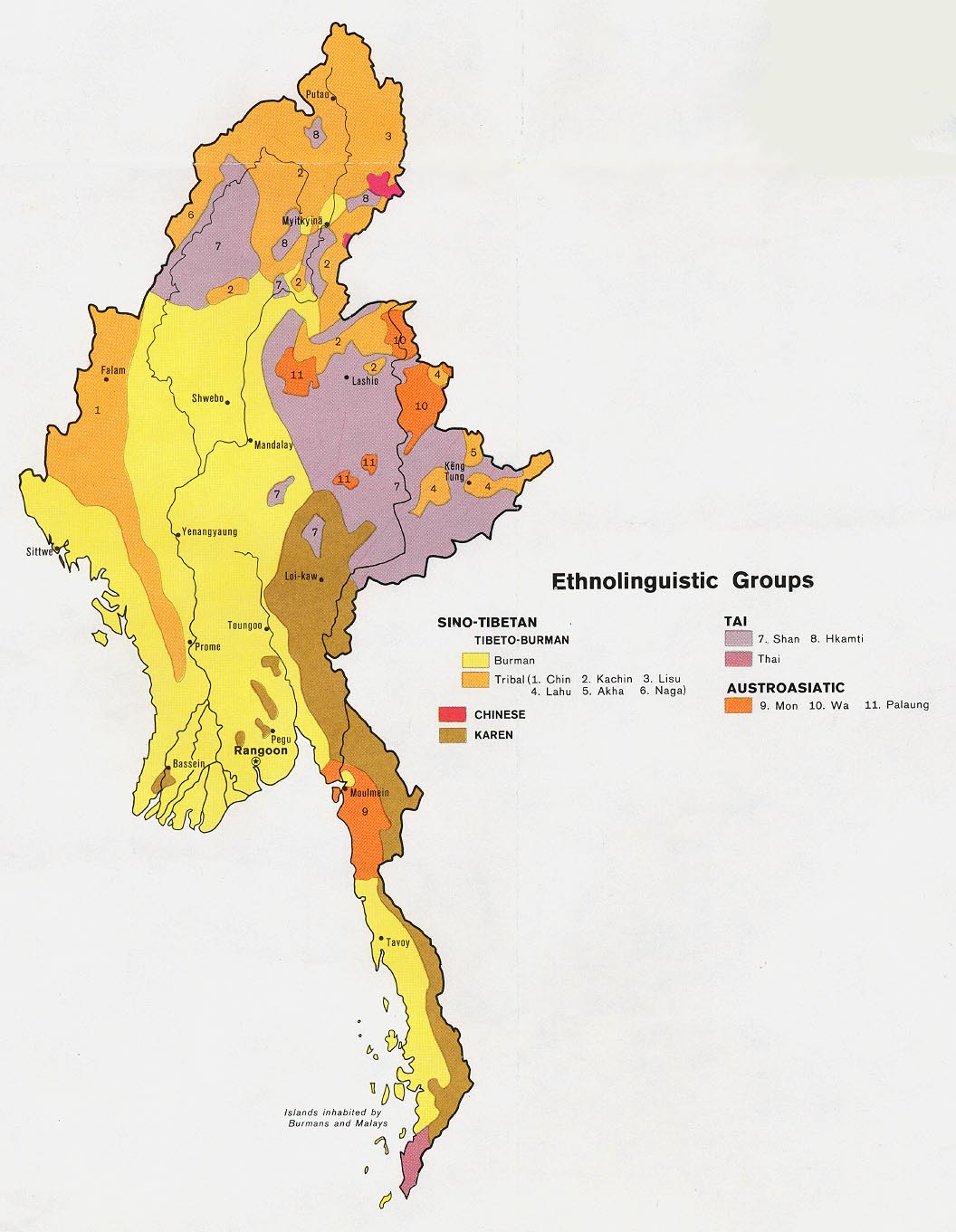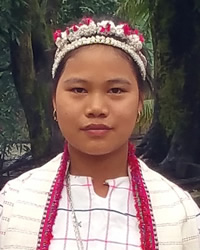

The Mru tribe of southwest Myanmar are concentrated in the Maungdaw and Sittwe districts of Rakhine State. The region borders the Bay of Bengal and is buffeted by regular cyclones. The 2022 Bangladesh census listed 52,455 Mru in that country, and a further 2,100 Mru live in West Bengal, India, although only a few hundred of the Indian Maru are still able to speak their tribal language.
The Mru people of Myanmar are not to be confused with the related, yet distinct, Mro-Khimi group. The Mru in Myanmar are divided into four dialect groups (Anok, Dowpreng, Sungma, and Launghu), each of which has its own customs and self-identity. Culturally, the Mru share many similarities with the Khumi people, although their languages are different.
The Mru language enjoys vigorous use among the group, and most people can also speak the regional Rakhine language. Due to separation and outside influences, the Mru vernacular used in Bangladesh and India has now diverged considerably from that spoken in Myanmar. Mru legend explains that they do not have a written language because Torai, the most powerful spirit, wrote his rules for living on banana leaves for the Mru, but an animal ate them, leaving them destitute and illiterate.
The Mru were originally part of an ethnic group known as the Masho, who were first recorded in Rakhine histories in the 11th century. They say they first migrated to the area by following a large river, with one historian stating: "They settled directly to the hills…. A group of Khumi who moved farther south are now called 'Mru,' which is 'Masho' in the Rakhine language." Another source claims the Mru left their homeland in Tibet and were driven south into Rakhine State in the 14th century. The forefathers of the Mru who now live in Bangladesh fled there after suffering military defeats to the Khumi in the 17th and 18th centuries.
Mru culture varies from place to place because of isolation caused by the dramatic terrain. In India, British scholars first documented the Mru in the 19th century, with one writing in 1882: "The Mroo are a quiet and inoffensive race, largely given to cultivation. The males frequently go naked or have only a rag fastened in front below the loins, except in the cold weather when a cloak is occasionally thrown over the body. Persons with incurable diseases are viewed by them as outcasts and are not permitted to reside in the same place with the rest, a separate village being assigned to them."
Although almost all Mru people in Myanmar today are professing Buddhists, their belief system includes layers of Animism and spirit worship. Their ceremonies are presided over by "hereditary priests, called passin, who officiate at weddings and funerals and act as exorcists in cases of sickness or seizure by witches." Fear and superstition rule most Mru communities, and although they have a legend that they once knew Torai ("the great spirit"), they were alienated from him long ago. In Bangladesh, a new syncretic religion known as Krama emerged in 1984 and quickly grew to become the second most followed religion among the Mru.?It has been noted, "The central text of the faith, known as Reyung Khiti ('Good Ethics'), builds on the teachings of the Hindu, Christian, and Buddhist faiths."
There are few Christians among the Mru people today, most of whom remain trapped in bondage to a myriad of spirits. People appear to have a fatalistic mindset with little motivation to change, causing them to remain "bound by poverty and illiteracy, as well as the ideology that their god, Torai, desires them to remain that way."
Pray for the Holy Spirit to give the Mru people teachable and understanding hearts.
Pray that a strong movement of the Holy Spirit will bring entire Mru families into a rich experience of God's blessing.
Pray for Mru people to be drawn by the Holy Spirit to seek forgiveness, and to understand the adequacy of Christ's work on the cross.
Pray for teams of believers to do sustained, focused prayer for the Lord to open the hearts of Mru family leaders to experience God's blessing through a movement of family-based discovery Bible studies.
Scripture Prayers for the Mru in Myanmar (Burma).
Asia Harvest, Copyrighted 2026 © Used with permission
| Profile Source: Joshua Project |
| Other PDF Profile |