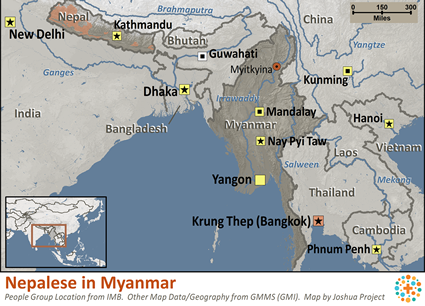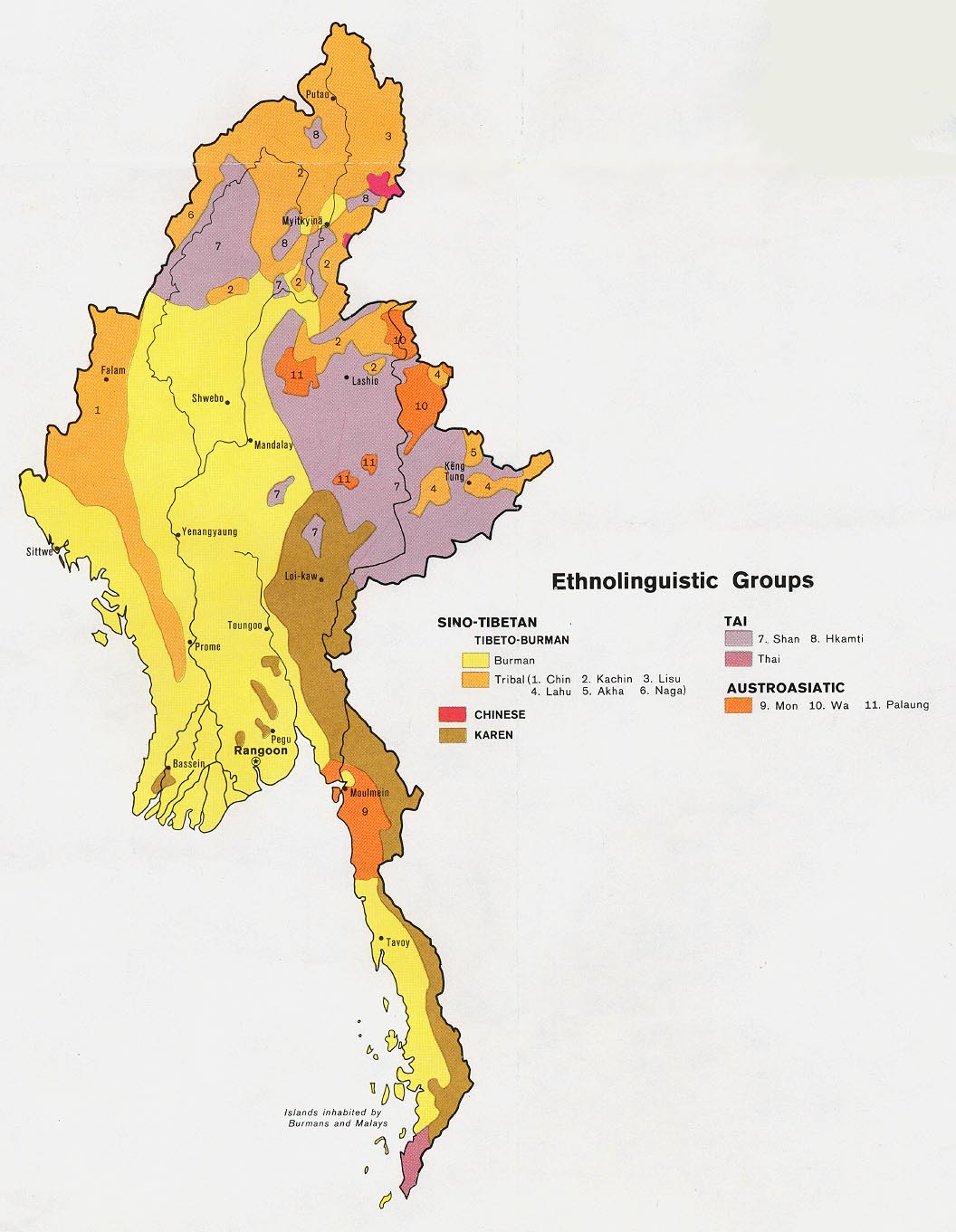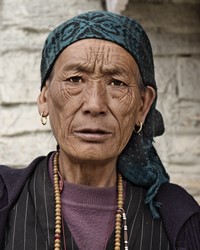

The 1931 census of Burma found "Gorkha" people, who were courageous soldiers recruited from Nepal by the British army to fight and help subdue the ethnic groups of Burma. The terms Gurkha, Gorkha, and Gorkhali is synonymous with Nepali people. They originate from the Gorkha kingdom which was at the heart of the formation of the kingdom of Nepal in 1768. This profile covers all Nepali-speaking people in Myanmar today, who come from a variety of tribes and people groups. Some are descended from the early Gurkha soldiers, while others are economic migrants who have arrived in recent decades seeking better lives.
Nepali, which is part of the Indo-European language family, is related to major regional languages spoken by hundreds of millions of people, such as Hindi and Urdu. The original Gurkha soldiers who served in the British army were required to learn English, and that custom has carried through to today, as most Nepali people in Myanmar can speak Burmese and English.
During the 19th century and the first half of the 20th century, Gurkha soldiers earned such a fearsome reputation as skilled and disciplined warriors that the British employed them throughout their empire, with troops stationed in Hong Kong, Singapore, India, and in Britain itself. The warriors were greatly respected for their bravery, and Queen Elizabeth II honored their service to the British Empire by attending the Gurkha bicentenary celebrations in 2015. When the British exited Burma in 1948, Gurkha troops acted as rear guard units to protect the British as the sun set on the colonial era. For a time, many Gurkha soldiers served in the new Burma Army, but as the decades went by the situation changed dramatically for many Nepalis, as the socialist government increasingly despised their presence and viewed them as illegal foreigners. Thousands left the country for Nepal and other parts of the world.
Gurkha soldiers famously use distinctive khukuri curved knives. It is said that if a Gurkha draws his knife in anger, he must draw blood before returning it to its sheath. Nepalis are renowned for being hard working and clever with money. They "place high importance on education, and they represent a disproportionately high share of those with advanced (medical, engineering, and doctorate) degrees in Myanmar." In the 1950s and 1960s, Nepalis were seen as key contributors to society, with some rising to prominent positions. One of them, Suk Bahadur, is considered the greatest Myanmar football (soccer) player in history, having captained the national side from 1952 to 1970.
Most Nepali people in Myanmar have retained the Hindu religion of their homeland and have constructed Hindu temples in several states. Some Nepalis have either adopted Buddhism or blended it with their traditional faith, while a small number are Muslims. Very few members of the Nepali community in Myanmar have embraced Christianity.
Little is known about Christianity among the Nepalis of Myanmar. Historically, almost nothing was mentioned of them in mission records, apart from fleeting mentions, such as by the Bible Churchmen's Missionary Society in 1931, who reported: "Eight adults were baptized at Mohnyin in Kachin State, belonging to five different races—Jingpo, Burmese, Gurkha, Shan, and Chinese." The Nepali New Testament was first published in 1824 and the full Bible in 1914, but it is not available in Myanmar.
Pray for the lives and culture of the Nepali people in Myanmar to evidence the rule and reign of the Kingdom of God as they open to the gospel and for the beauty of Jesus to be seen in them.
Pray for a "Book of Acts" type of movement to Christ among Nepalis.
Pray for the Nepali people to understand and embrace that Jesus wants to bless their families and neighborhoods.
Pray for the Holy Spirit to anoint believers from the Nepali people to change their society from within.
Pray for a movement in which the Holy Spirit leads and empowers disciples to make more disciples.
Scripture Prayers for the Nepali in Myanmar (Burma).
Asia Harvest, Copyrighted 2026 © Used with permission
| Profile Source: Joshua Project |
| Other PDF Profile |