


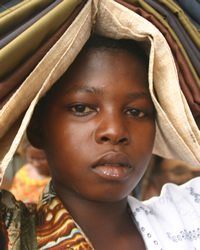

The Chokwe are a Bantu ethnic group that were once part of the Lunda Empire in the 17th and 18th centuries, which was overthrown in 1887 when it was divided between the Portuguese and Belgian colonial powers. Guerilla resistance continued until 1909, when Lunda leaders were captured and executed. In the second half of the 19th century there was considerable development of trade routes between their homeland and the Angolan coast. Chokwe were noted for their skill in trading ivory, rubber, beeswax, and slaves. Acquired wealth led to expansion and to eventually overtaking the Lunda states that had ruled them. However, their power later declined through overexpansion and the pressures of the colonizers and Swahili-Arab traders.
They speak Chokwe (also called Kichokwe or Tshokwe), as well as Kituba, Tshiluba, and French.
Their land is primarily woodland savanna, with rivers, marshes, and strips of rainforest. The northern Chokwe make their primary living by hunting and fishing, while the southern group focuses on subsistence farming of crops like cassava, peanuts, yams, millet, beans, maize, tobacco and hemp. They also keep domestic animals like sheep, goats, pigs, and chickens. The two seasons—rainy from October to April, and dry from May to September—shapes agricultural cycles and social activities. They are also well-known for their handcrafts, including baskets, pottery, carved masks, statues, and stools, some of which have spiritual significance. Symbols in their art reflect social values. One common symbol is the buffalo, which stands for strength and leadership.
Chokwe society is matrilineal, with descent traced through the mother's uncle's ancestry. Villages are compact and often arranged around a central meetinghouse. The Chokwe do not recognize a single paramount leader. Village chiefs called 'mwana nganga' rule in consultation with elders and ritual specialists. They are considered representatives of God and overseers of the land. Newlywed wives live with their husband's parents. Polygyny is generally practiced only by chiefs and wealthy families. Boys entering adulthood undergo the Mukanda initiation, which includes circumcision, survival training, sex education, and masculinity training by masked characters called 'makishi'. Girls also undergo initiation focusing of domestic skills and social responsibilities. All members of Chokwe society are divided into two groups—those descended from the founding matrilineal lines, and those descended from formerly enslaved populations.
The Chokwe believe is a supreme God, Kalunga, the Creator. They have many gospel resources, and most identify as Catholic. However, they also still venerate ancestral and nature spirits and practice divination. Much of their art reflects ancestral spirits and some, called 'ngombo' are used in divination.
Conflict and instability in and around the area have resulted in the displacement of many to overcrowded IDP camps. Economic activity is hampered by looting, bank closures, inflation, and difficult roads. This instability also delays and/or blocks humanitarian aid and exacerbates sanitation problems, malnutrition and disease. Spiritually, even nominal Christians still need to put all their hope and trust in Jesus, and evangelical witness needs to be strengthened.
Pray that Chokwe elders and chiefs may put all their faith in Jesus Christ and lead others to do the same.
Pray that the church may be purified and the evangelical witness strengthened.
Pray for an end to the conflict that makes their lives so difficult in a multitude of ways.
Pray that the church may become more missionary-minded and be strengthened to share the gospel with others.
Scripture Prayers for the Chokwe, Kioko in Congo, Democratic Republic of.
https://www.101lasttribes.com/tribes/chokwe.html
https://www.britannica.com/topic/Chokwe
https://traditionalzambia.home.blog/tribes-of-zambia/angola/chokwe/
https://africanfolder.com/the-chokwe-people-their-culture-and-heritage/
https:
| Profile Source: Joshua Project |



