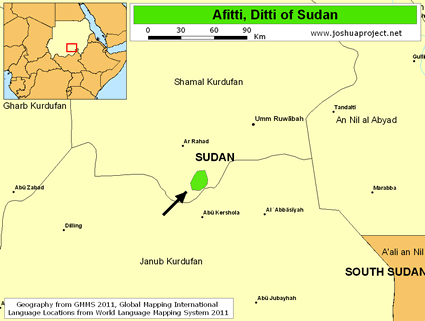
The Afitti people live in the region of the Nuba Mountains in central Sudan, particularly around the plains near Jebel el-Dair. They originally lived at the base of the mountains but gradually moved into the surrounding plains in the early twentieth century in search of better grazing land for their cattle. Over time, this migration led to the establishment of settlements such as Sidra, Kitra, and Kundukur. As the group spread geographically, a northern segment became known as the Ditti, though they remain closely related to the Afitti.
The Afitti speak the Afitti language, part of the Nilo-Saharan language family, though Arabic has increasingly become dominant in daily life, education, and trade. This linguistic shift reflects broader cultural changes and outside influence in the region.
The Afitti people traditionally relied on cattle herding, but environmental pressures—especially a severe drought in the 1980s—forced many to transition to farming as their primary livelihood. Today, they cultivate crops and maintain smaller herds of livestock where possible. Life varies somewhat between villages; for example, Sidra is more developed, with small shops and basic infrastructure, while other settlements remain more rural and traditional.
Family and community life are central, with strong ties between extended families. Language use reflects generational differences: children may grow up speaking Afitti at home, but Arabic quickly becomes dominant once they begin school. Over time, Arabic influence has increased to the point that even conversations in Afitti often include many Arabic words, and in some areas the traditional language is at risk of decline.
The Afitti people identify as Sunni Muslims. Islam was introduced to the region in the mid-twentieth century and gradually became the dominant religious identity. Today, Islamic belief and practice shape community life, and Arabic—closely tied to Islamic education—is widely used in religious and social settings. There is no meaningful known Christian presence among them.
The Afitti people face both physical and spiritual challenges. Environmentally, they have already experienced the effects of drought and economic disruption, which forced major changes in livelihood. Limited infrastructure and the pressures of modernization continue to affect their stability and traditional way of life.
Spiritually, they remain largely unreached with the gospel. Though they identify as Muslim, their access to clear biblical teaching is extremely limited. Their shifting language situation—between Afitti and Arabic—adds complexity to any outreach effort. They need faithful, long-term witness that communicates the message of Jesus Christ in ways they can understand and trust.
Pray that the Afitti people would develop a deep spiritual hunger and come to understand the truth of the gospel of Jesus Christ.
Ask God to raise up committed workers who are willing to go to the Afitti and live among them with wisdom and perseverance.
Pray that the Afitti people would be adopted through the People Group Adoption program, leading to sustained prayer and intentional gospel engagement.
Pray that, as individuals come to faith, they would grow in maturity and begin to disciple others within their own communities.
Scripture Prayers for the Afitti, Ditti in Sudan.
https://en.wikipedia.org/wiki/Afitti_people
https://peoplegroups.org/people_groups/pg011961/
https://en.wikipedia.org/wiki/Afitti_language
| Profile Source: Joshua Project |