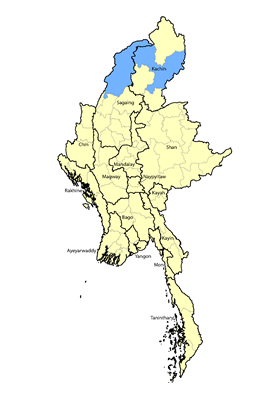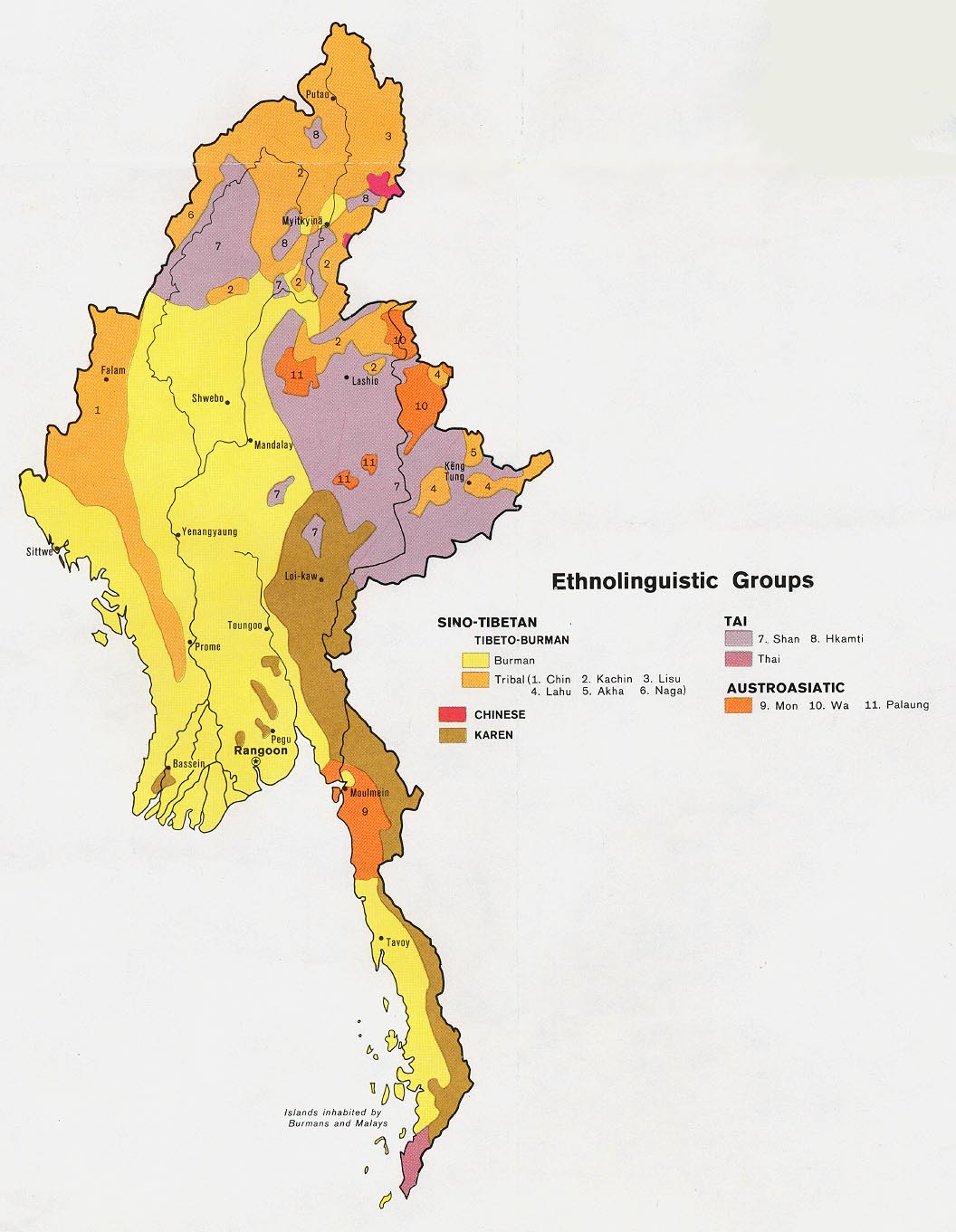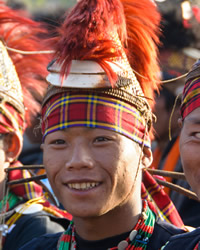

Shecyu people live in northwest Myanmar, with the majority of those in Nanyun Township on the border with the Indian state of Arunachal Pradesh. Despite their modest population, the Shecyu are spread over a wide swathe of territory. On the Indian side of the border, the Shecyu are known as the Sanke or Sechu, and have been granted status as a Scheduled Tribe.
There are two completely different theories regarding the meaning of the name Shecyu. Some say it means, "people who live on a hill with wild red dogs," while others claim it means "people who catch house flies and put them in a bamboo cage."
Neighboring tribes have their own names for the Shecyu people. The Moshang call them "Salke," and the Tikhak people know them as the "Sakheno."
Shecyu is considered a "prestigious dialect" among the Tangshang group of languages. While "nearly all people from other Tangshang tribes are able to speak at least one other variety, 69 percent of the Shecyu speak only their own dialect or Burmese." Shecyu is very closely related to the Cyamcyang dialect, and linguists have placed it in a group that includes the Cyolim, Cyamcyang, Dunghi, Lochang, Lungri, Maitai, Moshang, and Mungre. Each of these dialects also represents a tribal group profiled separately in this book.
The Shecyu share a peculiar legend with the Cyolim tribe, and together they "trace their roots to a tangle of worms that came from the swollen knee of an orphan." Tribe members in India agree that their forefathers crossed the Pangsau Pass from Myanmar about 120 years ago. Shecyu people come together several times a year to celebrate festivals. The largest, called kuck, is held for seven days each December after the harvests have been completed for the year. They are occasions of great joy and gaiety, with drink and feasting. Traditional songs and dances are held that teach Shecyu history to the youth.
The Shecyu community has two main divisions: Chungtuk and Choshey. Within each division are numerous clans, named after their respective ancestors. Strict rules apply to ensure that no one marries within their own clan, but they are allowed to marry into other clans or find a spouse from a related tribe. Divorce is not permitted in Shecyu society. Whereas other tribes in the region name their babies in the days following birth, the Shecyu and Ngaimong tribes hold naming ceremonies for boys three months after birth. On these occasions "a feast is held with sacrifices, and the head of the infant is shaved."
Although most Shecyu became Christians a few generations ago, traits of animistic rituals can still be seen in some of their customs. For example, after a death "the body is kept in the house for a day and then buried under the dwelling. After the burial a feast is arranged, and a small basket of food is hung on the inner wall in memory of the deceased. Shecyu Christians now bury the dead in a separate place in the forest according to Christian rules." Male and female shamans formerly acted as mediators between the spirits and the Shecyu, but today church pastors assumed the role of spiritual leadership within the tribe.
Almost all Shecyu people in Myanmar are professing Christians, with many belonging to the Church of Christ. Similarly, the 2011 Indian census recorded 86 percent of Shecyu people there were followers of Jesus. Two Christian groups in Myanmar are currently working on translating the Bible into Shecyu. If they finish, it will be the first Scripture in their language. Two Shecyu hymnals were used in the 1990s, but the government banned them for reasons that are unclear.
Pray that the Shecyu people will become part of God's plan to bring every tribe and tongue into his kingdom.
Pray for a radical spiritual transformation in their families, churches, and communities.
Pray for the Holy Spirit to use Shecyu Christians to do miraculous things, drawing others to Christ.
Intercede for freedom from fear of spirits and for hearts open to the hope found in Christ.
Scripture Prayers for the Shecyu in Myanmar (Burma).
Asia Harvest, Copyrighted 2026 © Used with permission
| Profile Source: Joshua Project |
| Other PDF Profile |