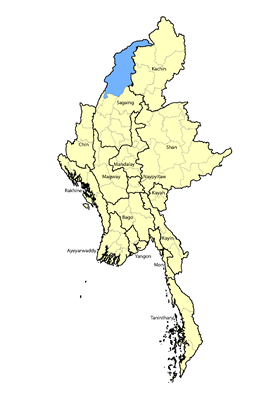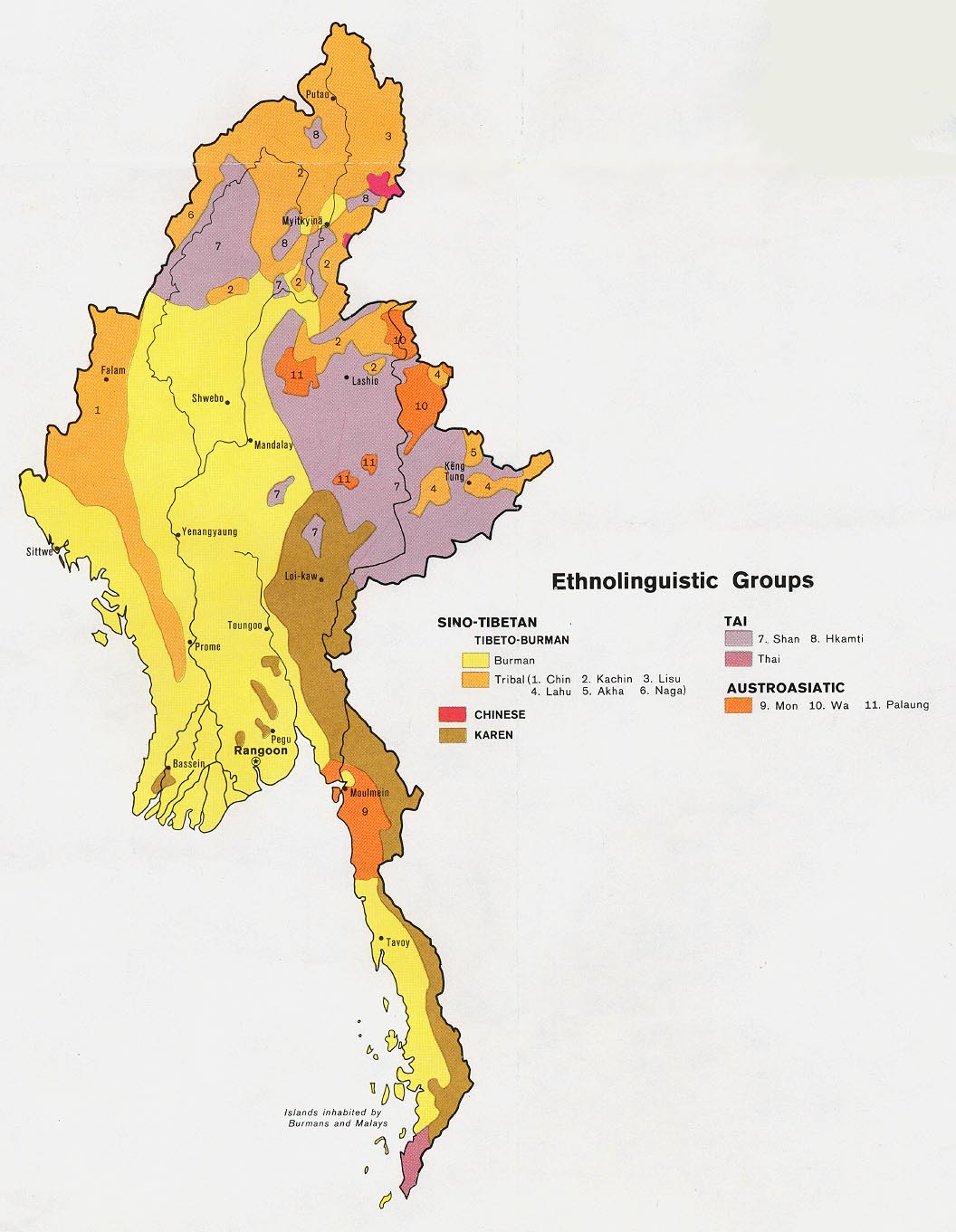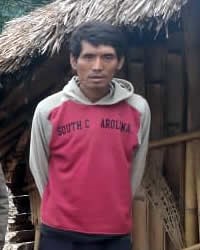

Inhabiting 32 villages in Lahe and Hkamti townships in western Myanmar's Sagaing Region, the Lainong people make up the most populous Naga group in this ethnically diverse area, which is home to dozens of small tribes. Lainong territory is bordered by the Konyak Naga to the north, the Paungnyuan Naga and various Tangshang tribes to the east, the Ponyo Naga to the south, and the related-but-little-known Lao Naga on their western flank.
The Lainong, whose name is often spelled Leinong, were formerly called "Htangan." They are well known in this mountainous part of Myanmar, and one of their villages, Hkamla, is the center of brass production in the area. Some researchers consider the Lainong to be the northernmost Khiamniungan Naga subgroup, but the Lainong proudly possess their own identity, customs, and language.
The Lainong Naga language is spoken by all members of the tribe, while only the educated can speak and read the national language, Burmese. Linguists have studied Lainong and compared their vocabulary with that of neighboring tribes. Although scholars in 2012 concluded that Lainong and Paungnyuan Naga "are clearly different languages, due to contact (especially among the older generation), the Paungnyuan might be able to understand Lainong sufficiently to use their literature." Tribal leaders have long shared a legend to explain why the Lainong have no writing, whereas other tribes do have scripts. They say that long ago, a family lived on a remote mountain, but the sons grew restless and wanted to leave home. Their parents decided to help by giving them the gift of writing. Most of the sons moved down to the plains and founded other tribes, but the elder son "received his instructions on leather, while his brothers all had theirs on bamboo parchment…. Up in the hills, the eldest brother kept the leather with the secrets of writing safely stored inside his house. One year there was a disastrous famine, and his family ate up all their supplies and there was nothing left. As a last resort they were forced to boil the leather and eat it, and thus the Lainong lost the ability to read and write."
Like many Naga and Tangshang tribes in the region, the Lainong have a dark history, where headhunting and even human sacrifice "were regarded as the only way to propitiate the spirits…. The sacrifice of a human, or the taking of an enemy's head, was regraded as an offering to the spirits to bring personal or communal gain, and festivals and ceremonies were held to emphasize this fact."
The Lainong have a proud and clearly defined culture. Some videos of festivals and traditional songs and dances have been uploaded to the internet in recent years, allowing the rest of the world to obtain a glimpse into life among the Lainong communities. Special customs must be observed by a Lainong man for his his proposal for marriage to be successful. For example, he "must send two mediators to the woman's side to agree on the marriage. Gifts for the girl's family should include a shawl, a parcel of land, and a cow."
An elaborate system of spirit worship and sacrifices has existed among the Lainong Naga for centuries and is still seen during key events and festivals. For example, on a wedding day, "ancient animistic rituals are often observed in a bid to procure blessing for the new couple. A chicken is killed and its blood smeared on the knees of the bride and groom to solemnize the marriage. In the evening the couple goes to the groom's house, escorted by all the village girls, to each of whom the groom must give a present."
Although most Lainong Naga people today are professing Christians, many struggle to break free from the past beliefs that enslaved their forefathers to the spirits. Some have a syncretic faith where Christianity is mixed with Animism. Portions of the Bible were translated into Lainong in 2005, but no further work appears to have been undertaken.
Pray for revival fire to spread uncontrollably from Lainong Naga family to family.
Ask God to strengthen those who are sharing the gospel so they can do it with love and wisdom.
Pray for Lainong Naga hearts to be open and for whole families to experience peace and hope in Christ.
Pray for their leaders to listen to the Lord, hear him, and obey him.
Scripture Prayers for the Naga, Lainong in Myanmar (Burma).
Asia Harvest, Copyrighted 2026 © Used with permission
| Profile Source: Joshua Project |
| Other PDF Profile |