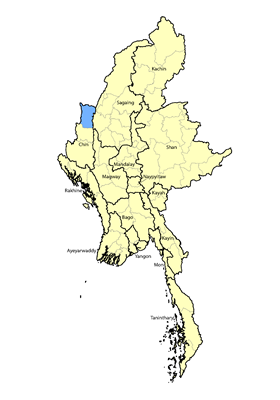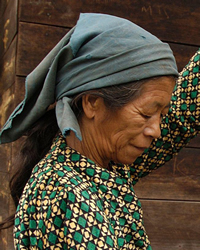

The Saizang tribe inhabits 15 villages in western Myanmar. Eleven villages are situated in and immediately surrounding the town of Tedim in northern Chin State, while four more villages are further west. Saizang territory is bordered by seven other Chin tribes, namely the Hualngo, Tedim, Dim, Teizang, Zo, Khuano, and Vangteh. Without citing any sources, an online article states that in 2019 the Saizang population was "about 10,000 in Myanmar and more than 5,000 have migrated to USA, Australia, Canada, UK, Denmark, Sweden, Japan, Malaysia, India etc."
Formerly considered just one of many subgroups of Tedim Chin, Saizang has been found to be a distinct dialect and people group. Their name means "near salt water," as the Saizang are believed to have previously lived at a place close to a brine spring. In Myanmar the Saizang and Siyin are closely related, and their names are often used in interchangeable ways. Many Saizang people have migrated across the border to the Indian states of Manipur and Mizoram, with a large number moving there in the 1930s. In India the Saizang have largely disappeared from official records, however, as they have been morphed into the official Paite tribe (totaling over 90,000 people), which is a collection of related dialect groups.
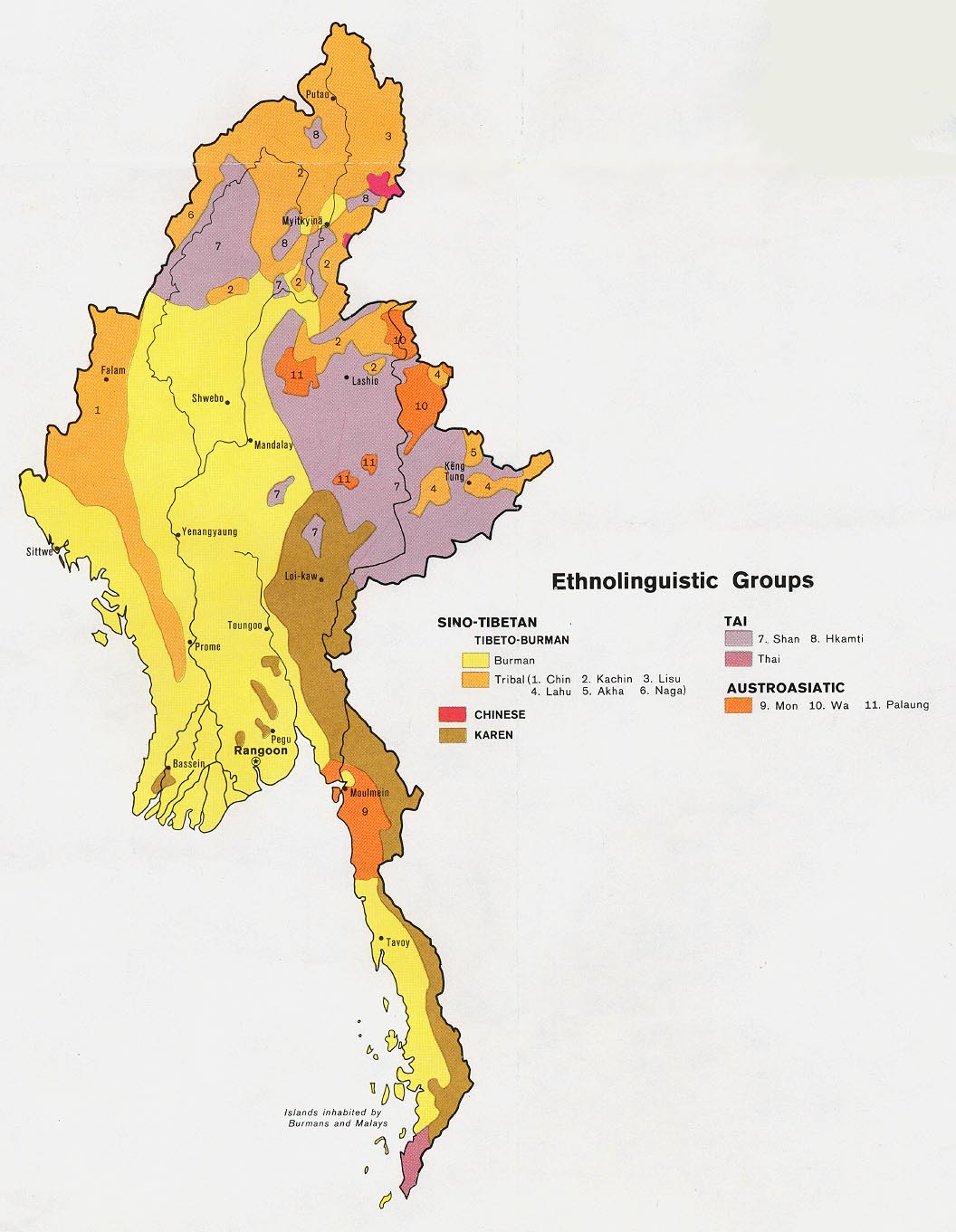
Although Saizang has yet to be formally categorized, the publication of a linguistic map of the languages of Chin State shows the extent of their territory and sets Saizang apart as a separate language, distinct from Siyin, Tedim Chin, and other varieties in the region. Saizang was not a written language throughout the tribe's history until recently, when a script based on the Roman orthography was created for them.
The Saizang and several other tribes in Chin State view Pu Thuantak as their progenitor. They originally lived in Shan State before moving to Kale in today's Sagaing Region, where they were oppressed by a cruel king and a famine killed thousands of people. According to legend, the Saizang were part of a migrating group that became separated on the journey south. The Saizang "walked in front of the others, and to mark their trail they cut down plantain trees. The trees grew up immediately after being cut, so the people following them assumed they had lost the trail and went no further. Other parties, however, marked their trail by cutting off tree bark." Life for the Saizang in their new location was marked by constant conflict with other tribes. One dispute caused them to separate from the Thado after the Thado killed a deer and distributed the meat to every household in the village. The Saizang then killed a flying squirrel, and when the Thado saw the squirrel's tail, they were angry at the Saizang for not sharing the meat with them, as they thought the bushy tail must come from a very large animal. The Saizang resisted colonial rule in the 19th century, which led to years of armed conflict until the British finally subdued them in 1888.
In the past the Saizang were feared as savage head-hunters. Like the Naga and Tangshang tribes, the Saizang accumulated hundreds of slaves from enemy villages. Today, most Saizang families practice slash-and-burn?agriculture, and they raise goats, pigs, chickens, and gayals, which are a species of large, domesticated ox that weigh up to 800 kg (1,760 lbs.).
Today almost 90 percent of Saizang people are Christians, but before their conversion they practiced Animism and worshiped a host of deities, including Pathian (the Creator) and Doai (the devil). The Saizang were so afraid of offending the spirits that they sacrificed to unknown gods.
Although a small percentage of Saizang people today continue to practice Animism or have converted to Buddhism, most are steadfast followers of Jesus Christ, having been affected by a powerful revival which spread throughout the Tedim region in the 1960s and 1970s. No Scripture exists in the Saizang language, however, forcing them to rely on the Tedim Chin Bible for their spiritual sustenance.
Pray that churches and believers will bless their entire people group in such a way that God's love will change the Saizang people like yeast changes dough.
Pray for families of believers loving and serving others to grow reproducing churches.
Pray for a chain reaction of families reaching families that results in thousands of new believers who share their faith with others.
Pray for grace and truth expanding into the entire Saizang society as all believers learn to love others.
Scripture Prayers for the Saizang in Myanmar (Burma).
Asia Harvest, Copyrighted 2026 © Used with permission
| Profile Source: Joshua Project |
| Other PDF Profile |