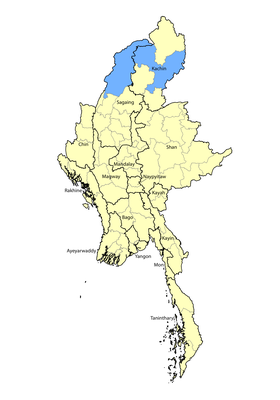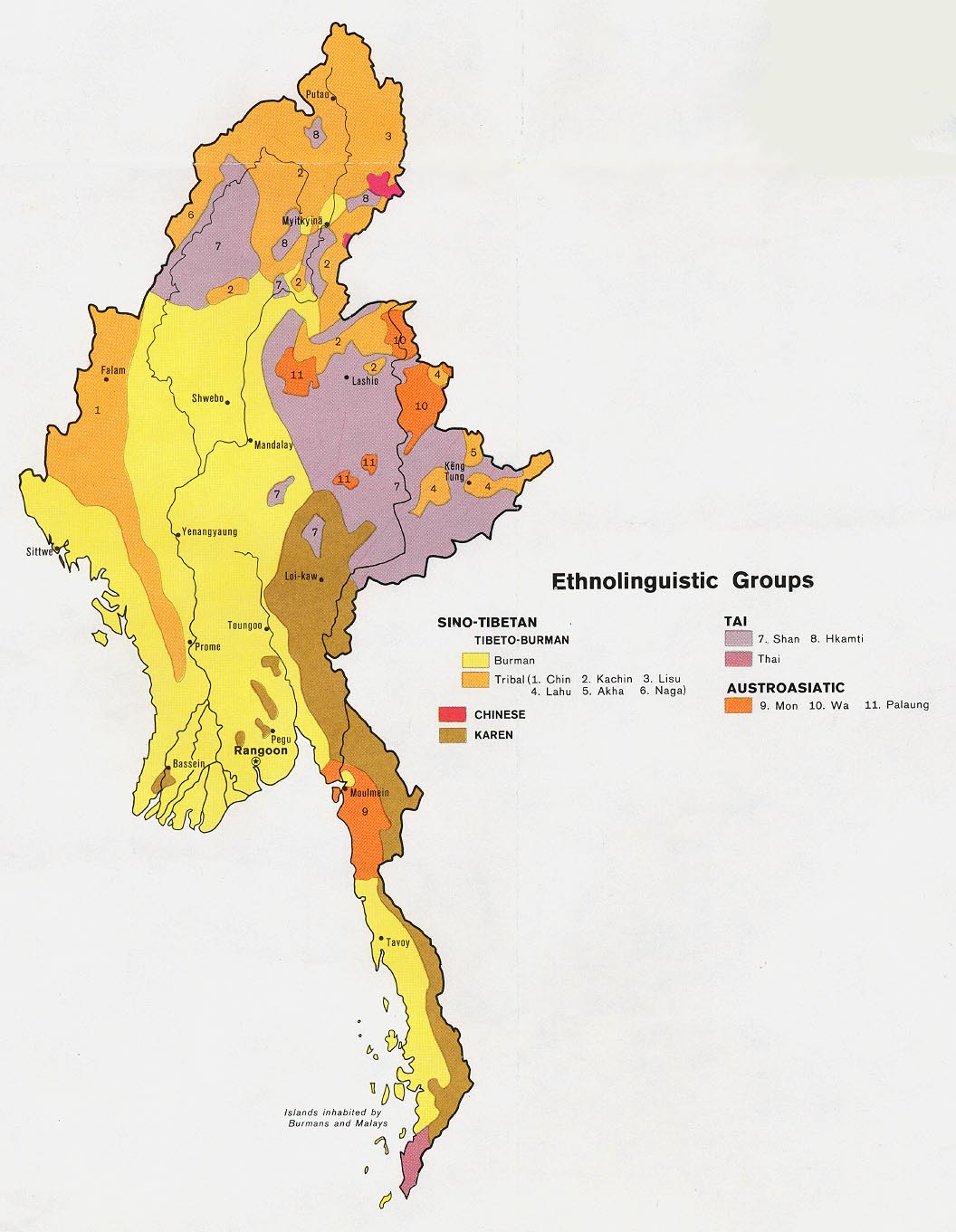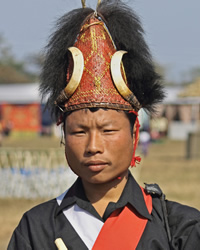

The little-known Ngaimong tribe inhabits two areas of northern Myanmar, with most found in and around the town of Shinbwiyan in Kachin State's Tanai District. The village of Khalon is home to at least 30 Ngaimong households, while 14 families live in Kyangkon village. Further west, a smaller number of Ngaimong people live in the Sagaing Region's Nanyun Township near the Indian border. A mere 159 Ngaimong people lived in the northeast state of Arunachal Pradesh according to the 2011 Indian census.
Identity: Although in India their tiny community has been granted status as a Scheduled Tribe under the name "Ngimong Tangsa," the Ngaimong in Myanmar have never been acknowledged by the government, which refuses to identity or classify dozens of distinct tribes in western parts of the country. Consequently, the Ngaimong have never appeared on any secular or Christian lists of Myanmar's ethnic groups. Instead, they have been considered just one of more than 50 tribes and dialect groups lumped together under the label of Tangshang, created by the Burmese authorities in 2003.
A linguistic team visited Nanyun Township in 2013 and surveyed an area containing 400 Ngaimong people. They found their language shares an 87 percent lexical similarity with Shecyu, which is considered a premier dialect for Scripture translation that Christians hope will influence related tribes with the gospel. They also found that Ngaimong is related to several related vernaculars, including Haqcyeng and Shangwan in Myanmar, and Jogli across the border in India.1
Whereas most tribes in the area name their children within days of their birth, among the Ngaimong "the ceremony for a boy was done three months after birth. Normally on these occasions a feast would be held, with sacrifices, and the head of the infant would be shaved."3 The Ngaimong love traditional music and dancing, which they enthusiastically perform during festivals.4
Most Ngaimong families live in rural villages where agriculture remains central to daily life. Rice is the primary staple food and is commonly eaten with vegetables, beans, and meat when available. Farming occupies much of the year, and many households cultivate crops suited to the hilly terrain. Livestock raising, small-scale trade, and wage labor provide additional sources of income for some families. Family and clan relationships are highly valued, and cooperation among relatives and neighbors is an important feature of community life. Although modern influences continue to shape daily life, the Ngaimong remain closely connected to their cultural traditions and community values.
The majority of Ngaimong people living in the mountains of Sagaing remain followers of Jesus Christ, but those in Kachin State have been more influenced by Buddhism. Only a small number of Ngaimong continue to observe the animistic ways of their forefathers, although traces of the centuries of spirit appeasement can still be seen during festivals and other important events.
Approximately two-thirds of Ngaimong people in Myanmar are estimated to be Christians today, while the 2011 Indian census found that 86 percent of Ngaimong people in that country were Christians, alongside a small number of Hindus and animists. The Ngaimong have no Scripture available in their language, although materials were developed in 1970 for a translation project that was never completed.
The remoteness of many Ngaimong villages creates challenges in transportation, healthcare, education, and economic development. Improved access to medical services and quality schools would benefit both children and adults. Opportunities for sustainable employment would help strengthen families and reduce economic hardship. Churches would benefit from additional leadership training, discipleship resources, and opportunities for theological education. Younger believers would be strengthened through mentoring relationships that encourage faithful Christian living. Because the gospel has gained a meaningful foothold among the Ngaimong, opportunities exist for believers to participate in sharing the message of Christ with neighboring ethnic groups that have less access to biblical teaching and Christian witness.
Pray that God will provide improved healthcare, education, and economic opportunities for Ngaimong communities.
Pray that pastors and church leaders will be equipped to teach God's word faithfully and disciple the next generation.
Pray that Ngaimong believers will grow in spiritual maturity and demonstrate Christ's love in their homes and villages.
Pray that the church among the Ngaimong will become an effective force for making disciples among neighboring peoples who have limited access to the gospel.
Scripture Prayers for the Ngaimong in Myanmar (Burma).
Asia Harvest
1 Graduate Institute of Applied Linguistics, "Fifty-Five Dialects and Growing: Literacy and Comprehension of Vernacular Literature among the Tangshang Naga in Myanmar," (thesis, name withheld, June 2013), p. 97.
2 J. E. Skoglund, The Spirit Tree: The Story of Baptist Work among Primitive People (Philadelphia: Judson Press, 1951), p. 68.
3 J. D. Saul, The Naga of Burma: Their Festivals, Customs, and Way of Life (Bangkok: Orchid Press, 2005), p. 129.
4 This video of a 2023 festival in India includes clips of Ngaimong people performing: https://www.youtube.com/watch?v=vpE6qekaU-c
https://www.ethnologue.com/
https://www.peoplegroups.org/
https://www.britannica.com/topic/Naga
https://en.wikipedia.org/wiki/Naga_people
https://nagalandpost.com/
https://www.myanmar.gov.mm/
| Profile Source: Joshua Project |
| Other PDF Profile |